
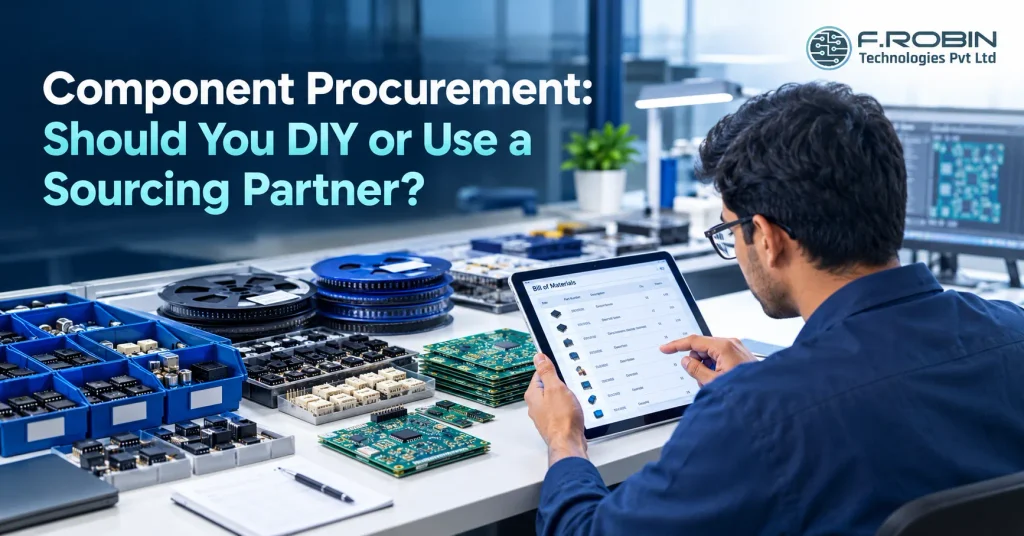
Should you buy parts yourself or let the EMS source them? For component procurement, DIY works best when you have a small bill of materials, in-house buying skills, and time to manage suppliers. A sourcing partner works best when your BOM is long, your schedule is tight, or shortages and counterfeit risk worry you. This guide shows how to decide, with a comparison table, a six-step process, and the questions to ask any partner.
It is written for hardware leads, founders, and procurement managers in Chennai and across India who are about to build boards. A note on transparency: F.Robin Technologies publishes this guide and offers PCB design and manufacturing. We state no prices, lead times, or savings figures, and we suggest you test every partner, including us, against the same criteria.
Key Takeaways
- Component procurement is a risk and time decision as much as a cost decision.
- DIY gives you control and price visibility, but it needs buying skills and management time.
- A sourcing partner takes on shortages, alternates, and paperwork, but you give up some visibility.
- A hybrid model, where you buy critical parts and the partner buys the rest, suits many teams.
What Does Component Procurement Involve?
Component procurement covers everything between a finished bill of materials and parts on the shelf. It includes selecting sources, requesting quotes, checking stock, buying parts, handling shortages and substitutes, and receiving and inspecting the delivery.
On paper, it looks like simple shopping. In practice, long lead times, end-of-life parts, minimum order quantities, and counterfeit risk can turn component procurement into a project of its own.
What to Count in the Total Cost of Component Procurement
Part prices are only one line in the budget. When you compare DIY with a sourcing partner, count every cost that each model creates:
- Staff time for quotes, purchase orders, follow-ups, and receiving.
- Shipping, duties, and handling for each supplier.
- Minimum order quantities that leave surplus stock.
- Delays and rework when a shortage or wrong part appears.
- Inspection effort on incoming parts.
As a result, the cheapest part price does not always give the lowest total cost. For small teams, staff time often outweighs the saving from buying direct.
Component Procurement Options: DIY, Sourcing Partner, or Hybrid
- DIY: your team buys every part and ships the kit to the assembler. Many assemblers call this consigned supply.
- Sourcing partner: an EMS or procurement specialist buys the parts for you, often called turnkey.
- Hybrid: you buy long-lead or critical parts, while the partner buys commodity parts.
Our guide on consigned versus turnkey procurement compares the cost angle in detail. This article focuses on the broader decision about who should own component procurement.
DIY vs Sourcing Partner: A Side-by-Side Comparison
Use this table to weigh the options against the factors that usually drive the decision.
| Factor | DIY | Sourcing partner |
| Control | You choose every source and part | The partner chooses within your approved list |
| Price visibility | You see each quote and can negotiate | The partner may bundle pricing, so ask for a breakdown |
| Management time | High, because your team chases suppliers | Low, because the partner handles the chase |
| Shortage handling | You find alternates and approve them | The partner proposes alternates for your approval |
| Counterfeit risk | You control sources and checks | Depends on the partner’s sourcing and inspection discipline |
| Schedule risk | Missing one part delays the kit | A shortage still delays the build, but the partner works it |
| Best for | Small BOMs and experienced buyers | Long BOMs, tight schedules, small teams |
When DIY Component Procurement Wins
- Your BOM is short, and the parts are common and easy to find.
- An experienced buyer on your team already holds good supplier accounts.
- Full control over part sources matters, for example for a regulated product.
- The same parts recur across many builds, so volume pricing becomes possible.
In these cases, DIY keeps costs transparent and gives you direct control over where parts come from.
When a Sourcing Partner Wins
- Your BOM is long, so chasing dozens of suppliers would drain your team.
- Your schedule is tight, and you need someone to work shortages daily.
- You build prototypes, where small quantities make direct buying awkward.
- Your team is small and has no dedicated buyer.
However, a sourcing partner is only as good as its process, so ask how it chooses sources and checks incoming parts.
How to Decide on Component Procurement in Six Steps
Follow this process to choose a model for your next build:
- Review your bill of materials. Count the lines, and flag long-lead, single-source, and end-of-life parts.
- Rate your risk. Consider how costly a delay, a counterfeit part, or a wrong substitute would be.
- Check your capacity. Be honest about how many hours your team can spend on buying.
- Compare total cost. Include staff time, shipping, shortages, and rework, not only part prices.
- Test a partner with a pilot. Run a small build with a sourcing partner and compare the result with your own buying.
- Choose and review. Pick DIY, partner, or hybrid, then review the choice after each build.
Prepare Your BOM Before You Choose a Component Procurement Model
A clean bill of materials makes component procurement easier in every model. Before you buy or hand over the list, check these points:
- Every line carries a full manufacturer part number, not just a value.
- The list names approved alternates for common or at-risk parts.
- Footprints match the real parts, which a DFA review can confirm.
- Quantities include a sensible overage for assembly losses.
- Moisture-sensitive and special-handling parts carry a clear mark.
Also remember that late BOM changes cause most buying chaos. Therefore, freeze the list before ordering whenever you can.
Making a Hybrid Component Procurement Model Work
A hybrid model needs clear boundaries. Agree in writing which parts you buy, which parts the partner buys, and who owns shortages in each group. Then set a delivery date for your parts so the assembler can plan the build.
In addition, review the split after each build. If your own buying keeps slipping, move more lines to the partner. If partner pricing looks high, take back the parts where you hold an advantage.
Risks to Manage in Any Component Procurement Model
- Shortages and long lead times, which can stall an entire build.
- Counterfeit or untraceable parts, especially from unverified sources.
- Wrong substitutes, when an alternate differs in footprint or behaviour.
- Obsolescence, when a part reaches end of life mid-project.
- Poor storage and handling, which can damage moisture-sensitive parts.
Strong incoming checks help in every model, and our guide on how to qualify a new PCB vendor shows how to build an inspection habit. High-reliability programmes should also read our guide to choosing a PCB manufacturer for defence and aerospace.
Questions to Ask a Component Sourcing Partner
- Which sources do you buy from, and can I approve or restrict them?
- How do you verify authenticity and traceability of parts?
- How do you handle shortages, and who approves alternates?
- Will you show part prices separately from assembly charges?
- What happens to leftover parts and minimum order quantities?
- How do you store moisture-sensitive components?
Chennai and Tamil Nadu Considerations
A local partner in Chennai makes it easier to review parts, resolve shortages, and approve alternates quickly. Moreover, you can visit to see how the team stores and inspects incoming parts. Our guide to PCB assembly services in Chennai lists the questions to ask local assemblers.
Even so, local access never replaces process discipline, so judge sourcing practice before location.
A Hypothetical Example
For example, imagine a small team building a prototype with a long BOM. Its engineer spends several days chasing suppliers, and one missing connector holds up the whole kit. The build slips while the team waits.
In contrast, a team that hands component procurement to a sourcing partner for the same build would likely get shortage updates and proposed alternates sooner. The outcome depends on the partner, so treat this as an illustration, not a promise.
How F.Robin Technologies Supports Your Build
F.Robin Technologies offers PCB manufacturing and PCB layout design with DFM and DFA review, which helps catch footprint and assembly issues before parts arrive. Our complete guide to PCB manufacturing explains the process from files to finished boards. For sourcing and assembly scope on your project, confirm details with our team, and compare us with any partner on the same questions.
If you are also deciding how many vendors should handle your project, read whether a single vendor for PCB design, fab and assembly is worth it.
