
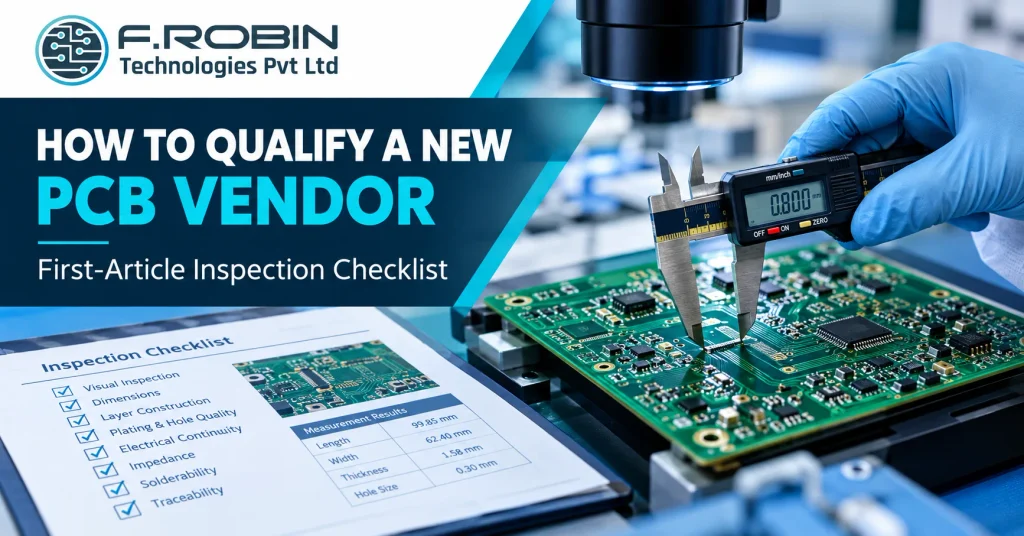
How do you trust a new board house? You do not trust it on a promise. To qualify a new PCB vendor, give it a clear specification, review its documents and process, order a small first-article lot, inspect that lot against your drawing, and approve the vendor only when the evidence matches. This guide shows you how to qualify a new PCB vendor step by step, with a first-article inspection checklist you can use on your next order.
It is written for hardware engineers, quality teams, and procurement managers who need to qualify a new PCB vendor, switch, or add a bare-board supplier without risking a production run. A note on transparency: F.Robin Technologies publishes this guide. We state no pass rates or defect statistics, because they depend on your design, and we suggest you apply the same checks to every vendor, including us.
Key Takeaways
- To qualify a new PCB vendor, verify capability, run a small first-article lot, and approve only against evidence.
- First-article inspection compares the first boards to your drawing, specification, and chosen IPC class.
- Ask for test reports, microsection results, and a certificate of conformance, not just photos.
- Qualification continues after approval through incoming inspection and change notification.
What First-Article Inspection Means for PCBs
First-article inspection (FAI) is a formal check of the first units from a new process, vendor, or design revision against the drawing and specification. For bare boards, it confirms that the manufacturer can actually build what you specified before you commit to volume. In aerospace, a standard called AS9102 defines the FAI requirements, and many other industries borrow its discipline.
In practice, for a printed board, FAI usually covers visual quality, dimensions, hole and plating quality, layer construction, electrical continuity, controlled impedance, and finish. Each check produces a record, so the decision to approve a vendor rests on data.
Why You Should Qualify a New PCB Vendor Before Volume
However, a board that looks fine on arrival can still hide problems, such as weak plating, poor layer registration, or impedance outside tolerance. Those problems often surface late, during assembly or in the field, when fixes cost far more. For that reason, it pays to qualify a new PCB vendor early, while changes are cheap.
Qualification also builds a shared baseline. Once the vendor passes, you know what a good lot looks like, and you can compare every later lot against it.
How to Qualify a New PCB Vendor Step by Step
Follow this seven-step process to qualify a new PCB vendor with evidence at every stage:
- Define your requirements. Write a complete fabrication drawing with stack-up, materials, finish, tolerances, impedance targets, and the IPC class you need.
- Review the vendor’s documents and capability. Ask about its quality system, inspection equipment, and process limits, and compare them with your design.
- Test the engineering response. Send your files for a DFM review and note how quickly and clearly the vendor raises questions.
- Order a first-article lot. Request a small lot built to your final files, with a full set of reports.
- Inspect the first article. Check the boards and reports against your drawing using the checklist below.
- Assemble and test a few boards. Build functional units to confirm the boards solder and perform as intended.
- Decide, document, and set controls. Approve, reject, or request corrective action, and record the result along with your ongoing inspection plan.
First-Article Inspection Checklist to Qualify a New PCB Vendor
Use this table as a starting point, and adjust it to your IPC class and product risk.
| Check | What to verify | Evidence to request |
| Visual quality | Solder mask, silkscreen, finish, and board edges match the drawing | Photos and an inspection record against the chosen IPC acceptability class |
| Dimensions | Outline, hole sizes, and thickness meet tolerance | Dimensional report |
| Layer construction | Stack-up and materials match the specification | Stack-up confirmation and material certificates |
| Hole and plating quality | Plated holes and vias show sound structure | Microsection (cross-section) report from a test coupon |
| Electrical continuity | Every net connects correctly, with no shorts | Electrical test report against your netlist |
| Controlled impedance | Impedance traces fall within tolerance | Impedance test report from coupons |
| Solderability | Pads and holes wet properly during soldering | Solderability test result or a trial assembly |
| Traceability | Lot, date, and process records exist | Certificate of conformance and lot identification |
In addition, IPC publishes the common reference documents. IPC-A-600 covers the acceptability of printed boards, and IPC-6012 covers qualification and performance for rigid boards. Agree with the vendor on which document and class applies before the build.
Documents to Request When You Qualify a New PCB Vendor
Ask for these items early, because a vendor that cannot produce them is telling you something:
- A description of its quality system and any certifications it holds.
- Process capability limits, such as minimum trace, spacing, and hole sizes.
- A sample test report, with customer data removed.
- The microsection and electrical test reports for your first-article lot.
- A certificate of conformance for each lot.
- A change-notification commitment covering materials, processes, and sites.
How Deep Should You Go When You Qualify a New PCB Vendor?
Inspection depth should match product risk. Therefore, decide up front how much evidence each board type needs:
- Low-risk consumer boards: visual inspection, dimensions, electrical test, and a certificate of conformance.
- Industrial or high-speed boards: add impedance reports and microsection results from test coupons.
- Regulated or high-reliability products: request the full documentation package your customer or standard demands, with records you can trace by lot.
Also remember that the cost of inspection is small next to the cost of a failed production lot. As a result, most teams choose more evidence for higher-risk designs and lighter checks for simple ones.
Red Flags When You Qualify a New PCB Vendor
- The vendor refuses to share test reports or sample records.
- Answers about process limits stay vague.
- Its engineers skip questions on your files and simply quote.
- No coupons or reports accompany the boards.
- It resists agreeing to an IPC class in writing.
- It cannot explain how it controls changes to materials or processes.
Keep Qualifying After You Approve the Vendor
However, approval is not a permanent pass. Once you qualify a new PCB vendor, treat it as the start of an ongoing relationship, and maintain these controls:
- Run an incoming inspection plan that matches the risk of each lot.
- Track defects and delivery in a simple vendor scorecard.
- Require notice before the vendor changes materials, processes, or manufacturing sites.
- Re-run a first article whenever you revise the design or the vendor changes a critical process.
If you are still choosing between suppliers, our guide on how to choose a PCB manufacturer and our comparison of local versus overseas printed circuit board manufacturers help you narrow the list first.
A Hypothetical Example
Imagine a team that switches to a new board house to cut lead time. The vendor sends clean photos of the first lot, and the team approves it. Later, assembly shows poor hole wall quality on a few vias, because nobody requested a microsection report.
In contrast, a team that follows the steps to qualify a new PCB vendor would request coupons and reports with the first lot. It would likely spot the plating issue before assembly, and the vendor could correct the process while the order was still small. Your case will differ, so use the checklist to decide what evidence matters for your board.
Questions to Ask Before You Qualify a New PCB Vendor
- Which IPC class and standard do you build and inspect to?
- What reports will accompany a first-article lot?
- How do you verify controlled impedance and plating quality?
- What are your process limits for trace, spacing, and hole size?
- How do you notify customers about process or material changes?
- Who answers engineering questions during the build?
How F.Robin Technologies Supports Reliable Board Builds
F.Robin Technologies offers PCB manufacturing and design review services that check stack-up, trace width and spacing, drill and annular ring data, solder mask and silkscreen, panelization, and Gerber outputs before fabrication. Those checks reduce surprises at first article. Our complete guide to PCB manufacturing explains the process from files to finished boards. We encourage you to put F.Robin through the same steps you use to qualify a new PCB vendor.

2 Responses