
How to Choose a Semiconductor Recruitment Partner
Semiconductor hiring is one of the least forgiving domains to get wrong. VLSI, verification, and physical design talent is scarce, the best engineers are rarely job hunting, and a recruiter without genuine chip-industry knowledge simply cannot tell a strong design candidate from a weak one. Choosing the wrong semiconductor recruitment partner does not just slow down a search — it can burn months on a role that stays open the whole time. This checklist gives you a clear way to evaluate a semiconductor recruitment partner before committing to a search. We cover the niche expertise that actually matters, how to verify a real track record, and the questions that separate a genuine specialist from a generalist recruiter with a semiconductor slide in their pitch deck. By the end, you will have a repeatable way to vet any semiconductor recruitment partner you are considering. Why Generalist Recruiters Struggle With Chip Roles Semiconductor roles span deeply distinct disciplines — RTL design, verification, physical design, DFT, analog and mixed-signal — and each demands a different skill profile, different interview signals, and often a different candidate pool entirely. A generalist recruiter who treats “chip engineer” as one category will misjudge candidates constantly, screening out strong fits and passing through weak ones. This is exactly why a genuine semiconductor recruitment partner matters more here than in most other technical hiring. The gap between a recruiter who understands the difference between DV and PD and one who does not shows up directly in shortlist quality, time-to-hire, and how many candidates you end up rejecting after an expensive interview process. The cost of this gap compounds quickly. Every interview cycle spent on a mismatched candidate is time your engineering team is not spending on actual design work, which is exactly the resource a scarce-talent search is supposed to protect. The Checklist: What to Evaluate Score any semiconductor recruitment partner against this list before committing, rather than relying on a confident sales conversation alone. Niche Expertise: What It Actually Looks Like Real niche expertise shows up as specificity. A genuine semiconductor recruitment partner can discuss the practical differences between RTL design and verification, describe what a strong DFT candidate’s background typically looks like, or explain how physical design timelines differ from front-end design timelines — without being prompted. A generalist pretending to have this expertise usually stays at the surface: “we place chip engineers” or “we understand the semiconductor industry” without ever getting specific. Push past the pitch and ask for the technical detail directly; the response tells you almost everything you need to know about whether you are speaking with a genuine semiconductor recruitment partner or a generalist in disguise. Track Record: How to Verify It Ask any semiconductor recruitment partner for specific examples: which roles, at what seniority, in which discipline, and how the search went. A partner with genuine experience will describe real search dynamics — where candidates were sourced from, what made the search hard, how long it actually took — rather than a polished, generic success story. Be especially wary of vague numbers without context, like “we’ve placed hundreds of engineers.” Ask instead how many of those were specifically in your discipline — VLSI, verification, physical design — and in a comparable market. Volume in unrelated tech roles says little about whether you are dealing with a genuine semiconductor recruitment partner or a generalist counting unrelated placements. Executive Search for Senior Chip Roles For design directors, VPs of engineering, or other senior chip leadership, standard recruitment often is not enough. Executive search — a retained, confidential, deeply researched process — is usually the right model, because the pool of qualified senior chip leaders is small and largely composed of people who are not looking. When evaluating a semiconductor recruitment partner for a senior search, ask specifically whether they offer retained executive search and how it differs from their standard process. A partner who treats every search identically, regardless of seniority or scarcity, is unlikely to bring the depth a leadership hire actually needs. This distinction is worth pressing on, because a contingency search naturally spreads a recruiter’s attention across many open roles at once, while a retained search dedicates real, focused time specifically to yours — a meaningful difference when the qualified candidate pool for a senior chip role can be measured in the dozens, not hundreds. Questions to Ask Before You Commit Specific, confident answers across all seven signal a genuine semiconductor recruitment partner. Vagueness on more than one or two is a reason to keep evaluating other options. Comparison: Generalist vs Semiconductor Specialist The table below contrasts what a generalist tech recruiter typically offers against a genuine semiconductor specialist. Factor Generalist recruiter Semiconductor specialist Domain fluency Surface-level, generic tech knowledge Specific VLSI/DV/PD/DFT expertise Sourcing Job boards, broad tech networks Established passive-candidate networks in chip hubs Screening Keyword and resume matching Technical, discipline-specific assessment Senior roles Standard contingency search Retained executive search when needed Track record Broad tech placements Verified, discipline-specific chip placements Reading down the table, the pattern is consistent: genuine semiconductor capability shows up as specificity and depth, while a generalist tends to stay broad and unable to go deeper on request. Red Flags to Avoid If several of these appear, the search is unlikely to go well — the cost of continuing to evaluate other partners is almost always smaller than the cost of a stalled, months-long search with the wrong one. Key Takeaways CTA – Semiconductor Recruitment Partner Need a Recruitment Partner Who Actually Knows Chips? Niche expertise, verified track record, executive search discipline — our AI Staffing Services bring genuine VLSI, verification, and physical design domain knowledge to your semiconductor hiring, not a generic tech-recruiter pitch. Explore AI Staffing Services Talk to Our Hiring Experts FAQ – How to Choose a Semiconductor Recruitment Partner Frequently Asked Questions
RPO for Semiconductor Hiring: When It Fits

Recruitment process outsourcing sounds like a natural fit for any company scaling a chip team fast, but RPO for semiconductor hiring only pays off in specific situations and forcing it onto the wrong kind of search wastes both money and time. RPO is built for volume and process, while semiconductor hiring is often defined by scarcity and specialization, which means the fit is not automatic. This guide explains exactly when RPO for semiconductor hiring makes sense, when a different model serves you better, and what to look for in an RPO partner if you decide it is the right fit. Whether you are scaling a design centre from ten engineers to a hundred or filling a handful of scarce, senior roles, this guide will help you choose the right model and avoid the common mistake of applying one model to every hiring situation. What RPO Actually Means RPO, or recruitment process outsourcing, means handing some or all of your hiring process to an external partner who embeds with your team and runs it as an extension of your own recruiting function, typically under defined service levels. It differs from standard recruitment agency work by scope and depth: rather than filling individual roles one at a time, an RPO partner owns process, technology, and often a dedicated recruiting team for a sustained period. This model was built for companies that hire continuously and at volume, where a dedicated, process-driven partner can lower cost-per-hire and improve consistency across dozens or hundreds of roles. Whether that same model fits semiconductor hiring depends heavily on what kind of hiring you are actually doing. Why the Fit Is Not Automatic for Chip Roles Semiconductor hiring often looks nothing like the high-volume, standardized hiring RPO was designed for. VLSI, verification, and physical design roles are scarce, highly specialized, and frequently require headhunting passive candidates rather than processing inbound applications a very different motion from the volume-and-process model RPO typically optimizes for. This does not mean RPO for semiconductor hiring never works. It means the fit depends heavily on the specific hiring situation: how much volume you actually have, how standardized the roles are, and whether the RPO partner has genuine chip-industry sourcing capability rather than just process infrastructure. Getting this assessment wrong in either direction is costly. Forcing RPO onto a handful of scarce, senior searches wastes the setup investment on a model that was never suited to that kind of hiring, while trying to run high-volume, standardized hiring through one-off contingency placements loses the efficiency RPO was specifically built to deliver. When RPO Fits Semiconductor Hiring RPO for semiconductor hiring fits well when you are scaling a design centre or team rapidly and need to fill a meaningful number of roles verification engineers, layout engineers, or similar mid-level positions over a sustained period, not just one or two scarce specialists. It also fits when the roles, while technical, are reasonably standardized across the hiring wave, so a dedicated RPO team can build repeatable sourcing and screening processes rather than reinventing the search for every single role. If you are opening a new design centre and need twenty or thirty engineers over the next year, RPO for semiconductor hiring is often exactly the right model the volume justifies the setup investment, and the roles are similar enough to benefit from a repeatable process. When RPO Does Not Fit RPO for semiconductor hiring fits poorly when you are filling a small number of highly scarce or senior roles a design director, a handful of specialized DFT engineers, or any search where passive-candidate headhunting matters more than process scale. These searches need deep, individualized attention that a volume-oriented RPO engagement is not built to deliver efficiently. It also fits poorly when your hiring volume is too low or unpredictable to justify the setup cost of embedding a dedicated team. RPO for semiconductor hiring carries real ramp-up investment on both sides, and that investment only pays back when there is enough sustained volume to amortize it. A Real-World Example Picture a fabless startup opening its first India design centre, needing to hire thirty verification and layout engineers over the next eighteen months while also filling a single VP of Engineering role to lead the site. RPO for semiconductor hiring fits the first need well the volume and role standardization justify embedding a dedicated recruiting team with clear SLAs. The VP search, by contrast, calls for retained executive search: one highly scarce, senior hire where individualized, confidential sourcing matters far more than process scale. Running both searches through the same RPO engagement would likely underserve the VP search, while running the thirty-engineer hiring wave through one-off executive search placements would be needlessly expensive and slow. Matching the model to each specific hiring need, rather than picking one approach for the whole program, is what makes this kind of blended hiring plan work. SLAs: What to Define Upfront Because RPO for semiconductor hiring runs as an ongoing partnership rather than a one-off placement, the service-level agreement matters enormously. Define time-to-shortlist and time-to-hire targets specific to semiconductor roles, not generic tech-hiring benchmarks that do not reflect how scarce chip talent actually is. Also define quality metrics offer-acceptance rate, early-stage retention, hiring manager satisfaction alongside speed metrics, so the RPO team is not incentivized to prioritize volume over fit. A well-structured SLA protects both sides: it gives your team a clear standard to hold the partner to, and it gives the RPO partner a fair, specific target rather than a vague expectation. RPO vs Standard Recruitment vs Executive Search The table below compares the three main models across the factors that matter for a semiconductor hiring decision. Factor Standard recruitment RPO Executive search Best for Individual roles, moderate volume Sustained volume, standardized roles Scarce, senior, or confidential roles Engagement Per-placement fee Ongoing, embedded team Retained, project-based Process ownership External recruiter Shared, deeply integrated External, highly specialized Cost structure Per-hire fee Often lower cost-per-hire at volume Higher per-search, justified by scarcity Reading across
How to Choose a Recruitment Firm for Niche/Hard-to-Fill Roles
Filling a niche or hard-to-fill role exposes the gap between an ordinary recruitment firm and a genuinely capable one almost immediately. Generic sourcing, job-board postings, and keyword-matched resumes work fine for common roles, but they fall apart the moment you need a rare combination of skills, a scarce certification, or a candidate who is not actively looking at all. This checklist helps you vet a recruitment firm specifically for niche and hard-to-fill roles. We cover what makes these roles different, the capabilities to look for, the questions to ask before you commit, and the red flags that signal a firm is out of its depth. By the end, you will have a clear, repeatable way to evaluate any recruitment firm for your hardest roles one you can reuse the next time a scarce vacancy lands on your desk. Why Niche Roles Need a Different Approach A niche or hard-to-fill role is defined by scarcity: too few qualified people exist, and most of them are not actively job hunting. A recruitment firm built around processing high volumes of active applicants simply has no lever to pull here — there is no pile of resumes to filter, because the candidates who matter are not applying anywhere. This changes what “good” looks like. Speed and volume metrics that work for common roles are the wrong measure for niche hiring. Instead, you need a recruitment firm that can map a scarce market, approach passive candidates directly, and assess specialized skills accurately — capabilities that a generalist, high-volume operation rarely builds. Getting this wrong is costly in a specific way: the role stays open far longer than expected, the firm cycles through the same small pool of active applicants repeatedly, and you eventually restart the search with a different partner months later than necessary. Vetting for niche capability up front avoids that entire cycle. The Checklist: What to Evaluate Score any recruitment firm against this list before you commit, and you avoid the common mistake of judging a specialist search by generalist criteria. Market Mapping Capability Market mapping is the process of identifying every credible candidate in a niche field, not just the ones who happen to be looking. A recruitment firm doing this well builds a real picture of who holds the skill, where they work, and how the market is structured, before a single approach is made. Ask any firm to describe their market mapping process concretely. A strong answer includes research methods, industry sources, and how they keep that map current. A vague answer — “we have a database” — is a sign the firm has not actually built this capability for your specific niche. Headhunting vs Job-Board Sourcing Headhunting means proactively identifying and approaching candidates who are not applying anywhere, often while they are happily employed elsewhere. This is fundamentally different from job-board sourcing, which waits for candidates to come to you. For a hard-to-fill role, a recruitment firm that only knows job-board sourcing will simply run out of candidates fast, because the pool of active applicants in a scarce niche is tiny or nonexistent. Ask directly what percentage of their niche placements come from proactive outreach versus inbound applications — the answer tells you a great deal about their real capability. Niche-Skill Screening Matching keywords on a resume is not the same as verifying a specialized skill. A recruitment firm serious about niche roles invests in technical screening — either in-house expertise, subject-matter partners, or structured technical assessments — to confirm a candidate genuinely has the skill claimed. Without this, you risk a shortlist that looks right on paper but fails the moment real technical depth is tested. Ask how the firm screens for the specific niche skill in your role, and expect a concrete answer, not a general description of their interview process. Executive Search for the Hardest Roles For the scarcest, most senior, or most sensitive niche roles, executive search is often the right model rather than standard recruitment. A retained executive search commits a firm’s dedicated effort to a thorough, confidential search, which matters when the pool of qualified candidates is measured in dozens, not hundreds. When evaluating a recruitment firm for your hardest roles, ask whether they offer retained executive search, and how that process differs from their standard placements. A firm that treats every search the same way — regardless of scarcity — is unlikely to give your hardest role the depth it needs. This distinction matters more than it might first appear, because a contingency search naturally spreads a recruiter’s effort across many open roles at once, while a retained search dedicates real, focused time to yours specifically — a meaningful difference when the candidate pool is this thin. Questions to Ask Before You Commit Clear, specific answers to every question signal a recruitment firm that has genuinely built niche capability. Vague or generic answers are a warning sign worth taking seriously. Comparison: Generalist vs Specialist Firms The table below summarizes how a generalist recruitment firm typically compares with a specialist one for niche and hard-to-fill roles. Factor Generalist firm Specialist niche firm Sourcing method Job boards, inbound applications Market mapping, direct headhunting Skill screening Keyword and resume matching Technical or subject-matter assessment Candidate pool Active job seekers Active and passive candidates Search model Standard contingency Retained executive search when needed Track record Broad, high-volume Deep, niche-specific placements Reading down the table, the pattern is clear: niche and hard-to-fill roles reward depth and proactive reach, which is exactly where a specialist recruitment firm outperforms a generalist one. Red Flags to Avoid If several of these appear, keep looking. A recruitment firm without genuine niche capability will burn time on a search it was never equipped to win. Key Takeaways CTA – Recruitment Firm for Niche/Hard-to-Fill Roles Struggling to Fill a Niche or Scarce Role? Job boards and generic sourcing only go so far for hard-to-fill positions. Our AI Staffing Services combine market mapping, proactive headhunting, and executive search discipline to reach the passive,
In-House Hiring vs Recruitment Agency: Which Is Better?
Every growing company eventually asks the same question: should we hire in-house, or bring in a recruitment agency in India to fill the role? Both paths can get you a great hire, but they differ sharply in cost, speed, and the quality of who walks through the door. Choosing the wrong one for a given role wastes time, money, or both. This comparison breaks the decision down honestly across the three metrics that actually matter: cost-per-hire, time-to-hire, and quality of hire. We also cover when an in-house team wins, when a recruitment agency in India is the smarter choice, and how many companies blend both. By the end, you will know exactly which approach fits your next hire — and just as importantly, which roles might call for the opposite answer next time. What Each Model Means In-house hiring means your own HR or talent acquisition team sources, screens, and closes candidates directly, using internal recruiters, job boards, and referrals. A recruitment agency in India, by contrast, is an external partner that runs some or all of that process on your behalf, drawing on its own networks, tools, and specialist recruiters. Neither model is inherently better. Each trades off cost, speed, and reach differently, and the right choice depends heavily on your hiring volume, the scarcity of the role, and how much internal capacity you already have. It also helps to recognize that this is rarely an all-or-nothing decision at the company level. Most organizations make this call role by role, or team by team, rather than picking one model for every hire they will ever make — and the criteria that follow are meant to be applied at that level of granularity. Cost-Per-Hire Compared In-house hiring carries fixed costs — recruiter salaries, job board subscriptions, and tools — regardless of how many roles you fill in a given month. For high, steady volume, that fixed cost spreads across many hires, often making in-house cheaper per role over time. An external partner typically charges a placement fee, often a percentage of the candidate’s salary, payable only when a hire is made. For occasional or unpredictable hiring, this variable cost avoids paying for idle recruiter capacity between searches. For very high volume, though, agency fees can add up to more than an equivalent in-house team would have cost. The break-even point depends on your specific hiring volume: steady, high-volume hiring favors in-house cost structures, while occasional or specialized hiring usually favors a recruitment agency in India’s pay-per-placement model. Time-to-Hire Compared Speed depends heavily on the role and your internal bandwidth. An in-house team that already knows your culture and hiring bar can move quickly on common roles, especially with a warm referral network. However, if your recruiters are stretched thin across many open roles, time-to-hire can stretch out for weeks. A recruitment agency in India often has a ready pipeline of pre-screened candidates for common role types, letting them present a shortlist faster than a stretched internal team could build one from scratch. For scarce or specialized roles, an external partner’s existing relationships with passive candidates can meaningfully cut time-to-hire compared with starting a search from zero internally. In short, whichever side has spare capacity and existing relevant candidates ready to go will usually win on speed for a given role. Quality of Hire Compared Quality of hire depends less on which model you choose and more on how rigorously either side assesses candidates. An in-house team’s advantage is deep cultural knowledge — they know exactly what has worked and failed before, and can calibrate to that fit precisely. A skilled recruitment agency in India brings a different advantage: broad pattern recognition across many companies and roles, plus structured assessment methods refined over many placements. The best agencies also carry accountability through replacement guarantees, which is a useful signal of confidence in their own quality of hire. In practice, quality tends to track the rigor of the process — structured interviews, real assessments, and clear success criteria — more than whether that process runs in-house or through an external partner. Side-by-Side Comparison The table below summarizes how in-house hiring and a recruitment agency in India compare across the three core metrics. Metric In-house hiring Recruitment agency in India Cost structure Fixed (salaries, tools) Variable (per placement) Best for volume Steady, high volume Occasional or variable volume Speed Fast if capacity exists Fast via ready pipelines Best for scarce roles Limited reach Strong for passive, scarce talent Cultural fit knowledge Deep, built over time Learned through close briefing Accountability Internal ownership Often backed by replacement guarantee Reading down the table, the pattern is clear: an in-house team wins on steady, high-volume, culturally nuanced hiring, while an external partner wins on speed, reach, and flexibility for variable or scarce roles. When In-House Hiring Wins For companies with these conditions, in-house hiring usually delivers the best long-term cost and control, and the investment in building that internal capability compounds with every subsequent hire. When a Recruitment Agency Wins In these situations, a recruitment agency in India often delivers a better outcome per rupee spent than trying to force an ill-suited internal search, especially when the role is too rare or too urgent for an internal team to reasonably absorb. The Cost of Getting This Decision Wrong It is worth pausing on what happens when the model does not fit the role. Forcing every hire through an internal team that lacks time or reach means roles sit open for months, hurting the business far more than any recruiter salary would have cost. Conversely, routing every single hire — including common, high-volume roles — through an external partner can quietly erode margins that in-house hiring would have protected. The companies that get the most value treat this as an ongoing calibration, not a one-time policy. They revisit the mix periodically as hiring volume, role mix, and internal capacity shift over time, rather than locking in one answer indefinitely. A Hybrid Approach Many growing companies do
Best Recruitment Company in India: How to Choose the Right Partner
There is no single best recruitment company in India for every business the right partner depends on your industry, your roles, and how you hire. What matters is knowing exactly how to evaluate one, so you can find the best fit for your specific needs rather than chasing a generic ranking. A great match for a Chennai manufacturing firm looks very different from a great match for a Bangalore deep-tech startup which is exactly why the best recruitment company in India for one business can be the wrong choice for another. This buyer’s guide gives you that evaluation framework. We cover the criteria that actually predict success domain expertise, talent acquisition capability, time-to-hire, and success rate the red flags to avoid, and how location factors into your choice. By the end, you will know how to choose the right recruitment partner, wherever you are hiring in India.Why “Best” Depends on Fit Why “Best” Depends on Fit Searching for the best recruitment company in India often assumes a single right answer exists. In reality, the best fit depends heavily on your industry, your role types, your hiring volume, and your location. A firm that excels at high-volume IT staffing may be the wrong choice for scarce semiconductor talent, and a partner strong in Bangalore’s tech scene may have little reach in Chennai’s manufacturing base. Rather than searching for a universal answer, treat this as a matching exercise: define what you need, then evaluate candidates against those specific requirements. The sections below give you the criteria to do exactly that. Core Evaluation Criteria When comparing candidates for the best recruitment company in India, focus on evidence, not marketing claims. Prioritise: A firm that scores well across these criteria is a strong candidate regardless of general reputation. This is a far more reliable test than any “best of” list. Domain Expertise Matters Most Of all the criteria, domain expertise separates a generic agency from the best recruitment company in India for your specific field. A recruiter who understands the difference between a design engineer and a verification engineer will source and screen far more effectively than one treating every technical role as interchangeable. This matters even more for scarce or technical talent — semiconductor, EMS, AI, and engineering roles rarely respond to generic sourcing. A partner with deep talent acquisition capability in your specific field builds pipelines and relationships that a broad, generalist agency simply cannot match. When evaluating any candidate for the best recruitment company in India, ask pointed, technical questions about your field. Vague or generic answers are a clear signal to keep looking. Time-to-Hire and Success Rate Beyond expertise, two metrics reveal how well a partner actually performs: time-to-hire and success rate. Ask any candidate for the best recruitment company in India for both numbers, ideally for roles similar to yours. A partner who shares this data confidently, with context, is usually more trustworthy than one who avoids the question. Together, these metrics tell you far more than a generic pitch ever will. Recruitment Models to Expect The best recruitment company in India should offer more than one hiring model, because your needs will vary by role and by stage: Model Best for Permanent staffing Core, long-term roles Contract staffing Project work, flexible scaling RPO High-volume, ongoing hiring Executive search Senior, scarce leadership roles A firm offering all four can support you as your hiring needs evolve, without forcing a new vendor search every time your requirements shift. For a closer look at these models, see our guide to recruitment services. Evaluating Local vs National Partners Location shapes what “best” looks like too. The best recruitment company in India for a Chennai-based business often has strong local roots, understanding the manufacturing, electronics, and engineering talent base, and can move quickly on local roles. A Bangalore-focused partner, by contrast, typically has deeper reach into tech, software, and semiconductor talent. For companies hiring across multiple cities, weigh whether you need one national partner or specialists in each hub. Many businesses find a hybrid works well: a strong local partner for their primary base — say, Chennai — supplemented by a specialist for scarce skills concentrated elsewhere, like Bangalore’s chip-design talent. Neither approach is universally “best” — it depends on where your roles and your talent pools actually sit. A Vetting Checklist Use this checklist to evaluate any candidate for the best recruitment company in India before you commit: A firm that answers every item clearly is a strong candidate. Gaps or vague answers are worth investigating further before you sign. Red Flags to Avoid Watch for these warning signs when comparing recruitment partners: If several of these appear, keep looking. The cost of a poor recruitment partner shows up later, in slow hires and weak placements. Key Takeaways There is no universal best recruitment company in India — fit depends on your industry, roles, and location. Evaluate on domain expertise, talent network, process quality, track record, flexibility, and transparency. Domain expertise is the single biggest differentiator for technical and scarce roles. Ask for time-to-hire and success rate data, not just a generic pitch. Strong partners offer permanent, contract, RPO, and executive search as your needs evolve. Weigh local expertise (Chennai, Bangalore, or elsewhere) against national reach based on where your roles sit. Conclusion The best recruitment company in India for your business is the one that matches your industry, your roles, and your locations not the one at the top of a generic list. Evaluate on domain expertise, talent network, transparent time-to-hire and success rate data, and the flexibility to support permanent, contract, RPO, and executive search as your needs evolve. Do that, and you will find the right partner, whether you are hiring in Chennai, Bangalore, or across India. Build a Stronger Workforce with AI Staffing Hiring for technology, semiconductor, EMS, engineering, or AI roles? Our AI Staffing Services combine domain expertise, AI-assisted candidate matching, and proven talent acquisition to help you hire professionals who perform, stay, and grow with
Permanent Staffing: How to Improve Quality of Hire
Quality of hire is the single metric that matters most in permanent staffing, yet it is also the hardest to get right. Speed and cost-per-hire are easy to measure; whether someone actually performs, stays, and grows is not. The result is that many companies optimize for the wrong things fast placements over lasting ones and pay for it later in turnover and lost productivity. This guide gives you practical tactics to raise quality of hire in permanent staffing. We cover how to define it, the assessment methods that predict success, the retention practices that protect your investment, and the mistakes that quietly undermine even a well-run process. Whether you hire occasionally or run a constant pipeline, these tactics will help you hire people who genuinely work out. What Is Quality of Hire? Quality of hire measures how well a new employee performs, fits, and stays — not just how quickly the seat was filled. It combines performance ratings, time to full productivity, retention, and manager satisfaction into a single picture of whether a hire actually worked out. This differs sharply from the metrics permanent staffing teams usually track. Time-to-fill and cost-per-hire measure the process; quality of hire measures the outcome. A fast, cheap hire who leaves in six months is a worse result than a slower, costlier one who thrives for years — yet most dashboards reward the former. Getting this right in permanent staffing starts with agreeing what “good” looks like before the search begins, not after the person has started. Why Permanent Staffing Needs to Prioritize Quality of Hire Permanent roles carry long-term consequences that contract placements do not. A weak permanent hire affects the team for years, not months, and the cost of replacing them — sourcing, onboarding, lost productivity — is substantial. Because permanent staffing decisions are hard to reverse cheaply, the bar for quality has to be higher than for short-term placements. A slightly slower process that reliably surfaces the right person beats a fast one that gambles on fit. This is why the tactics below focus on predicting long-term success, not just filling the role. Fixing the Job Requirements Quality of hire is often decided before sourcing even starts — in how the role is defined. Vague or bloated requirements attract the wrong candidates and make good ones hard to spot. Improve this stage by: In permanent staffing, a precise, outcome-focused brief is the foundation every later step builds on — get it wrong, and no amount of clever assessment fixes it. Better Assessment Methods Resume screening and gut-feel interviews are poor predictors of performance. Stronger assessment methods catch what they miss: In permanent staffing, combining two or three of these methods gives a far more reliable signal than any one alone. The goal is evidence of how someone actually works, not how well they interview. Structured Interviews Unstructured interviews — different questions for every candidate, judged on gut feel — are notoriously unreliable. Structured interviews fix this by asking every candidate the same core questions, scored against the same criteria. To structure interviews well: This structure removes much of the noise and bias that erodes results in permanent staffing, and it produces a clear, comparable record for every candidate — useful for both the decision and future calibration. Retention Starts Before Day One Quality of hire is not just about who you select — it is also about whether they stay and thrive. Retention begins well before the first day of work. Build retention into the hiring process itself: A candidate who fully understands the role and feels genuinely matched to it is far more likely to stay and perform. Treating retention as part of selection, not a separate HR task, meaningfully raises quality of hire in permanent staffing. The Cost of Getting It Wrong It helps to see the numbers behind why this matters so much. A failed permanent hire typically costs far more than salary alone once you add sourcing time, onboarding, lost productivity, and the disruption to the team while the role is filled again. Estimates commonly put the true cost of a bad permanent hire at several times their annual salary. That is the real business case for investing in quality of hire. Spending a little more time on requirements, assessment, and structured interviews is trivial next to the cost of repeating the whole permanent staffing cycle for the same role within a year. Treat the extra diligence as insurance, not overhead. Measuring Quality of Hire You cannot improve what you do not measure. Track a combination of indicators over time: Metric What it shows 90-day performance rating Early on-the-job success 1-year retention rate Whether the hire lasted Manager satisfaction score Fit and contribution as perceived by the team Time to full productivity How quickly the hire became effective Promotion / growth rate Longer-term potential realized Review these metrics regularly, and feed what you learn back into your requirements and assessment methods. Over time, this creates a feedback loop that steadily improves permanent staffing outcomes rather than repeating the same mistakes. Common Mistakes That Hurt Quality of Hire Even well-intentioned processes undermine themselves. Watch for these: Avoiding these keeps your permanent staffing process focused on lasting hires, not just filled seats. Key Takeaways Conclusion Improving quality of hire in permanent staffing starts long before the interview — with a precise job brief — and continues through better assessment, structured interviews, and retention built into the process itself. Track the right metrics, feed what you learn back into your process, and resist the pull to optimize for speed alone. The result is fewer bad hires, less turnover, and a team that performs. Build a Stronger Workforce with AI Staffing Looking to improve the quality of your permanent hires? Our AI Staffing Services combine AI-assisted candidate matching, structured assessments, and expert talent acquisition to identify professionals who genuinely fit your organization and stay for the long term. Strengthen your hiring process with a strategic workforce partner. Explore AI Staffing Services
Executive Search for Semiconductor Leadership Roles
Executive search is how chip companies find the scarce leaders who make or break a business the design directors, VPs of engineering, and CTOs who set technical direction and build winning teams. These roles are too critical, too senior, and too rare to fill through job ads. That is exactly where it comes in: a focused, proactive method for securing the leadership talent your semiconductor business depends on. This decision guide explains when to use it for semiconductor leadership roles, how the process works, and how it differs from standard recruitment. Whether you are hiring a first VP of engineering or replacing a departing design director, you will learn when it is the right and often the only way to get the leader you need. What Is Executive Search? Executive search often called headhunting is a specialized service for finding and securing senior leaders and scarce specialists. Unlike standard hiring, it proactively identifies and approaches high-performing candidates who are not looking for a new role, rather than waiting for applications. The approach is focused and confidential. A search consultant maps the market, identifies the best leaders in the field, and engages them discreetly on your behalf. Because the target candidates are usually employed and successful, this proactive, relationship-led method is the only reliable way to reach them. For senior, business-critical roles, it is the standard approach worldwide. It trades the speed of mass applications for the precision of finding exactly the right leader which, for leadership hires, is what matters most. When Do You Need Executive Search? Not every role needs it. It is the right choice for senior and high-stakes hires where the wrong person is costly and the right one is transformative. Use it when: For semiconductor leadership specifically, these conditions are common. The pool of proven chip leaders is tiny, so reaching them requires the proactive approach that headhunting provides. For non-leadership roles, standard recruitment services are usually the better fit. Executive Search vs Standard Recruitment The two solve different problems. The table clarifies the difference. Factor Executive Search Standard Recruitment Target Roles Senior leadership, executives, and strategic decision-makers. Individual contributors, specialists, and mid-level professionals. Approach Proactive headhunting and direct outreach to qualified leaders. Job advertising, applications, database searches, and referrals. Candidates Primarily passive, employed executives who are not actively job hunting. Mostly active job seekers responding to job opportunities. Confidentiality High confidentiality for sensitive leadership hiring. Standard recruitment process with typical confidentiality practices. Engagement Model Usually retained search with dedicated recruiter commitment. Often contingency-based, with payment upon successful placement. Best For Critical, confidential, scarce, and senior leadership hires. Volume hiring and recruiting for defined technical or business roles. Reading across the rows, the message is clear: it is built for the top of the org chart, where a proactive, discreet, relationship-led approach is essential. Standard recruitment handles the roles below it efficiently. Semiconductor Leadership Roles That Warrant Executive Search In chip companies, several leadership roles are ideal candidates for it, because they are senior, scarce, and pivotal: Each of these roles shapes the success of the whole organization. Filling them with the wrong person is enormously costly, which is why this approach — with its rigorous, targeted method — is the standard way to hire them. How the Executive Search Process Works A retained search follows a structured, thorough process. Understanding it clarifies the value it delivers. This rigor is what separates it from ordinary hiring. Because leadership hires carry such high stakes, the depth of research and assessment is the whole point. Retained vs Contingency Search There are two main search models. Retained search is the standard for senior roles: you pay a retainer, and the firm commits dedicated effort to a thorough, exclusive search. Contingency search, by contrast, pays only on placement and suits less senior roles. For genuine leadership hires, retained search is almost always the right model. The retainer buys focus, depth, and a consultant who will map the entire market rather than skim the surface. For critical chip leadership, that commitment is exactly what the role demands. What to Look for in an Executive Search Firm Not every recruitment firm can deliver leadership hires. When choosing a search partner, look for: A firm that combines chip-industry knowledge with genuine search discipline will reach and secure leaders others cannot. For semiconductor, EMS, and AI leadership, our AI staffing services pair that discipline with deep technical networks, and our client outcomes show the impact. Benefits of Executive Search for Chip Leadership Done well, it delivers advantages standard hiring cannot: For roles where a single hire shapes the company’s direction, these benefits far outweigh the cost. That is why it, backed by strong talent acquisition, is the trusted route to leadership talent. How Long Does a Search Take? A leadership search is thorough, so it takes longer than filling a junior role — typically several weeks to a few months. Market mapping, discreet approaches, and deep assessment all take time, and rushing them defeats the purpose. For a critical chip leadership hire, that timeline is an investment, not a delay: a few extra weeks to secure the right VP or director is trivial against the cost of the wrong one. Plan ahead, start early, and treat the search as a strategic project rather than an emergency. Key Takeaways Conclusion Executive search is the right way to hire semiconductor leadership — the design directors, VPs, and CTOs who are too senior, scarce, and critical to fill through job ads. It works by proactively headhunting passive leaders through a confidential, rigorous, retained process, delivering a fit and quality that standard hiring cannot match. When a single hire will shape your technology and teams, that precision is worth every rupee. Secure Top Semiconductor Leadership Talent Hiring critical chip leadership? Our AI Staffing services combine executive search expertise with deep semiconductor talent networks to help you recruit exceptional leaders for your most strategic roles. From engineering directors to VLSI and semiconductor leadership positions, we identify and engage
Semiconductor Staffing in India: How to Hire Scarce Chip Talent

Semiconductor recruitment in India has become one of the toughest hiring challenges in tech. As global chip firms and startups expand across Bangalore, Chennai, and Hyderabad, demand for VLSI, verification, and physical design engineers far outstrips supply. The result: scarce talent, fierce competition, and long vacancies that stall critical projects. This buyer’s guide explains how to win at semiconductor recruitment in India. We cover why chip talent is so scarce, which roles you will need, where the talent lives, and a practical playbook for hiring it including when to bring in a specialist partner. Whether you are building a design team from scratch or filling a critical verification seat, these strategies will help you hire the scarce chip talent your roadmap depends on. Why Chip Talent Is So Scarce in India India is in the middle of a semiconductor boom. Backed by the India Semiconductor Mission and heavy private investment, global chip companies and fabless startups are scaling design centres rapidly. That growth has created demand for experienced engineers far faster than the talent pool can grow. The scarcity is sharpest at the experienced end. Fresh graduates are plentiful, but engineers with real VLSI, verification, or physical design experience are few and heavily courted. Consequently, semiconductor recruitment now means competing hard for a small pool of proven specialists not simply posting a job and waiting. This imbalance is why hiring here demands a deliberate strategy. The companies that hire well treat it as a competitive discipline, not an afterthought. Which Roles You Need to Hire Chip design spans many specialized roles, each with its own scarce skill set. Effective hiring starts with knowing exactly which you need. Role Focus Why It’s Hard to Hire VLSI / RTL Design Digital logic design Requires deep domain expertise and extensive hands-on experience. Design Verification (DV) Functional verification, UVM High market demand combined with a steep learning curve. Physical Design (PD) Place-and-route, timing closure Highly specialized skill set with a limited talent pool. DFT Design-for-Test Niche engineering discipline with few experienced professionals. Analog / Mixed-Signal Analog IC design Long learning cycle and extremely scarce experienced talent. Embedded / Firmware Silicon bring-up, device drivers Requires expertise across both hardware and software domains. Because each role is distinct, semiconductor recruitment cannot be generic. A recruiter who understands the difference between DV and PD will find and screen candidates far more effectively than one who treats them as interchangeable. Where the Talent Is: Bangalore, Chennai & Beyond India’s chip talent clusters in a few cities. Bangalore is the largest hub, home to major design centres and the deepest VLSI talent pool. Chennai is a strong and growing centre, with established semiconductor and electronics ecosystems. Hyderabad, Pune, and the NCR add further depth. For local semiconductor recruitment, this geography matters. Talent is concentrated, so a partner with networks in Bangalore and Chennai can reach candidates that a generic, nationwide search misses. Proximity also helps with faster interviews and stronger relationships. That said, remote and hybrid work has widened the map. A smart hiring strategy taps the core hubs while staying open to talent elsewhere in India — especially for roles where remote work is viable. Why Standard Hiring Fails for Semiconductor Roles Generic hiring approaches break down for chip roles. Posting on a job board and screening resumes works for common positions, but semiconductor recruitment needs more, for several reasons. Because of this, a standard recruitment services approach often underperforms for chip roles. Success comes from proactive, specialist sourcing and expert screening — the heart of effective semiconductor recruitment. How to Hire Scarce Chip Talent: A Playbook Winning scarce chip talent takes a deliberate playbook. Apply these practices to your semiconductor recruitment: Together, these turn semiconductor recruitment from a waiting game into an active, winnable one. The teams that hire best combine speed, expertise, and a genuine pull for talent. Recruitment Models: Permanent, Contract & RPO Semiconductor recruitment is not one-size-fits-all. Different models suit different needs: Many companies blend these — permanent for the core, contract for surges, and RPO for rapid scale-up. Choosing the right mix is a key part of a smart semiconductor recruitment strategy, and a good partner offers all three. Factor In-House Team Specialist Semiconductor Recruitment Partner Domain Expertise Varies depending on the recruitment team’s technical knowledge. Deep understanding of semiconductor technologies, roles, and hiring requirements. Talent Network Limited network built through internal sourcing and job portals. Established semiconductor talent network across Bangalore, Chennai, and other major hubs. Hiring Speed Typically slower due to sourcing and screening from scratch. Faster hiring through pre-qualified candidate pipelines. Cost Model Fixed overhead including recruiters, tools, and subscriptions. Flexible per-hire or project-based engagement. Best For Steady, predictable, and high-volume hiring needs. Scarce, specialized, confidential, or urgent semiconductor hiring. For most companies, a hybrid works well: an internal team for steady hiring, and a specialist partner for the scarcest roles. When speed and domain expertise matter most, a dedicated semiconductor recruitment partner usually delivers faster, better hires. Key Takeaways Conclusion Semiconductor recruitment in India rewards teams that treat it as a competitive discipline. The talent is scarce, the roles are specialized, and the best engineers rarely apply to ads — so success comes from proactive sourcing, expert screening, speed, and a genuine pull for talent. Focus your search on hubs like Bangalore and Chennai, choose the right mix of permanent, contract, and RPO, and lean on specialist expertise for the scarcest roles. Build Your Semiconductor Team Faster Building a chip team in India? Our AI Staffing services connect you with highly skilled semiconductor professionals through specialist recruitment expertise and deep talent networks across Bangalore, Chennai, and other leading technology hubs. Whether you’re hiring for VLSI, RTL, Physical Design, Design Verification, DFT, Analog, or Embedded roles, we help you secure the talent your product roadmap depends on. Explore AI Staffing Talk to Our Team Frequently Asked Questions Why is semiconductor recruitment so difficult in India? India’s semiconductor industry is growing rapidly, creating demand for experienced VLSI, verification, and physical
Talent Acquisition vs Recruitment: Are They the Same?
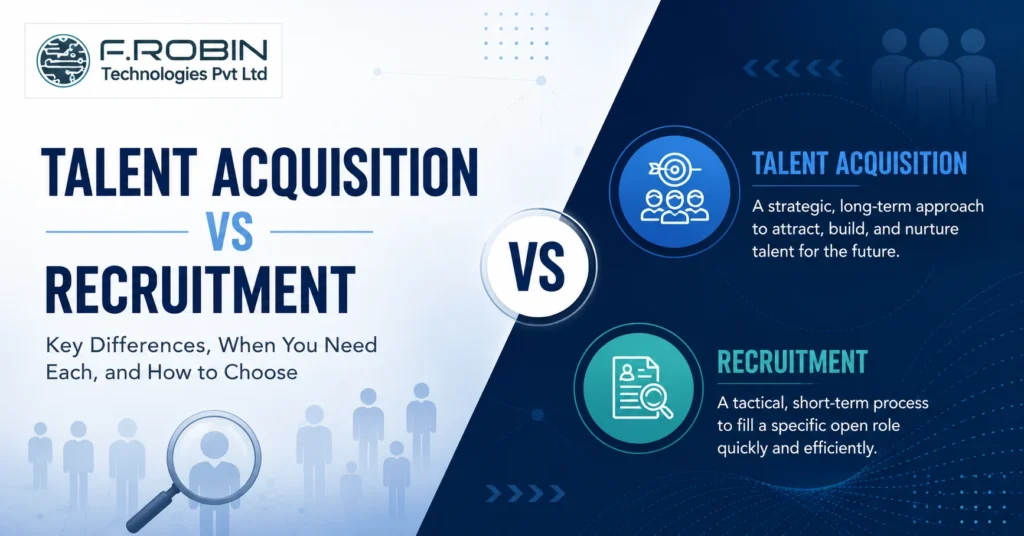
Talent acquisition and recruitment are often used interchangeably — but they are not the same thing. Recruitment is the tactical work of filling open roles, while talent acquisition is the broader, strategic approach to attracting and building talent over time. Confusing the two leads companies to hire reactively when they should be planning ahead. So are they the same? The short answer is no: recruitment is part of talent acquisition, not a synonym for it. In this comparison, we define each term, break down the key differences, and explain when you need one, the other, or both. By the end, you will know exactly which approach fits your hiring needs. What Is Talent Acquisition? Talent acquisition is the strategic, ongoing process of identifying, attracting, and building a pipeline of talent to meet a company’s long-term needs. Rather than reacting to a single vacancy, it plans ahead for the skills the business will need months or years from now. This strategic hiring approach includes workforce planning, employer branding, talent pipelines, and relationship-building with potential candidates. It treats hiring as a continuous investment, not a one-off event. As a result, companies with a strong talent strategy fill critical and senior roles faster, because they have already built relationships before the need arises. In short, it is about playing the long game ensuring the right people are available when the business needs them, especially for hard-to-fill technical and leadership roles. What Is Recruitment? Recruitment is the tactical process of filling a specific open role — sourcing, screening, interviewing, and hiring a candidate for a defined position. It starts when a vacancy opens and ends when the seat is filled. Recruitment is reactive by nature: a role becomes available, and the team moves to fill it quickly. It is essential, efficient, and the right tool for immediate hiring needs. Many companies use external recruitment services or a hiring agency to speed this up, especially for one-off or urgent roles. The key point is scope. Recruitment handles the here-and-now vacancy, while the wider strategy looks beyond it. Both matter, but they operate on different timelines and mindsets. Talent Acquisition vs Recruitment: The Key Differences The two differ across three core dimensions. Understanding these makes the distinction clear. Scope: Strategic vs Tactical It is strategic and ongoing, covering planning, branding, and pipeline building. Recruitment is tactical and specific, focused on filling the role in front of you. One is the long-term system; the other is a single transaction within it. Time Horizon: Long-Term vs Immediate A strategic approach plans for future skills needs, often months or years ahead. Recruitment addresses an immediate vacancy with a short, defined timeline. Therefore, the two answer different questions: “Who will we need?” versus “Who do we hire now?” Approach: Proactive vs Reactive It proactively nurtures relationships with potential candidates before roles open. Recruitment reacts once a role exists. Consequently, proactive pipelines shorten time-to-hire when a vacancy finally appears. Comparison Table The table below summarizes the two at a glance. Factor Talent Acquisition Recruitment Scope Strategic and ongoing Tactical and role-specific Time Horizon Long-term Immediate Approach Proactive Reactive Focus Building and nurturing a talent pipeline Filling a current vacancy Includes Employer branding, workforce planning, talent pipelines, and recruitment Sourcing, screening, interviewing, and hiring candidates Best For Critical, senior-level, and hard-to-fill positions Specific and immediate hiring requirements The clearest takeaway: recruitment is one activity inside the wider talent acquisition function. They are related, not identical. When You Need Talent Acquisition vs Recruitment Match the approach to your situation with these guidelines. Lean on recruitment when: Invest in talent acquisition when: In reality, most growing companies need both — fast recruitment for today’s openings and strategic hiring for tomorrow’s. The mix depends on your growth rate and the scarcity of your roles. How Talent Acquisition Works A strong function rests on a few connected pillars: These pillars feed each other. A strong employer brand fills the pipeline, the pipeline shortens time-to-hire, and good data sharpens planning. Together, they turn hiring from a scramble into a system. For specialized fields, this matters even more. In technology and engineering, the best candidates are rarely on the job market, so a proactive pipeline and employer brand are what win them. Do You Need Both? For most companies, the answer is yes. Recruitment handles immediate needs; a ready pipeline ensures you are never starting from zero when a critical role opens. Relying on recruitment alone keeps you in permanent catch-up mode, while strategy without execution never fills a seat. The smart approach blends them. Use a strategic approach to build pipelines and brand for your hardest roles, and efficient recruitment — often via a hiring agency or specialist partner to fill specific openings fast. Balanced together, they cut both cost and time-to-hire. This is especially true for fast-scaling firms, where today’s vacancy and next year’s skills gap both demand attention at once. Picture a fast-growing chip-design firm. It needs three verification engineers this quarter a clear recruitment job. At the same time, it knows it will need a design lead and ten more engineers within eighteen months. Building relationships with those future hires now, through an employer brand and a nurtured pipeline, is the strategic side. Handle only the urgent three and the firm will scramble later; handle both and it scales smoothly. Benefits of a Strong Hiring Strategy Investing beyond reactive hiring delivers lasting advantages: These gains compound. The longer you invest in this approach, the deeper your pipeline and the easier each future hire becomes. Common Misconceptions A few myths cloud this topic. Clearing them up helps you plan better: Avoiding these misconceptions keeps your hiring grounded in reality and your expectations realistic. Key Takeaways Conclusion Talent acquisition and recruitment are not the same. Recruitment fills today’s vacancy; it builds the pipeline and brand that make tomorrow’s hires faster and stronger. They differ in scope, time horizon, and approach — but they work best together. Most growing companies need efficient recruitment for immediate roles
Recruitment Services Explained: Permanent, Contract & RPO

Recruitment services help companies find, attract, and hire the right people without carrying the full burden of hiring alone. But “recruitment services” is an umbrella term that covers very different models — permanent staffing, contract staffing, RPO, and executive search — each suited to a different hiring need. Choosing the wrong one wastes time and money; choosing the right one fills critical roles fast. This guide explains the main types in plain language and shows when to use each. Whether you are hiring one engineer, scaling a whole team, or filling a leadership seat, understanding these options helps you partner smartly and hire with confidence. What Are Recruitment Services? Recruitment services are professional hiring solutions that source, screen, and place candidates on behalf of an employer. In short, a provider handles part or all of your hiring process so you can fill roles faster and with less effort. These services range from filling a single permanent role to managing an entire hiring function. Some providers focus on speed and volume; others specialize in scarce skills or senior leadership. The best fit depends on your role type, timeline, and how much of the process you want to outsource. For technology and engineering teams especially, specialist providers bring deep talent networks that an internal team rarely matches. That access is often the difference between a six-week hire and a six-month one. The Main Types of Recruitment Services Most providers offer several models. Here are the four you will encounter most often. Permanent Staffing Permanent staffing fills full-time, long-term roles. The provider sources and screens candidates, and you hire the chosen person directly onto your payroll. This model suits core roles you intend to keep, and it is the most common form of hiring service. Contract / Temporary Staffing Contract staffing places workers for a fixed period or specific project. The staffing firm often employs the worker, handling payroll and compliance, while they work under your direction. This model gives you flexibility to scale up and down without long-term commitment. RPO (Recruitment Process Outsourcing) RPO means outsourcing all or part of your recruitment function to a provider who runs it as an extension of your team. RPO suits high-volume or ongoing hiring, delivering process, technology, and scale. As a result, it lowers cost-per-hire and improves consistency. Executive Search Executive search — also called headhunting — finds senior leaders and hard-to-fill specialists. It is a focused, often retained service that proactively approaches passive candidates. Use it for critical leadership roles where the right hire transforms the business. Recruitment Services Compared The table below compares the four main types at a glance. Model Best For Engagement Typical Cost Model Permanent Staffing Core, long-term roles Per placement Percentage of annual salary Contract Staffing Projects and flexible scaling Fixed term Hourly or monthly markup RPO (Recruitment Process Outsourcing) High-volume, ongoing hiring Long-term partnership Monthly fee or per-hire fee Executive Search Senior and hard-to-find leadership roles Retained search Retainer plus success fee Reading across the rows shows there is no single “best” model only the best fit for a given hiring need. Many companies blend several, using permanent staffing for core roles and contract or RPO for surges. When to Use Each Type Match the model to your situation with these guidelines. In practice, your needs may span more than one model. A growing technology firm, for example, might use permanent staffing for engineers, contract staffing for a project spike, and executive search for a new head of engineering all at once. How Recruitment Services Work Whatever the model, good providers follow a clear process: This structure reduces your time-to-hire and protects candidate experience. Consequently, a strong process is one of the clearest signs of a capable partner. Benefits of Using a Recruitment Partner Partnering with a provider delivers real advantages: These benefits compound on hard-to-fill roles, where the cost of a vacancy or a bad hire far outweighs the cost of expert help. In technology hiring especially, where a single unfilled senior role can stall a product roadmap, that speed and reach translate directly into shipped products and protected revenue. In-House Hiring vs Using a Provider Should you hire through your own team or bring in a provider? In-house hiring gives you full control and deep cultural knowledge, but it depends on your recruiters’ bandwidth and reach. When roles are scarce, urgent, or high-volume, an internal team can quickly hit its limits. A provider adds reach, speed, and specialist networks on demand. For a steady trickle of common roles, in-house often works well. For surges, niche skills, or leadership hires, outside help usually pays for itself. Many companies run a hybrid model — keeping everyday hiring in-house and calling in a partner for the hard roles. The cost comparison matters too. Internal recruiting carries fixed salary and tooling costs regardless of output, while a provider’s fee scales with actual hiring. For variable or seasonal demand, that flexibility is often the deciding factor. How to Choose the Right Recruitment Services Partner Not every provider fits every need. Evaluate candidates on a few key points: If your hiring centres on engineering, semiconductor, EMS, or AI talent, a specialist partner like our AI staffing services brings the domain networks and screening depth those roles demand. You can also review our client outcomes to gauge fit. Key Takeaways Conclusion Recruitment services come in four main forms permanent staffing, contract staffing, RPO, and executive search and the right choice depends on your role, timeline, and volume. Permanent suits core hires, contract gives flexibility, RPO scales high-volume hiring, and executive search secures critical leaders. Many companies use several together, and the best partners offer all of them. Need Specialized Talent? Hiring for Technology, Semiconductor, EMS, or AI roles? Our AI staffing services combine deep domain expertise with Permanent Staffing, Contract Staffing, and RPO solutions to help you find the right talent faster. Whether you’re scaling a team, filling niche positions, or managing high-volume hiring, our specialists can build a hiring strategy tailored
