
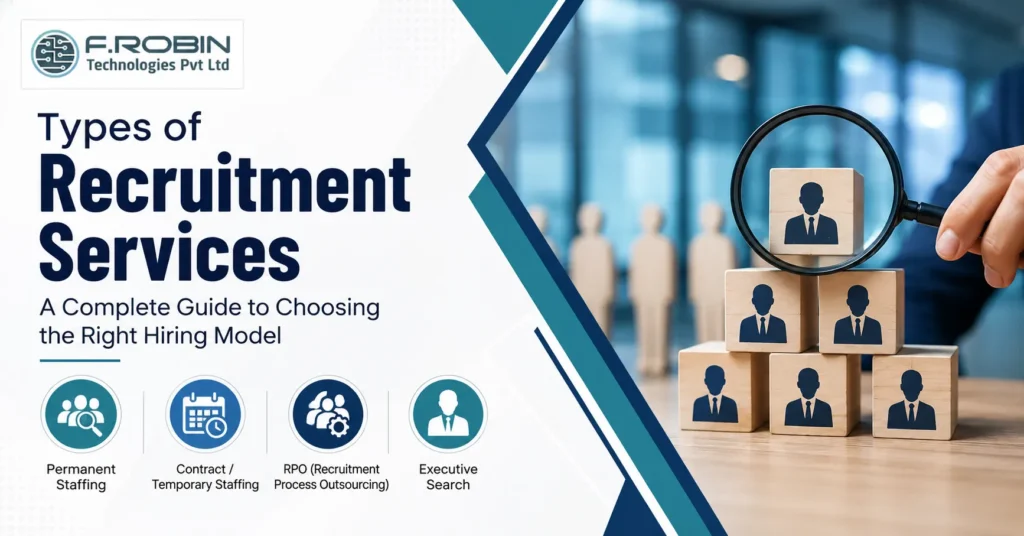
Recruitment services help companies find, attract, and hire the right people without carrying the full burden of hiring alone. But “recruitment services” is an umbrella term that covers very different models — permanent staffing, contract staffing, RPO, and executive search — each suited to a different hiring need. Choosing the wrong one wastes time and money; choosing the right one fills critical roles fast.
This guide explains the main types in plain language and shows when to use each. Whether you are hiring one engineer, scaling a whole team, or filling a leadership seat, understanding these options helps you partner smartly and hire with confidence.
What Are Recruitment Services?
Recruitment services are professional hiring solutions that source, screen, and place candidates on behalf of an employer. In short, a provider handles part or all of your hiring process so you can fill roles faster and with less effort.
These services range from filling a single permanent role to managing an entire hiring function. Some providers focus on speed and volume; others specialize in scarce skills or senior leadership. The best fit depends on your role type, timeline, and how much of the process you want to outsource.
For technology and engineering teams especially, specialist providers bring deep talent networks that an internal team rarely matches. That access is often the difference between a six-week hire and a six-month one.
The Main Types of Recruitment Services
Most providers offer several models. Here are the four you will encounter most often.
Permanent Staffing
Permanent staffing fills full-time, long-term roles. The provider sources and screens candidates, and you hire the chosen person directly onto your payroll. This model suits core roles you intend to keep, and it is the most common form of hiring service.
Contract / Temporary Staffing
Contract staffing places workers for a fixed period or specific project. The staffing firm often employs the worker, handling payroll and compliance, while they work under your direction. This model gives you flexibility to scale up and down without long-term commitment.
RPO (Recruitment Process Outsourcing)
RPO means outsourcing all or part of your recruitment function to a provider who runs it as an extension of your team. RPO suits high-volume or ongoing hiring, delivering process, technology, and scale. As a result, it lowers cost-per-hire and improves consistency.
Executive Search
Executive search — also called headhunting — finds senior leaders and hard-to-fill specialists. It is a focused, often retained service that proactively approaches passive candidates. Use it for critical leadership roles where the right hire transforms the business.
Recruitment Services Compared
The table below compares the four main types at a glance.
| Model | Best For | Engagement | Typical Cost Model |
|---|---|---|---|
| Permanent Staffing | Core, long-term roles | Per placement | Percentage of annual salary |
| Contract Staffing | Projects and flexible scaling | Fixed term | Hourly or monthly markup |
| RPO (Recruitment Process Outsourcing) | High-volume, ongoing hiring | Long-term partnership | Monthly fee or per-hire fee |
| Executive Search | Senior and hard-to-find leadership roles | Retained search | Retainer plus success fee |
Reading across the rows shows there is no single “best” model only the best fit for a given hiring need. Many companies blend several, using permanent staffing for core roles and contract or RPO for surges.
When to Use Each Type
Match the model to your situation with these guidelines.
- Choose permanent staffing when you need a long-term hire for a core role.
- Choose contract staffing when you have project work, seasonal demand, or want to try before you commit.
- Choose RPO when you hire at volume, lack internal recruiting capacity, or need a scalable, repeatable process.
- Choose executive search when a leadership or rare-skill role is too important to fill through standard channels.
In practice, your needs may span more than one model. A growing technology firm, for example, might use permanent staffing for engineers, contract staffing for a project spike, and executive search for a new head of engineering all at once.
How Recruitment Services Work
Whatever the model, good providers follow a clear process:
- Intake. The provider learns your role, skills, culture, and timeline.
- Sourcing. They tap networks, databases, and outreach to build a candidate pool.
- Screening. Candidates are assessed for skills, experience, and fit.
- Shortlisting. You receive a curated set of qualified candidates.
- Interview support. The provider coordinates interviews and feedback.
- Offer and onboarding. They help close the candidate and smooth the start.
This structure reduces your time-to-hire and protects candidate experience. Consequently, a strong process is one of the clearest signs of a capable partner.
Benefits of Using a Recruitment Partner
Partnering with a provider delivers real advantages:
- Faster hiring through ready talent networks and proven processes.
- Access to scarce skills, especially in technology and engineering.
- Lower hiring risk via professional screening and assessment.
- Flexibility to scale teams up or down with demand.
- Reduced cost-per-hire, particularly with RPO at volume.
- Internal focus, freeing your team to do its core work.
These benefits compound on hard-to-fill roles, where the cost of a vacancy or a bad hire far outweighs the cost of expert help. In technology hiring especially, where a single unfilled senior role can stall a product roadmap, that speed and reach translate directly into shipped products and protected revenue.
In-House Hiring vs Using a Provider
Should you hire through your own team or bring in a provider? In-house hiring gives you full control and deep cultural knowledge, but it depends on your recruiters’ bandwidth and reach. When roles are scarce, urgent, or high-volume, an internal team can quickly hit its limits.
A provider adds reach, speed, and specialist networks on demand. For a steady trickle of common roles, in-house often works well. For surges, niche skills, or leadership hires, outside help usually pays for itself. Many companies run a hybrid model — keeping everyday hiring in-house and calling in a partner for the hard roles.
The cost comparison matters too. Internal recruiting carries fixed salary and tooling costs regardless of output, while a provider’s fee scales with actual hiring. For variable or seasonal demand, that flexibility is often the deciding factor.
How to Choose the Right Recruitment Services Partner
Not every provider fits every need. Evaluate candidates on a few key points:
- Domain expertise. For tech roles, choose a partner who understands the skills, not just generic hiring.
- Track record. Ask for proof of similar placements and time-to-hire.
- Process and technology. A strong ATS, screening method, and reporting matter.
- Flexibility. Can they offer permanent, contract, and RPO as your needs change?
- Transparency. Clear fees and honest timelines signal a trustworthy partner.
If your hiring centres on engineering, semiconductor, EMS, or AI talent, a specialist partner like our AI staffing services brings the domain networks and screening depth those roles demand. You can also review our client outcomes to gauge fit.
Key Takeaways
- Recruitment services are professional hiring solutions that source, screen, and place candidates.
- The four main models are permanent staffing, contract staffing, RPO, and executive search.
- Permanent suits core roles; contract suits flexibility; RPO suits volume; executive search suits leadership.
- Many companies blend several models at once.
- Good providers follow a clear sourcing-to-onboarding process.
- For tech roles, domain expertise is the single biggest differentiator.
Conclusion
Recruitment services come in four main forms permanent staffing, contract staffing, RPO, and executive search and the right choice depends on your role, timeline, and volume. Permanent suits core hires, contract gives flexibility, RPO scales high-volume hiring, and executive search secures critical leaders. Many companies use several together, and the best partners offer all of them.
Need Specialized Talent?
Hiring for Technology, Semiconductor, EMS, or AI roles? Our AI staffing services combine deep domain expertise with Permanent Staffing, Contract Staffing, and RPO solutions to help you find the right talent faster. Whether you’re scaling a team, filling niche positions, or managing high-volume hiring, our specialists can build a hiring strategy tailored to your needs.
Talk to Our Staffing ExpertsFrequently Asked Questions
1. What are recruitment services?
Recruitment services are professional hiring solutions that source, screen, and place candidates for employers. They range from filling a single permanent role to running an entire hiring function through RPO.
2. What is the difference between permanent and contract staffing?
Permanent staffing fills long-term roles you hire directly, while contract staffing places workers for a fixed period or project, often employed by the staffing firm. Contract staffing offers flexibility, while permanent hiring provides continuity.
3. What is RPO in recruitment?
RPO (Recruitment Process Outsourcing) means outsourcing all or part of your recruitment function to a provider who operates as an extension of your team. It is ideal for high-volume, ongoing hiring and can help reduce cost-per-hire.
4. What is executive search?
Executive search, often called headhunting, is a specialized service focused on identifying senior leaders and hard-to-find specialists. It involves proactively approaching passive candidates for critical leadership and strategic roles.
5. When should I use recruitment services instead of hiring in-house?
Recruitment services are valuable when you lack internal recruiting capacity, need access to niche talent, require faster hiring, or want to improve hiring quality without expanding your in-house team.
