
Medical PCB Solutions: What to Check Before You Choose a Partner
Medical PCB solutions carry a different bar than a consumer or industrial board. The layer count and footprint might look similar. But the documentation, risk management and quality control behind a medical board run far heavier. This guide covers what medical device PCB design services and assembly actually require. It also covers which standards commonly apply and what to ask before you scope a project. Note: this is general engineering guidance, not regulatory or legal advice. Confirm requirements for your specific device with your regulatory team. Key takeaways What counts as a medical PCB solution? A medical PCB solution covers everything from schematic and layout through assembly, test and the documentation a medical device file requires. It usually spans three stages: design, where risk and safety margins are built into the board; assembly, where workmanship and traceability are controlled; and verification, where the finished board is tested and documented against the device requirements. Stage What it adds beyond a standard board Design Risk analysis, safety margins, EMC planning and biocompatible material choices where the board contacts the patient Assembly Higher workmanship class, ESD control, and full component and lot traceability Verification Test records, first-article inspection and documentation that feeds the device history file What is different about PCB design for medical devices? PCB design for medical devices starts from risk, not just function. A design team maps failure modes for each critical circuit. It then builds in safety margins so a single failure does not put a patient at risk. That thinking shapes creepage and clearance distances, isolation between patient-connected circuits and mains power, and the choice of materials. These standards are published by ISO and IEC. Which ones apply, and how strictly, depends on your device’s classification and target market, so involve your regulatory lead early in the design. What does medical device PCB assembly require beyond standard SMT? Medical device PCB assembly follows the same SMT and through-hole processes as any other board. The quality bar just sits higher at every step. Workmanship is commonly held to IPC-A-610 Class 3, the strictest of the three IPC acceptability classes, rather than the Class 2 used for most industrial electronics. Requirement Why it matters for medical boards IPC-A-610 Class 3 workmanship Sets tighter solder, placement and defect criteria for high-reliability boards Full lot and component traceability Supports recalls and investigations if a field issue occurs ESD-controlled handling Protects sensitive components used in sensing and signal-processing circuits Documented first-article and in-process inspection Feeds the quality records a medical device file needs Cleanroom or controlled-environment assembly (where required) Reduces contamination risk for boards used in sterile or invasive applications IPC publishes the acceptability standards referenced above through IPC, the trade association for electronics manufacturing. Which standards commonly apply to medical PCB solutions? No single standard covers a whole medical device. The exact list depends on device class and target market. These are the ones that come up most often in medical PCB design and assembly conversations. Standard Focus area Where it applies ISO 13485 Quality management system The manufacturer’s overall quality system, not the board alone IEC 60601-1 Electrical safety for medical equipment Devices with patient or mains electrical connections ISO 14971 Risk management Design-stage failure mode analysis and mitigation ISO 10993 Biocompatibility Materials that contact skin, tissue or fluids IPC-A-610 Class 3 Assembly workmanship Solder and placement quality during assembly Treat this as a starting checklist, not a complete regulatory map. A qualified regulatory consultant should confirm the exact standards and certifications your specific device needs. What should you ask before choosing a medical device PCB design services partner? The right questions separate a partner who has done this work from one who is willing to try. A provider that answers these with specifics, not general reassurance, is more likely to handle the documentation load a medical project brings. Where does F.Robin Technologies fit? F.Robin Technologies, part of the F.Robin Group of Companies, provides PCB layout and design services, PCB manufacturing and electronics manufacturing services from its Chennai head office, built to IPC, ISO and RoHS standards. If you are evaluating medical PCB solutions specifically, confirm directly which medical-focused certifications and quality-system scope, such as ISO 13485, apply to your project. Share your schematic, device classification, target market and any known compliance requirements through the contact page so the scope, and the applicable standards, can be confirmed against your actual project. Scoping a Medical PCB Project? Let’s Confirm What It Needs Every medical board carries its own mix of risk management, workmanship class and traceability requirements. Share your device classification and target market, and our PCB Design and Assembly team will confirm what applies before you get a quote. Discuss Your Medical PCB Project Explore PCB Design Services Head office: KOSMO ONE, Tower B, 4th Floor, Sai Nagar Plot, 14, 3rd Main Rd, Ambattur Industrial Estate, Chennai 600058 Get directions · sales@frobintech.com Frequently Asked Questions What makes medical PCB solutions different from standard PCB design? Medical PCB solutions add safety margins, documented risk management and stricter quality control on top of standard layout work. A patient monitor board and a consumer gadget board can share the same layer count, yet the medical board carries far more documentation and testing. Which standards apply to medical device PCB design services? Common references include ISO 13485 for the quality management system, IEC 60601-1 for electrical safety, ISO 14971 for risk management, and ISO 10993 for biocompatibility where a board contacts the patient. Confirm which standards apply with your regulatory team, since requirements vary by device class and market. What does medical device PCB assembly require beyond standard SMT? It typically requires IPC-A-610 Class 3 workmanship, full lot and component traceability, ESD-controlled handling, and documented first-article and in-process inspection. Some devices also need cleanroom assembly or additional cleaning and coating steps. Can a PCB design company handle both design and assembly for a medical device? Some companies offer both, and one accountable partner can simplify document control across the project. Confirm the specific certifications,
PCB Design Company in Chennai: How to Choose the Right Fit

Chennai has no shortage of PCB design companies, from one-person layout services to full electronics design companies that also manufacture. Price alone is a poor comparison, since “PCB design” can mean a quick layout job or a full schematic-to-release engagement. This guide covers what each provider type offers, where they cluster in the city, and how to spot a capable PCB design company in Chennai before you sign. Key takeaways What does a PCB design company in Chennai actually offer? Service scope varies more than the name suggests. Some providers only place components and route traces from a supplied schematic. Others operate as a full electronics design company in Chennai, covering schematic, layout, prototype, manufacturing and test. Provider type Typical scope Best fit PCB layout company Placement and routing from a supplied schematic Teams with in-house schematic design who need layout capacity Full electronics design company Schematic, layout, DFM, prototype, manufacturing, test Product teams that want one accountable partner end to end Independent consultants One or two engineers, project-based A single board with a clear, fixed scope In-house team Continuous internal capability High, steady design volume across many products Decide which column fits your project before you request quotes. A layout-only quote and a full-service quote are not comparable numbers. PCB design company in Ambattur, or elsewhere in Chennai? Capability rarely changes by neighbourhood, though location still affects turnaround. A PCB design company in Ambattur sits inside an established industrial corridor, close to component distributors, EMS units and manufacturing support. That helps when a prototype needs a quick site visit or a last-minute part swap. If your team sits in one of these corridors, ask whether the design company can visit on short notice. That single detail affects turnaround more than the exact address on a map. PCB layout company vs full electronics design company: which do you need? A PCB layout company fits when you already have a verified schematic and need placement, routing and manufacturing files. It is usually the faster, lower-cost option, since the scope stays narrow. A full electronics design company earns its higher quote when your project still needs schematic work, DFM decisions, prototype builds or ongoing test support. One accountable team across those stages often costs less overall than coordinating three separate vendors. For the technical checks either provider should pass, and a full cost breakdown, see our companion guide, PCB Design Company Near Me: How to Choose in Chennai. When should you hire independent PCB design consultants in Chennai? Independent PCB design consultants in Chennai can suit a single board with a fixed, documented scope and a flexible timeline. Hourly rates often run lower, and a good consultant brings deep experience in a narrow area. A consultant is usually one or two people, though. If that person is unavailable mid-project, or the board grows beyond scope, no team is there to absorb the change. A company carries process, backup engineers and often a direct path to manufacturing. How do you spot a strong PCB design company in Chennai? A strong PCB design company in Chennai is specific. It names the IPC standards it designs to. It also walks you through a sample release package and explains who checks the design for manufacturability. An average provider talks about experience but stays vague on deliverables and process. IPC standards such as IPC-2221 are published by IPC, the trade association for electronics manufacturing. For products needing safety approval, also check whether boards are UL recognised; UL Solutions publishes UL 796 for printed-wiring boards. A provider that names these by name, rather than saying “industry standard,” is usually further along in its process. How do you compare quotes from different Chennai providers? Quotes are only comparable when they cover the same scope. Before comparing numbers, confirm the layer count, the revision rounds and whether DFM review is included. Also confirm exactly which files you receive at handover. What to confirm in every quote Why it matters Scope: layout only, or schematic through release Prevents comparing a partial job against a full one Revision rounds included Extra rounds are often billed separately once accepted DFM review: included or optional A missing DFM step raises the risk of a failed first build File handover list Confirms Gerbers, BOM, pick-and-place and drawings, not just a PDF Turnaround time A lower price with a longer queue may cost more in delay than it saves Once three quotes share the same terms, price differences usually reflect real process gaps, not margin. Where does F.Robin Technologies fit? F.Robin Technologies, part of the F.Robin Group of Companies, runs its head office in Chennai. It operates as a full electronics design company in Chennai rather than a layout-only vendor, providing PCB layout and design services, PCB manufacturing and electronics manufacturing services, with additional offices in Madurai and Bangalore. Manufacturing capability spans multilayer, HDI, rigid-flex and metal-core boards, built to IPC, ISO and RoHS standards. That structure lets one team carry a design from schematic through manufacturing, instead of handing it between vendors. Teams needing chip-level testing can also use its silicon validation services. To get a scoped quote, share your schematic, board size, interfaces and quantity through the contact page. Comparing PCB Design Companies in Chennai? Talk to Us First Schematic review, layout, DFM checks and a full release package — our PCB Design Services cover it all from one Chennai team, with PCB manufacturing and EMS support if your project needs to go further. Get a PCB Design Quote Explore PCB Design Services Head office: KOSMO ONE, Tower B, 4th Floor, Sai Nagar Plot, 14, 3rd Main Rd, Ambattur Industrial Estate, Chennai 600058 Get directions · sales@frobintech.com Frequently Asked Questions What does a PCB design company in Chennai typically offer? Most firms offer schematic capture and PCB layout. A full electronics design company in Chennai goes further, adding DFM review, prototype support, PCB manufacturing and testing under one roof. Is a PCB design company in Ambattur different from one elsewhere in Chennai? Not
Should You Outsource PCB Design or Hire an In-House Designer?

“Is it worth outsourcing PCB layout, or should I just hire someone?” is one of the first real staffing decisions a growing hardware team faces, and getting it wrong in either direction is expensive. Hire too early and you carry a fixed salary against inconsistent design workload; outsource everything indefinitely and you may pay more per board than an in-house hire would have cost once volume justifies the headcount. This decision guide compares the two paths honestly — cost, speed, design capacity, and control so you can match the choice to your actual situation rather than defaulting to whichever your last company did. Whether you are building your first product in Chennai, scaling a design team in Bangalore, or anywhere else, the same underlying logic applies, and the right answer can shift as your board volume grows. The Quick Answer In short: outsource PCB design when your board workload is occasional or variable, and hire an in-house designer when you have steady, continuous layout work to keep that person productive year-round. Neither path is universally correct — the right answer depends on your workload, your timeline, and how much day-to-day control you need over the design process. A Chennai hardware startup building its first product has very different needs from a Bangalore product company running continuous PCB development across multiple lines. The sections below help you identify which situation you are actually in, and every one of the factors below applies whether you decide to outsource PCB design for one board or for an entire product line. This mirrors the same decision on the mechanical side see our guide to outsourcing mechanical design vs hiring in-house if your product also needs enclosure or mechanical work. In-House PCB Designer: Pros and Cons Pros Cons An in-house PCB designer pays off when layout work is steady enough to keep the role genuinely busy and productive across the full year, not just during your next single project. Outsource PCB Design: Pros and Cons Pros Cons For most companies with variable board workload, choosing to outsource PCB design reduces both cost and hiring risk compared with a full-time layout hire. Cost Comparison An in-house PCB designer costs salary, benefits, CAD tool licensing, and management overhead payable every month whether or not there is enough layout work to fill that time. For a company with one or two board projects a year, this fixed cost is expensive relative to the actual work delivered. Outsourcing converts that fixed cost into a variable one: you pay for the specific board design you need, when you need it, with no idle-time cost between projects. The break-even point shifts with your actual project volume intermittent PCB work favors choosing to outsource PCB design, while continuous, high-volume layout work can make an in-house hire more cost-effective over time, once workload is steady enough to justify the fixed cost. Side-by-Side Comparison Factor In-house PCB designer Outsource PCB design Cost structure Fixed (salary + tools) Variable (per project) Best for Steady, continuous layout work Occasional or variable board projects Expertise breadth Limited to the hire’s skill set Broad, across many past projects Ramp-up time Hiring cycle required Immediate Control High, direct Moderate, via clear briefs Scalability Limited by headcount Flexible with project demand Reading down the table, the pattern is consistent: steady, predictable board work favors hiring in-house, while variable, project-based work favors choosing to outsource PCB design. When to Hire In-House For an established company in Chennai or Bangalore with a steady product pipeline, an in-house PCB designer can become the backbone of ongoing hardware development. When to Outsource PCB Design For most early-stage hardware companies — including many building their first product in Chennai and Bangalore’s growing startup ecosystems — choosing to outsource PCB design gets a working board built faster and cheaper than hiring would. Apply our full 12-point checklist for choosing a PCB design company once you decide to outsource, and see our Chennai buyer’s guide if sourcing locally. A Hybrid Approach Many companies do not choose one path exclusively. A small in-house designer handles day-to-day product knowledge, quick revisions, and manufacturing liaison, while an external partner is brought in for peak workload, specialized high-speed or HDI work, or a first product line before headcount is justified. This hybrid model captures the control and continuity of an in-house presence alongside the flexibility and depth of an outside partner exactly when you need it. It is especially common among growing companies that started by choosing to outsource PCB design entirely, then added in-house capacity once board volume grew enough to justify it. A practical way to start the hybrid approach is to map your last year of board projects: which ones an in-house hire would have handled comfortably, and which ones genuinely needed outside expertise or extra hands. That history usually makes the right split between the two obvious without much further guesswork. If your workload has grown beyond simple layouts, see our guide to custom PCB design services for when off-the-shelf modules no longer fit your needs. A Real-World Example Picture a three-person hardware startup in Chennai building its first IoT sensor product. Hiring a full-time PCB designer would burn scarce runway on a role that sits idle after the layout is finished, so choosing to outsource PCB design to a specialist partner gets a professional board built in weeks, at a fraction of the cost of a salaried hire. Now picture a scaling product company in Bangalore shipping four new devices a year, each needing ongoing layout revisions and close coordination with manufacturing. Here, an in-house PCB designer earns their keep every month, building deep product knowledge that an outsourced partner would have to relearn on every project. Same decision, two different situations, two equally correct answers. Key Takeaways CTA – Outsource PCB Design or Hire In-House Weighing In-House vs Outsourced PCB Design? Cost, speed, control, and design capacity — our PCB Layout Design Services give Chennai and Bangalore hardware companies flexible outsourced PCB design, from
PCB Design Company Near Me: How to Choose in Chennai

Searching for a PCB design company near me usually means you have a schematic and a deadline. You want a partner who can review the board with your engineers and release files your fabricator accepts first time. This guide covers what a design partner should deliver and which technical checks matter. It also explains what drives cost and what to ask before you sign. Key takeaways What does a PCB design company actually deliver? A PCB design company turns your schematic and requirements into a manufacturable board design. That covers stack-up, placement, routing, design-rule checks and a release package for the fabricator and assembler. You receive design data, but not a physical board, unless the company also manufactures. A complete release package normally contains these files: Deliverable What it contains Used by Gerber or ODB++ data Copper, mask, silkscreen and outline data per layer Fabricator NC drill file Hole sizes and locations Fabricator Bill of materials Every part with reference designator and part number Purchasing, assembly Pick-and-place file Position and rotation of each surface-mount part SMT assembly Fabrication drawing Stack-up, materials, tolerances, finish, impedance notes Fabricator Assembly drawing Placement, polarity and special instructions Assembler, inspection IPC-356 netlist Connectivity data for bare-board electrical test Fabricator Why hire a PCB design company in Chennai instead of a remote freelancer? A PCB design company in Chennai gives you same-day design reviews and one accountable team. It also shortens the path from layout to fabrication. Remote options can cost less per hour. However, every clarification adds a full-day round trip when time zones differ. The right choice depends on your project: Option Best for Trade-off Local company in Chennai Products needing frequent reviews and prototype handoff Hourly rate can exceed offshore Freelancer Small, well-defined single boards Single point of failure; no link to manufacturing Offshore vendor Large volumes of routine layouts Time-zone delay; harder on-site review In-house team Continuous, high-volume design work Licences, hiring and idle-capacity cost Chennai also sits inside one of India’s densest automotive and electronics manufacturing regions, including the Sriperumbudur and Oragadam industrial areas. That proximity matters because a layout change has to be checked against a live assembly line. So when you compare PCB design services near me, favour a team that can visit, review and prototype locally. Which technical checks should a PCB design company near me pass? A strong partner controls five things before release: stack-up and impedance, return paths, power delivery, thermal paths and manufacturability. Each one is checked against a written rule set, not left to habit. Then ask to see that rule set. The generic design standard is IPC-2221, and IPC-2222 covers rigid boards. Both are published by IPC, the electronics industry association. How much do PCB layout services in Tamil Nadu cost? PCB layout services in Tamil Nadu are usually quoted per project, per board or per hour. The price follows design complexity rather than board size. For example, a dense eight-layer board with a BGA and DDR memory takes far more engineering time than a two-layer sensor board of the same area. Cost driver Why it adds effort Layer count More stack-up work and routing constraints BGA pitch and pin count Escape routing, sometimes via-in-pad or microvias High-speed interfaces Impedance control, length matching and extra review Component and net count Placement and routing time grow with each part EMI and safety requirements Extra spacing, filtering and review rules Rigid-flex or metal-core boards Special stack-ups and mechanical constraints Documentation depth A full release package takes longer than Gerbers alone Ask for a quote that lists deliverables, revision rounds and a review schedule. Two quotes are only comparable when both state the same scope. What should you ask a PCB design company before you sign? Before you shortlist any PCB design company near me, ask six questions. They cover tools, standards, DFM ownership, revision limits, file ownership and prototype support. The answers also show whether the company works to a process or improvises. Where a product needs safety approval, also ask whether boards and laminates are UL recognised. UL Solutions publishes UL 796, the standard for printed-wiring boards. What does a PCB design project look like from brief to release? A PCB design project moves through six stages, from requirements review to a released design package. The sequence is the same for a simple two-layer board and a dense multilayer one. Only the depth of each stage changes. Is F.Robin Technologies a PCB design company near me in Chennai? Yes, if you are in or near Chennai. F.Robin Technologies, part of the F.Robin Group of Companies, has its head office in Chennai. It provides PCB layout and design services, PCB manufacturing and electronics manufacturing services for consumer electronics, automotive and industrial products. Its manufacturing page lists multilayer, HDI, rigid-flex and metal-core boards, and states adherence to IPC, ISO and UL standards. As a result, a design team gets support from layout through production with one company. Teams that also need chip-level testing can use its silicon validation services. For PCB layout services in Tamil Nadu, or for teams elsewhere in India, start with a short brief. Include the schematic, board size, interfaces and quantity, then request a PCB design quote through the contact page. Need a PCB Design Company Near You? Start With Our Chennai Team From schematic review to fabrication-ready files, our PCB Design Services in Chennai cover stack-up planning, impedance control and DFM review — with PCB manufacturing and EMS support when you are ready to build. Get a PCB Design Quote Explore PCB Design Services Head office: KOSMO ONE, Tower B, 4th Floor, Sai Nagar Plot, 14, 3rd Main Rd, Ambattur Industrial Estate, Chennai 600058 Get directions · sales@frobintech.com Frequently Asked Questions How do I find a reliable PCB design company near me? A reliable PCB design company near me will publish its deliverables, name the IPC standards it designs to and describe its DFM process. Ask for a scoped quote and a sample release package before you commit. What files
Workforce Planning: How to Forecast Hiring for the Year

Most companies plan hiring reactively a role opens, and the search starts. Workforce planning flips that sequence, forecasting headcount and skills needs for the year ahead so hiring becomes a planned activity rather than a constant scramble. Done well, it turns recruiting from a series of fire drills into a predictable, budgeted function. This how-to guide gives you a practical framework for annual workforce planning: forecasting headcount demand, identifying skills gaps before they become urgent, and building a hiring plan that survives contact with a real, changing business. Whether you are planning for a ten-person team or a hundred-person department, the same core framework applies only the level of detail and formality needs to scale with the size of the organization. Why Reactive Hiring Fails Reactive hiring means a role only gets attention once someone resigns, a team is already overloaded, or a project is already blocked waiting for headcount. By the time that search starts, the business has already been paying the cost of the gap for weeks or months, and the pressure to fill the role fast often lowers the bar on who gets hired. Workforce planning solves this by moving the decision earlier. Instead of discovering a need when it becomes urgent, you forecast it months ahead, giving recruiting whether internal or through a specialist partner the lead time to find a strong candidate rather than the first available one. Step 1: Start With the Business Plan Workforce planning only works when it is anchored to the actual business plan for the year revenue targets, new product launches, market expansion, or planned efficiency gains. Headcount needs flow directly from these business decisions, so planning hiring in isolation from the business plan produces a forecast disconnected from reality. Sit down with business and functional leaders early in the planning cycle and translate their plans into people implications: which teams grow, which stay flat, and which functions face new skill requirements the current team does not have. This conversation is the foundation everything else in the workforce planning process builds on. Step 2: Forecast Headcount Demand Headcount planning translates business plans into a specific number of roles, by function and by timing, across the year. For each team, estimate the workload implied by the business plan, compare it against current capacity, and identify the gap including planned departures, internal promotions, and expected attrition based on historical patterns. Build this forecast by quarter, not just as a single annual number. A team that needs five hires spread evenly across the year has a very different hiring plan than one that needs all five in the first quarter to support a specific launch, even though the annual total is identical. Step 3: Identify Skills Gaps Headcount numbers alone do not capture whether you have the right skills, only whether you have enough people. A skills gap analysis compares the capabilities your business plan will require against what your current team actually has, surfacing specific gaps a new technical skill, a leadership capability, a domain expertise that pure headcount planning misses entirely. This step matters most for specialized or scarce skills, where the gap cannot be closed quickly once discovered. Identifying a skills gap a year ahead gives you time to build a pipeline or invest in training; discovering it three months before you need it leaves far fewer good options. Identifying a skills gap early only matters if your evaluation process can actually detect it — see our guide to candidate screening and assessment for how to build that evaluation capability. Step 4: Build the Hiring Plan and Budget With headcount demand and skills gaps identified, translate the forecast into a concrete hiring plan: which roles, in what order, with what budget, and against what timeline. Prioritize roles that unblock the business plan’s most time-sensitive commitments, and sequence hiring so that critical roles are not competing with each other for the same limited recruiting capacity at the same time. Budget realistically for both the cost of hiring recruitment fees, sign-on costs, time-to-productivity and the cost of any gap between when a role is identified and when it is filled. This budget becomes the reference point the rest of the year is measured against, so build it with enough detail to actually be useful later. Step 5: Choose the Right Hiring Model for Each Need Not every role in your workforce plan should be filled the same way. Steady, predictable roles suit permanent hiring or an ongoing recruitment partnership; a temporary spike suits contract staffing; a large, sustained hiring wave for standardized roles may suit RPO; and a single scarce, senior role may need executive search. Mapping the right model to each part of the plan rather than defaulting to one approach for everything is where workforce planning connects directly to talent acquisition strategy. The plan tells you what and when; the model tells you how. For a full breakdown of these models, see our guide to recruitment services, and our comparison of talent acquisition vs recruitment for how pipeline-building fits into the plan. Step 6: Review and Adjust Quarterly A workforce plan built once in January and never revisited becomes stale the moment the business plan changes — and business plans always change. Review the plan quarterly against actual hiring progress, revised business priorities, and attrition that did not match the original forecast. This does not mean rebuilding the plan from scratch every quarter. It means checking the core assumptions, adjusting the roles and timing that no longer match reality, and keeping the plan a living reference rather than a document filed away after the annual planning cycle ends. A Real-World Example Picture a company planning to launch a new product line in the second half of the year, requiring three additional verification engineers and one new product manager. Reactive hiring would mean posting these roles once the launch date is confirmed and engineering is already stretched thin, likely missing the launch window while the search runs. Workforce planning built
Candidate Screening & Assessment: Getting It Right

Most hiring mistakes are decided long before an offer letter goes out — in a screening call that missed a real gap, or an interview so unstructured that two candidates were never actually compared on the same basis. Candidate screening and assessment is where hiring quality is won or lost, yet it is often the least standardized part of the whole process. This how-to guide covers what genuinely reliable candidate screening and assessment looks like: how to structure the process consistently, which assessment methods actually predict performance, and the common mistakes that quietly undermine even a well-intentioned hiring process. Whether you hire occasionally or run a constant pipeline, these practices apply — and most of them cost nothing to implement beyond the discipline to follow them consistently. Why Screening and Assessment Is Where Hiring Succeeds or Fails By the time a candidate reaches a final interview, most of the important decisions have already been made who got filtered out at the resume stage, what the screening call actually probed for, and whether the interview panel evaluated everyone against the same criteria. Weak candidate screening and assessment at these early stages either lets weak candidates through or filters out strong ones for the wrong reasons. Getting this right matters more than almost any other part of hiring, because it is repeatable. A flawed screening process does not fail once it fails on every single requisition that runs through it, quietly compounding cost and lost opportunity across every hire made that way. This is exactly why we cover the connection between hiring quality and process discipline in our guide to improving quality of hire in permanent staffing. Building a Consistent Screening Process Consistency is the foundation of reliable candidate screening and assessment. Define the criteria that matter for a role before you look at a single resume the must-have skills, the experience level, and the specific outcomes success in the role requires so that every candidate is measured against the same bar rather than a shifting impression. Document the screening questions and evaluation criteria in advance, and use them for every candidate in that requisition. This single change writing down the criteria before screening starts, rather than deciding what matters as you go is one of the highest-leverage improvements available to almost any hiring process. This process discipline matters most once candidates are already in your pipeline see our guide to recruitment services for how sourcing and screening fit together. Structured Interviews Structured interviews are not about removing human judgment from candidate screening and assessment they are about applying that judgment consistently, against the same evidence, for every candidate. Skills-Based Assessment Resume claims and interview answers are weak predictors of how someone actually performs the work. Skills-based assessment a work sample, a case study, or a practical test that mirrors real tasks in the role gives you direct evidence instead of a self-report. The best skills assessments are short, relevant, and respectful of a candidate’s time, testing exactly the capability that matters most for the role rather than generic aptitude. Combined with a structured interview, this kind of candidate screening and assessment produces a far more reliable signal than either method alone. For technical roles, this often means domain-specific testing see our guide to choosing a semiconductor recruitment partner for an example of specialized technical screening. Reference Checks Done Properly Reference checks are often treated as a formality, but done properly they add real signal to candidate screening and assessment. Ask specific, behavioural questions about verifiable performance not “would you recommend them” but “can you describe a specific project where they had to solve a difficult problem, and how they handled it.” Speaking with more than one reference, and specifically former managers or close collaborators rather than only hand-picked advocates, produces a more balanced picture. This step is quick relative to the rest of the process, but skipping it removes one of the few sources of independent, real-world evidence available before an offer is made evidence that neither the interview nor the skills assessment can fully replace. Reducing Bias in the Process Unstructured candidate screening and assessment leaves far more room for unconscious bias to influence outcomes than a structured process does, because vague criteria are easy to unconsciously bend around a general impression of a candidate. Structured interviews, written scoring rubrics, and panel-based evaluation all reduce this risk by anchoring decisions to specific, pre-defined evidence. Reviewing screening and interview data periodically who advances at each stage, and whether that pattern is explainable by job-relevant criteria helps catch systemic issues in the process itself, not just in any individual hiring decision. This kind of periodic review is what separates a process that quietly drifts away from its original design over time from one that stays reliable requisition after requisition. A Real-World Example Picture two candidates for the same technical role. The first is confident, articulate, and interviews well, but the panel never asked either candidate the same set of questions, so the strong interview performance is really the only thing distinguishing them from the second candidate a quieter, more methodical engineer who happened to interview with a less enthusiastic panelist that day. With a structured process the same core questions, a shared scoring rubric, a skills-based work sample, and reference checks asking specific behavioural questions the picture often reverses. The quieter candidate’s work sample and references reveal exactly the kind of careful, reliable problem-solving the role actually needs, while the confident candidate’s assessment reveals gaps that the interview alone never surfaced. Candidate screening and assessment built this way catches what an unstructured process, run purely on interview chemistry, would have missed entirely. A Screening and Assessment Checklist Working through this checklist consistently, requisition after requisition, is what turns candidate screening and assessment from an art into a repeatable process. Common Mistakes to Avoid Avoiding these keeps candidate screening and assessment focused on evidence, not habit or convenience. Key Takeaways CTA – Candidate Screening & Assessment Build a Screening Process You Can
Custom PCB Design Services: When Off-the-Shelf Won’t Cut It
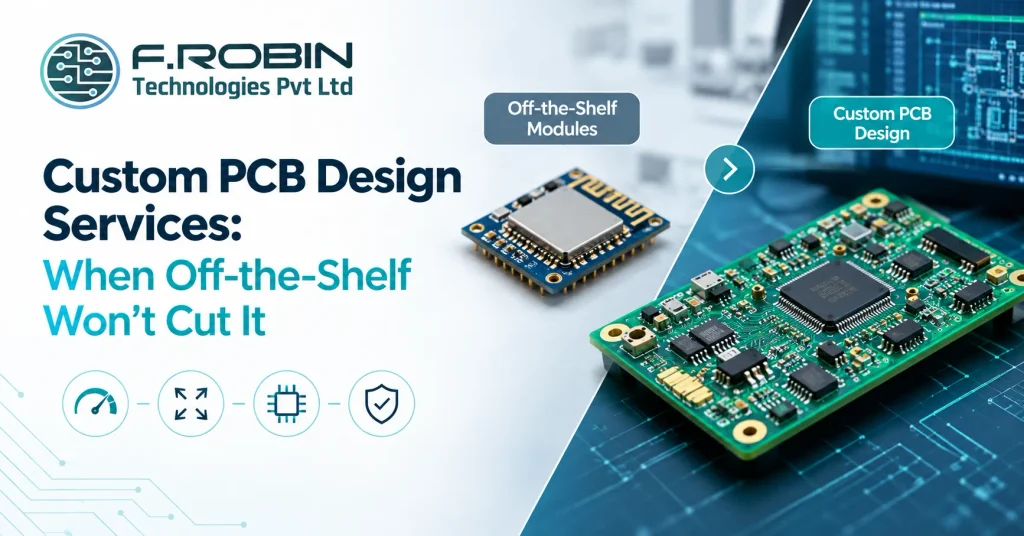
Off-the-shelf modules solve most early-stage hardware problems cheaply and fast — until they do not. The moment your product needs a specific form factor, a cost target modules cannot hit at volume, or genuine high-speed digital and mixed-signal PCB layout that a generic module was never designed for, custom PCB design services become the only real path forward. This decision guide covers exactly when that shift makes sense, what custom PCB design services actually involve, and what you should expect in cost, timeline, and process once you commit. Whether you are scaling past a prototype built on development boards or designing a product that a module simply cannot support, this guide will help you make the call with confidence — and avoid the common trap of discovering the limitation only after significant time has already been invested in a module-based approach. The Quick Answer In short: stick with off-the-shelf modules for early prototypes, low volume, and simple designs where speed to market matters more than cost or form factor. Move to custom PCB design services once you need a specific size or shape, a cost structure that only custom hardware can hit at volume, or performance — especially high-speed digital and mixed-signal PCB layout — that a generic module was never built to deliver. The decision is rarely close once you actually hit one of these triggers. The harder part is recognizing the trigger early, before a module-based prototype has locked in assumptions that make the eventual custom redesign more painful than it needed to be. Why Off-the-Shelf Modules Work Until They Don’t Modules exist because they solve a real problem well: a pre-certified, pre-tested subsystem lets a small team build a working prototype in weeks instead of months, without needing deep PCB design expertise on staff. For early validation, that speed is genuinely valuable, and there is no reason to reach for custom PCB design services before you need to. The trade-off is that modules are designed to be generic. They carry a fixed size, a fixed feature set, and a per-unit cost that includes someone else’s margin and overhead. That trade-off is invisible at low volume and increasingly expensive as volume grows, or once your product’s requirements diverge from what the module was designed to serve. Signs You Need Custom PCB Design Services If one or more of these apply, custom PCB design services are very likely the right next step, even if the transition feels premature. When High-Speed and Mixed-Signal Layout Forces the Issue High-speed digital and mixed-signal PCB layout is one of the clearest, least negotiable triggers for custom PCB design services. Modules are built as generic subsystems, and their layout is optimized for the module vendor’s own use cases — not for the specific high-speed interfaces, controlled impedance requirements, or sensitive analog sections your product actually needs. Once your design involves fast digital interfaces alongside sensitive analog or RF sections, the layout decisions — grounding strategy, plane splits, trace routing, component placement — become deeply product-specific. A generic module cannot make those decisions for you, because it was never designed with your specific mixed-signal requirements in mind. This is the point where custom PCB design services stop being a nice-to-have and become a technical necessity. For the underlying stack-up and signal-integrity decisions this involves, see our guide to impedance control in PCB design, which covers controlled impedance and signal integrity in depth. What Custom PCB Design Services Actually Involve A capable custom PCB design services provider covers this whole scope, or works cleanly alongside your existing manufacturing partner if you already have one in place. For boards with higher layer counts, see our guide to multilayer PCB design to understand how layer count interacts with the custom design process. Cost: Custom vs Module at Different Volumes The table below illustrates how the cost balance shifts between modules and custom PCB design services as volume grows. Factor Off-the-shelf module Custom PCB design Upfront cost Low (design already done) Higher (NRE for design and tooling) Per-unit cost at low volume Competitive Often higher due to NRE amortization Per-unit cost at high volume Fixed, includes vendor margin Typically lower once NRE is amortized Form factor control Limited to module footprint Full control Performance ceiling Generic, module-defined Matched exactly to your requirements The crossover point varies by product, but as a rule, custom PCB design services become cost-competitive once volume is high enough to amortize the upfront NRE investment across enough units. A Real-World Example Picture a startup that validated its first product using an off-the-shelf wireless module, a separate sensor breakout board, and a carrier board connecting them together. It worked well enough to raise funding and land early customers, but the assembly was bulky, expensive per unit, and used three separate boards where the final product needed to fit in a pocket-sized enclosure. Moving to custom PCB design services combined all three functions onto a single board, purpose-built for the target enclosure, with the wireless section laid out properly for its RF requirements alongside the sensor’s sensitive analog circuitry — real high-speed digital and mixed-signal PCB layout work that the original three-board stack never needed to solve. Unit cost dropped substantially at volume, and the product finally fit the form factor customers actually wanted. What to Expect: Timeline and Process Custom PCB design services take longer upfront than dropping in a module, and setting realistic expectations avoids frustration later. A straightforward design might move from requirements to a validated prototype in a matter of weeks; a complex board with genuine high-speed digital and mixed-signal PCB layout, tight certification requirements, or multiple design iterations can take considerably longer. Expect a structured process: requirements and schematic first, then layout, then DFM review, then a prototype build and validation cycle before production files are finalized. Build in time for at least one revision cycle — very few complex boards are perfect on the first pass, and planning for that reality up front keeps the overall timeline realistic rather than
PCB Design Analysis Services: What’s Included and the ROI

PCB design analysis services are easy to skip when a schedule is tight and a board looks fine on screen — right up until a signal integrity failure, a power delivery problem, or a thermal hotspot shows up in a prototype that already cost real money and time to build. Knowing exactly what these services include, and what return they actually deliver, makes it far easier to justify the investment before that expensive discovery happens. This guide breaks down PCB design analysis services commercially: what signal integrity (SI), power integrity (PI), and thermal analysis each cover, what a DFM review and sign-off report actually contain, and the real ROI case for paying for this work before your board goes to fabrication rather than after. By the end, you will know exactly what to expect from a PCB design analysis services engagement and how to scope it to your specific board. What PCB Design Analysis Services Include PCB design analysis services typically bundle several distinct engineering disciplines into one commercial offering: signal integrity analysis, power integrity analysis, thermal analysis, a DFM (design for manufacturability) review, and a formal sign-off report documenting the results. Each discipline answers a different question about whether your board will actually work reliably once it is built. Not every project needs every discipline at the same depth. A simple, low-speed board may need only a light DFM pass, while a high-speed, power-dense design may need full SI, PI, and thermal analysis together. Understanding what each piece covers lets you scope PCB design analysis services to what your specific board actually needs, rather than either overpaying for unnecessary depth or underpaying and missing a real risk. Signal Integrity (SI) Analysis Signal integrity analysis verifies that high-speed signals — DDR, USB, PCIe, Ethernet, and similar interfaces — arrive at their destination clean, on time, and without excessive reflection or crosstalk. It typically includes pre-layout topology exploration, post-layout simulation of routed traces, and verification against the interface standard’s timing and voltage margins. Deliverables usually include simulation reports showing eye diagrams or waveform plots for critical nets, a list of any nets that fail margin, and specific routing or stack-up recommendations to fix them. For any board with real high-speed interfaces, SI analysis is what confirms the design will actually meet its data-rate targets rather than merely looking correct on the schematic. For the underlying stack-up decisions behind SI results, see our guide to impedance control in PCB design. Power Integrity (PI) Analysis Power integrity analysis verifies that every component on the board receives clean, stable power within its required voltage tolerance, even under transient load changes. It typically covers DC voltage drop analysis across power planes, decoupling capacitor placement and value verification, and AC impedance analysis of the power delivery network across the relevant frequency range. Deliverables usually include voltage drop maps showing where the power plane is undersized, decoupling recommendations tied to specific component requirements, and impedance plots confirming the power network stays below target impedance across frequency. Power problems are notoriously hard to diagnose after a board is built, which is exactly why PI analysis before fabrication delivers such a clear return. Thermal Analysis Thermal analysis predicts operating temperatures across the board under real load conditions, identifying hotspots before they cause component derating, reduced reliability, or outright failure in the field. It typically includes power dissipation mapping from your bill of materials, thermal simulation of the board and enclosure together, and identification of components running above their rated temperature. Deliverables usually include a thermal map of the board under worst-case load, a list of components at risk of exceeding their temperature rating, and specific recommendations — added copper, thermal vias, heatsinking, or airflow changes — to bring hotspots back within safe limits. Thermal problems caught here are inexpensive layout or component changes; caught after fabrication, they often mean a full board or enclosure redesign. For the mechanical side of thermal validation, see our guide to when you need FEA vs hand calculations DFM Review A DFM (design for manufacturability) review checks that the board can actually be built reliably at your target fabricator and assembly house, catching issues like insufficient clearances, unsupported stack-ups, or component footprints that will not assemble cleanly. This is usually the fastest and least expensive piece of a PCB design analysis services engagement, and arguably the one with the most consistent, immediate payoff. Deliverables typically include a marked-up list of manufacturability issues by severity, specific fixes for each, and confirmation that the design falls within your chosen fabricator’s standard process capability. Skipping DFM to save a small fee is one of the most common ways teams end up paying far more later in a failed or delayed production run. DFM connects directly to fabrication cost — see our guide to reducing PCB fabrication cost without hurting quality. The Sign-Off Report The sign-off report is the formal document that ties every analysis discipline together into a single record: what was checked, what passed, what was fixed, and what residual risk — if any — remains at the point the design was released to fabrication. This is the artifact that lets you, your team, or a certifying body trust that the design was genuinely validated, not just visually reviewed. A thorough sign-off report includes the specific pass/fail criteria used for each discipline, the actual simulation or measurement data behind each result, and a clear statement of any known limitation or assumption. This documentation also has lasting value: it is what a future engineer references when modifying the design, rather than re-deriving the same analysis from scratch. A Real-World Example Picture a compact industrial controller with a DDR memory interface, a dense power section feeding several ICs, and a sealed enclosure with limited airflow. Skipping PCB design analysis services here would leave three separate, expensive risks untested: whether the DDR interface actually meets its timing margin, whether the power plane can supply transient current without excessive droop, and whether the sealed enclosure traps enough heat to
Gasket and Sealing Design for Waterproof Electronics
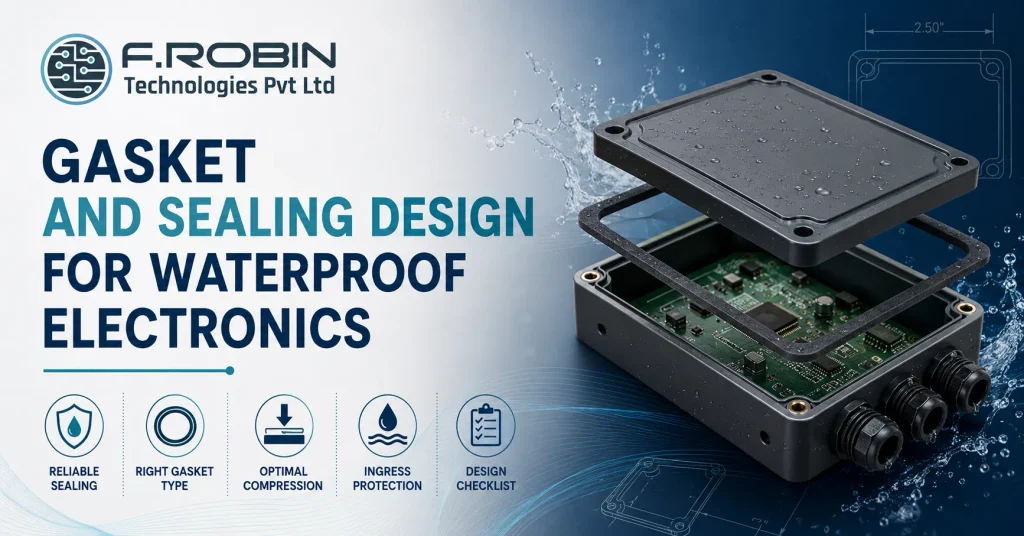
“How do I get a reliable seal?” is one of the most common questions in waterproof electronics design, and the honest answer is that reliability comes from a handful of deliberate decisions, not a single magic gasket material. Gasket and sealing design determines whether a product genuinely holds its IP rating in the field or fails quietly the first time it gets rained on. This how-to guide walks through the practical decisions behind reliable gasket and sealing design — choosing the right gasket type, designing for proper compression, planning a continuous seal path, and matching your design to the IP rating your product actually needs. Whether you are sealing a simple outdoor sensor enclosure or a fully ruggedized industrial product, these fundamentals apply, and getting them right the first time avoids expensive field failures down the line. Why Gasket and Sealing Design Is Harder Than It Looks A gasket looks simple: a strip of material between two surfaces. In practice, gasket and sealing design fails in the field far more often than it fails in the lab, because real enclosures have corners, fasteners, cable entries, and manufacturing tolerance that a simple flat-surface test never exposes. Reliable sealing requires treating the gasket as one part of a system — material, groove geometry, compression force, and the continuity of the seal path around the whole enclosure — rather than a component you simply drop in and hope works. Get any one part of that system wrong, and water finds the gap. This system-level thinking is the same discipline behind good electronic enclosure design more broadly — sealing is one part of the enclosure, not a separate afterthought bolted on at the end. Choosing the Right Gasket Type Different gasket types suit different enclosure geometries and environments. Closed-cell foam gaskets compress easily and forgive minor surface irregularities, making them a common, cost-effective choice for enclosure lids and access panels. O-rings provide excellent, consistent sealing in a compact groove, well suited to cylindrical connectors and small access ports. Silicone and rubber extrusion gaskets offer good chemical and temperature resistance for demanding environments, while liquid-dispensed gaskets — applied as a bead that cures in place — suit complex, non-uniform sealing paths where a pre-formed gasket would be difficult to fit precisely. Match the gasket type to your enclosure’s geometry and environmental demands, rather than defaulting to whatever was used on a previous, possibly quite different, product. Your material choice here also interacts with the enclosure substrate itself — see our comparison of sheet metal vs die-cast vs plastic enclosures for how the base material affects gasket groove design and sealing surface quality. Designing for Proper Compression A gasket only seals effectively within its intended compression range — typically 20-30% of its original thickness for most closed-cell foam materials, though this varies by material and manufacturer. Too little compression leaves gaps the gasket cannot bridge; too much compression can cause permanent set, where the gasket loses its ability to spring back and seal on the next opening. Gasket and sealing design must account for real manufacturing tolerance in the mating parts, not just nominal dimensions. If tolerance stack-up could push compression outside the gasket’s effective range at either extreme, the seal will fail intermittently — precisely the kind of failure that is hardest to catch in testing and most damaging once it reaches the field. Planning a Continuous Seal Path A seal is only as good as its weakest point, and that weakest point is almost always a corner, a fastener boss, or a cable entry where the gasket path changes direction or gets interrupted. Plan the seal path as a single, continuous loop around the entire enclosure opening, with generous, consistent radii at corners rather than sharp turns that a gasket cannot follow cleanly. Cable and connector entries deserve particular attention in gasket and sealing design, since they punch through what would otherwise be a clean, continuous seal path. Use dedicated cable glands or grommets rated to your target IP level, and ensure the gasket groove routes cleanly around these penetrations rather than stopping and restarting at each one. Matching Design to Your IP Rating Target Ingress protection ratings define what your gasket and sealing design actually needs to achieve the first digit rates protection against solids (dust), the second against liquids (water). A common target like IP65 means dust-tight and protected against water jets, while IP67 adds protection against temporary immersion, demanding a more robust seal design and typically tighter compression tolerances. Design to your real target, not the highest rating available. Over-specifying building an IP67 seal for a product that only needs IP54 indoor protection adds cost and assembly complexity for no operational benefit, while under-specifying risks field failures the moment the product meets real-world conditions. Gaskets Also Handle EMI/EMC Shielding Gasket and sealing design is not only about keeping water and dust out — the same gasket location often has to maintain electrical continuity across an enclosure seam to control EMI/EMC. These are two genuinely different jobs, and a gasket chosen only for environmental sealing does nothing for shielding unless it is also electrically conductive. Standard closed-cell foam or silicone gaskets seal against moisture and dust but are electrical insulators, so they leave a gap in the shielding at every seam they cover. If your product has EMI/EMC requirements, you need a conductive gasket material — conductive elastomer, knitted wire mesh, or beryllium copper fingerstock — at the seam, or a combination gasket that provides environmental sealing and EMI continuity together. Combination gaskets exist specifically for this dual requirement: a conductive core or conductive-coated foam that seals against the environment while also bridging the shielding across the seam. When both requirements apply to the same enclosure, specify the combination gasket explicitly in your gasket and sealing design rather than assuming a good environmental seal automatically delivers EMI performance — the two properties do not come from the same material property, and a gasket optimized for one alone can fail the other
Structural & Vibration Analysis (FEA) for Electronics

Electronics products face real physical forces in the field shipping shocks, vehicle vibration, thermal cycling, and simple gravity acting on a mounted board and structural and vibration analysis for electronics predicts how a design will hold up before it is ever built. Rather than discovering a cracked solder joint or a fractured bracket after a product ships, FEA lets you find and fix the weak point on screen. This explainer covers how structural and vibration analysis for electronics actually works: the main analysis types (static, dynamic, shock, and vibration), what modal, random vibration, and fatigue analysis each reveal, and how FEA tools like Ansys turn a 3D model into a reliability prediction. Whether you are validating a simple bracket or a fully populated PCB assembly, these fundamentals apply, and the earlier they are applied in the design cycle, the cheaper any resulting design change will be. Why Structural and Vibration Analysis Matters for Electronics Electronics assemblies are not static objects sitting on a shelf they get shipped, mounted in vehicles, dropped, and subjected to years of vibration in the field. Structural and vibration analysis for electronics predicts how the board, enclosure, and mounted components respond to these real-world forces, catching failure modes that are invisible in a static visual review of the design. The cost of skipping this analysis shows up later and larger: a cracked solder joint discovered after a product ships is far more expensive to fix than one caught in a simulation during design. For any electronics product facing shock, vibration, or sustained mechanical load, structural and vibration analysis is not an optional extra it is core validation. This is exactly why structural and vibration analysis for electronics has become standard practice across automotive, aerospace, telecom, and industrial product development, rather than a specialized add-on reserved for the most demanding applications alone. Static Analysis Static analysis calculates stress and deflection under steady, unchanging loads the weight of a board under gravity, a mounting bracket supporting a fixed load, or the force from a pressed connector. It answers a simple question: does the structure hold up under the loads it experiences at rest? Static analysis is usually the first and simplest type of structural and vibration analysis for electronics, establishing a baseline before moving to more complex dynamic scenarios. It identifies obvious weak points thin sections, stress concentrations at sharp corners, or under-supported spans that would fail even under constant load, let alone dynamic ones. Dynamic and Modal Analysis Modal analysis identifies a structure’s natural frequencies the frequencies at which it wants to vibrate when disturbed and their associated mode shapes. This matters enormously for electronics, because if a natural frequency coincides with a frequency the product will actually experience in service, the resulting resonance can amplify vibration dramatically and cause failure far faster than the raw input vibration would suggest. Running modal analysis early in structural and vibration analysis for electronics reveals whether a board or enclosure design risks resonance at operationally relevant frequencies, letting you adjust stiffness, mounting, or mass distribution before committing to tooling. Shock Analysis Shock analysis predicts how a structure responds to a sudden, short-duration force a drop, an impact during shipping, or an explosive event in defence applications. Unlike steady loads, shock events are brief but can produce very high peak stresses, especially at points where mass is concentrated or support is discontinuous. For electronics that will be shipped, handled, or deployed in rugged environments, shock analysis validates that solder joints, connectors, and mounting points survive the peak forces of a realistic drop or impact event, not just the average handling case. Random Vibration Analysis Random vibration analysis models a structure’s response to vibration that is not a single, predictable frequency but a broad spectrum of frequencies occurring simultaneously and randomly closely matching real-world vibration from vehicles, aircraft, or industrial equipment. This is a statistical analysis, predicting the probable range of stress and displacement rather than a single deterministic value. For electronics destined for automotive, aerospace, or industrial environments, random vibration analysis is often the single most important structural and vibration analysis for electronics performed, since it most closely represents the actual operating environment rather than a simplified, idealized load case. Fatigue Analysis Fatigue analysis predicts how a structure degrades under repeated cyclic loading over time, even when each individual cycle produces stress well below the material’s immediate failure point. Repeated vibration, thermal cycling, or mechanical flexing can eventually crack a solder joint or fracture a bracket purely from accumulated cyclic damage. This matters for electronics with a long service life or a demanding vibration environment, where the relevant question is not “will it survive one shock event” but “will it survive ten years of continuous vibration.” Fatigue analysis, often combined with random vibration results, estimates the expected service life under realistic, repeated loading completing the full picture that structural and vibration analysis for electronics is meant to provide. How Ansys Fits Into the Process Ansys is one of the most widely used professional FEA platforms for structural and vibration analysis for electronics, supporting all the analysis types above static structural, modal, harmonic, random vibration, and fatigue within an integrated workflow. A typical process imports the 3D model (including the PCB and key components), applies material properties and boundary conditions, meshes the geometry, then runs the appropriate solver for the analysis type needed. The quality of the result depends heavily on modeling discipline: accurate material properties, a converged mesh, and boundary conditions that genuinely represent how the assembly is mounted and loaded in the field. A skilled analyst validates results against hand calculations or physical test data rather than trusting the first output uncritically. A Real-World Example Picture a controller board destined for a vehicle-mounted enclosure. Static analysis confirms the board and its mounting bracket support their own weight without excessive deflection a reasonable first check, but not remotely sufficient for this application. Modal analysis then reveals a natural frequency uncomfortably close to the vehicle’s typical engine vibration range, flagging a
