
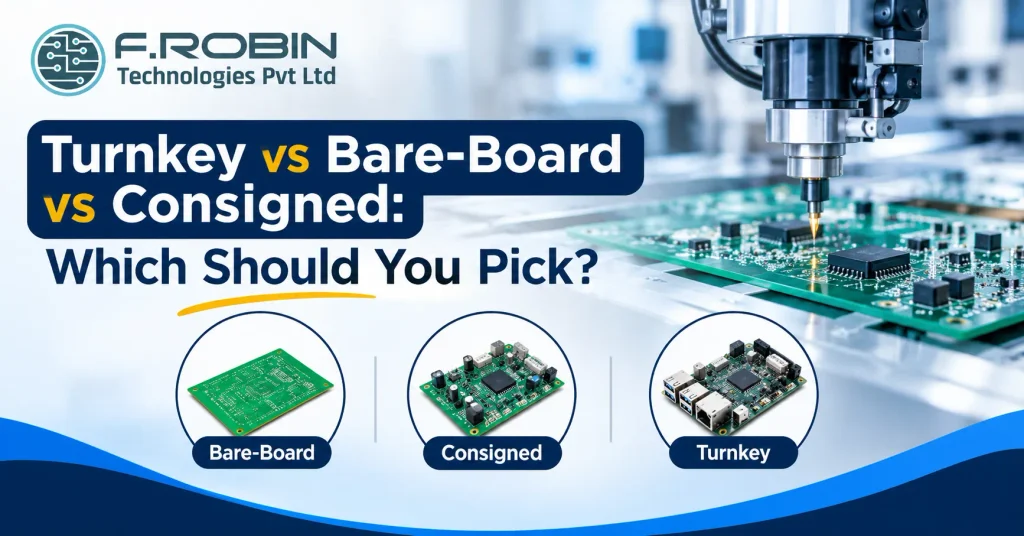
Should the fab buy my parts too? It depends on your bill of materials, your schedule, and how much sourcing work your team can carry. In the turnkey vs bare-board vs consigned choice, bare-board gives you the most control, consigned lets you own the parts while someone else builds, and turnkey hands the whole job to one vendor. This guide compares all three side by side, shows who carries which risk, and gives you a six-step way to choose.
It is written for hardware leads, founders, and procurement managers in Chennai and across Tamil Nadu who are about to order boards. A note on transparency: F.Robin Technologies publishes this guide and offers PCB manufacturing. We state no prices, lead times, or savings figures, and we suggest you hold every vendor, including us, to the same questions.
Key Takeaways
- The turnkey vs bare-board vs consigned decision is mostly about who owns parts risk and who does the sourcing work.
- Bare-board gives control, consigned gives part ownership, and turnkey gives convenience.
- Terms vary between vendors, so confirm exactly what each quote includes.
- A hybrid, where you supply critical parts and the vendor buys the rest, suits many teams.
What Do Bare-Board, Consigned, and Turnkey Mean?
Vendors use these terms slightly differently, so treat the definitions below as a working guide and confirm them in writing.
- Bare-board: the fabricator delivers unpopulated boards. You, or another vendor, buy the parts and handle assembly.
- Consigned: you buy the components and send a kit to the assembler, who builds the boards.
- Turnkey: one vendor buys the boards and parts, assembles, tests, and ships finished units.
- Partial turnkey: the vendor buys some parts, while you supply the rest.
Turnkey vs Bare-Board vs Consigned: Side-by-Side Comparison
Use this table to compare turnkey vs bare-board vs consigned on the factors that usually decide the question.
| Factor | Bare-board | Consigned | Turnkey |
| Who buys the parts | You | You | The vendor |
| Who assembles | You or a separate vendor | The assembler | The vendor |
| Control over sources | Full | Full | Limited to what you approve |
| Shortage risk | Yours | Yours, and it delays the kit | The vendor works it, but delays still hit your schedule |
| Price visibility | High, line by line | High, line by line | Lower unless you ask for a breakdown |
| Your management effort | High | Medium to high | Low |
| Number of vendors | Several | Two or more | One |
| Best for | Teams with strong sourcing and in-house assembly | Teams that want part control but outsourced assembly | Small teams and prototypes that value speed |
Who Carries Which Risk in Turnkey vs Bare-Board vs Consigned?
Risk is the real difference in turnkey vs bare-board vs consigned. Before you decide, map each risk to an owner:
- Part shortages and long lead times: with bare-board and consigned, you carry them. With turnkey, the vendor carries the chase.
- Wrong or substitute parts: you control this in bare-board and consigned, while turnkey needs your approval step.
- Counterfeit or untraceable parts: this depends on whoever buys, so ask for source and traceability details.
- Surplus stock and minimum order quantities: they land on you in bare-board and consigned, and on the pricing in turnkey.
- Assembly faults: with consigned and turnkey, the assembler owns workmanship, but disputes over parts versus process can arise.
Our guide on how to handle a PCB manufacturing defect or dispute explains how to separate those causes.
When Bare-Board Wins in the Turnkey vs Bare-Board vs Consigned Choice
- Your team already buys parts well and wants full control.
- You assemble in-house, for example for low-volume or special builds.
- You need the cheapest, fastest board for a quick electrical test.
- Your parts are unusual or regulated, and you must pick every source.
In these cases, a fab-only order keeps things simple, and you manage the rest yourself.
When Consigned Wins the Turnkey vs Bare-Board vs Consigned Choice
- You hold stock already, or you get better part prices than a vendor would offer.
- You need control over sources but not over assembly.
- Your BOM has a few long-lead or critical parts that you want to secure early.
- Your team can deliver complete kits on time.
However, consigned only works when kits arrive complete. A single missing part can hold the whole build.
When Turnkey Wins the Turnkey vs Bare-Board vs Consigned Choice
- Your BOM is long, so chasing many suppliers would drain your team.
- Your schedule is tight, and you need someone to work shortages daily.
- You build prototypes, where small quantities make direct buying awkward.
- Your team is small and has no dedicated buyer.
Even so, ask for a cost breakdown and an approved-source list, because convenience should not hide the price of parts.
Hybrid Options Between Turnkey vs Bare-Board vs Consigned
The choice does not have to be all or nothing. Many teams mix the models:
- You supply long-lead or critical parts, and the vendor buys common parts.
- You order bare boards from one vendor and let another vendor buy parts and assemble.
- You start turnkey for prototypes, then move to consigned for volume once you negotiate part prices.
Our comparison of consigned versus turnkey procurement covers the cost angle, and our article on component procurement, DIY or sourcing partner covers who should own the buying work.
How to Choose Between Turnkey, Bare-Board, and Consigned in Six Steps
Follow this process to settle turnkey vs bare-board vs consigned with evidence:
- Review your bill of materials. Count the lines, and flag long-lead, single-source, and end-of-life parts.
- Rate your risk. Consider the cost of a delay, a counterfeit part, or a wrong substitute.
- Check your capacity. Be honest about how many hours your team can spend on buying and kitting.
- Compare total cost. Include staff time, shipping, shortages, surplus parts, and rework, not only part prices.
- Ask vendors for quotes in each model. Request the same files and a breakdown of parts, boards, and assembly.
- Pilot and review. Run a small build, then keep, change, or mix the model after you see the results.
Questions to Ask Before You Pick a Model
- Exactly what does your quote include: boards, parts, assembly, test, and shipping?
- Which sources do you buy from, and can I approve or restrict them?
- How do you handle shortages, and who approves substitutes?
- What happens to leftover parts and minimum order quantities?
- How do you check incoming parts and store moisture-sensitive ones?
- Can I see part prices separately from assembly charges?
Hidden Costs to Watch in Every Model
- Staff time spent on quotes, purchase orders, and follow-ups.
- Shipping, duties, and handling across several suppliers.
- Surplus stock from minimum order quantities.
- Delays and respins when a part or a file is wrong.
- Mark-ups on parts in bundled turnkey pricing.
Therefore, compare the total cost of each option, not the quoted board or assembly price alone.
Chennai and Tamil Nadu Considerations
For turnkey vs bare-board vs consigned work, a local partner in Chennai makes kitting, shortage reviews, and first-article checks easier, because you can visit and settle questions in person. Our guide to PCB assembly services in Chennai lists the questions to ask local assemblers, and our comparison of local versus overseas printed circuit board manufacturers covers distance and lead-time trade-offs.
Even so, process discipline matters more than location in turnkey vs bare-board vs consigned, so judge sourcing and inspection practice first.
Red Flags in a Quote or Vendor Reply
- The quote does not say what it includes.
- The vendor refuses to share part sources or prices.
- Substitutes appear without your approval.
- No incoming inspection or traceability exists for parts.
- Terms for leftover parts stay vague.
Before you commit volume, run a first-article lot, as our guide on how to qualify a new PCB vendor explains.
A Hypothetical Example
For example, imagine a small team building a prototype with a long BOM. It picks consigned to save money, but a single connector arrives late, and the assembler cannot start. The build slips while the team waits.
In contrast, a team that compares turnkey vs bare-board vs consigned before ordering might choose partial turnkey, buying the critical parts itself and letting the vendor source the rest. The outcome depends on the vendor, so treat this as an illustration, not a promise.
How F.Robin Technologies Supports Your Build
F.Robin Technologies offers PCB manufacturing and PCB layout design with DFM and DFA review, which helps catch footprint and assembly issues before parts arrive. Our complete guide to PCB manufacturing explains the process from files to finished boards. For sourcing and assembly scope on your project, confirm details with our team, and compare us with any vendor on the same questions.
If you are also weighing how many vendors to use, read whether a single vendor for design, fab and assembly is worth it.
