
EMI/EMC Compliance Starts in the Enclosure
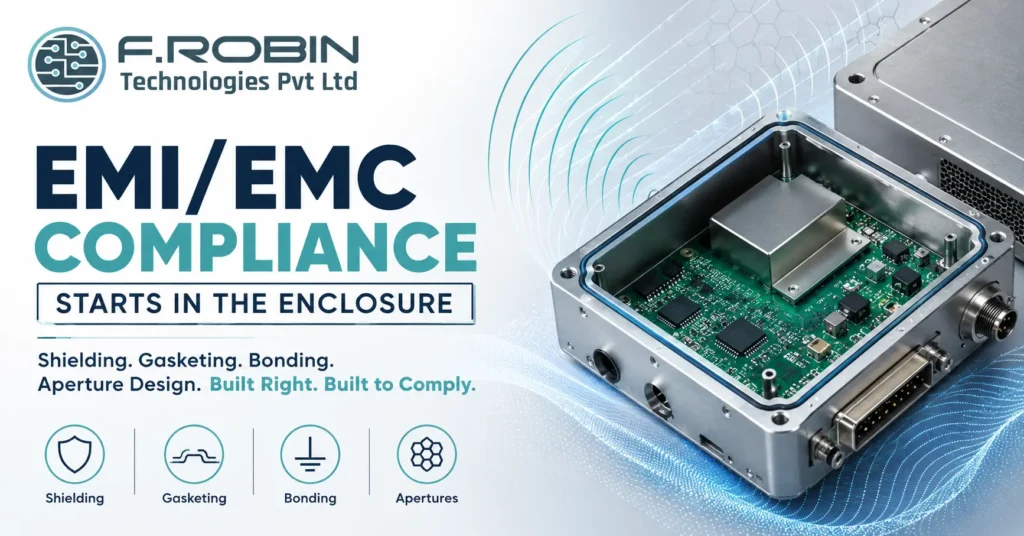
EMI/EMC compliance is too often treated as a test-lab problem something to fix after the board is built and the enclosure is finished. In reality, EMI/EMC compliance starts in the enclosure, long before any product reaches a test chamber. Shielding, gasketing, bonding, and aperture design decide whether your product passes or fails, and retrofitting them after the fact is slow, expensive, and often only partly effective. This guide explains how enclosure design drives EMI/EMC compliance. We cover the mechanical fundamentals shielding, gasketing, bonding, and apertures the standards you need to know, and the best practices that turn compliance from a last-minute scramble into a built-in feature of ruggedized, standards-compliant design. Why EMI/EMC Compliance Starts in the Enclosure Electromagnetic interference does not respect the boundary between board and box. Signals radiate from the PCB, and the enclosure either contains them or lets them escape. That is why EMI/EMC compliance starts in the enclosure: it is the last physical barrier between your electronics and the outside world, and its design decides how much energy gets through. Fixing EMI/EMC problems after a failed test is far harder than designing them out. Adding shielding or gaskets to a finished enclosure often means costly tooling changes, and some fixes simply do not work once the mechanical design is frozen. Building compliance in from the start — through shielding, gasketing, bonding, and careful apertures — is dramatically cheaper and more reliable than debugging it afterward. This is also why EMI/EMC compliance belongs firmly within mechanical enclosure design, not as an afterthought bolted on once the shape is set. Shielding Shielding blocks electromagnetic energy from entering or leaving the enclosure. It is the primary defence in EMI/EMC compliance and the first thing to plan for. Common shielding approaches include: The goal is a continuous conductive boundary with no significant gaps. Every seam, vent, or opening is a potential leak, so shielding effectiveness depends as much on the details seams, joints, and closures as on the base material itself. Gasketing Where two enclosure panels meet, a plain metal-to-metal joint rarely provides consistent contact across its length. Gasketing closes those gaps with a conductive material that maintains electrical continuity along the seam. Common EMI gasket types include: Choosing the right gasket depends on the frequency range, the compression available, environmental sealing needs, and how often the joint will be opened. Gasketing works hand in hand with bonding a gasket without a solid, low-impedance path to ground is far less effective. Bonding and Grounding Bonding creates a low-impedance electrical connection between enclosure parts, ensuring stray currents have a clear path rather than radiating as interference. Poor bonding is one of the most common causes of EMI/EMC compliance failures, because even a well-shielded enclosure leaks if its panels are not properly bonded together. Good bonding practice includes: Because bonding is easy to overlook in a purely mechanical review, it deserves explicit attention during design not just at final assembly. A gap in the bonding path can undo an otherwise well-shielded enclosure. Apertures and Openings Every enclosure needs openings for connectors, displays, vents, and buttons and each one is a potential leak in your EMI/EMC compliance. The size and shape of an aperture, relative to the wavelength of the interference, determines how much energy escapes. Key aperture design principles: Apertures are often the last thing considered and the first thing that causes a compliance failure. Planning them early as part of PCB mechanical integration — avoids surprises late in the project. Standards You Need to Know EMI/EMC compliance is governed by recognized standards, and knowing which apply to your product early shapes your enclosure decisions. Common standards include: Identifying the relevant standard early lets you design the enclosure to the right margin from day one, rather than guessing and hoping. For ruggedized, standards-compliant design, this step is not optional — it defines the whole shielding and gasketing strategy. A Compliance-by-Design Checklist Use this checklist during enclosure design to build in EMI/EMC compliance from the start: Ticking every box before tooling dramatically improves your odds of passing formal testing the first time. Common Mistakes to Avoid Even experienced teams get caught out. Watch for these: Avoiding these keeps your EMI/EMC compliance predictable instead of a last-minute scramble. Key Takeaways Conclusion EMI/EMC compliance starts in the enclosure, not the test lab. Shielding, gasketing, bonding, and thoughtfully designed apertures determine whether a product passes on the first try or bounces back from certification. Identify your target standard early, build compliance into the mechanical design from day one, and you turn a stressful last-minute scramble into a predictable, built-in outcome. Need a Rugged, EMI/EMC-Compliant Product Design? Designing a ruggedized, standards-compliant product? Our Mechanical Engineering Services integrate EMI/EMC compliance into enclosure design from concept through production. We help you develop reliable, manufacturing-ready products that meet demanding industry standards. Explore Mechanical Engineering Services Talk to Our Engineering Team Frequently Asked Questions Why does EMI/EMC compliance start in the enclosure? + The enclosure is the last physical barrier between your electronics and the outside world. Its shielding, gasketing, bonding, and aperture design determine how much electromagnetic energy escapes or enters, making mechanical design a critical part of EMI/EMC compliance long before laboratory testing begins. What is shielding in EMI/EMC compliance? + Shielding creates a continuous conductive barrier using enclosure materials, conductive coatings, or internal shields to prevent electromagnetic energy from entering or leaving the product. What is gasketing used for in EMC design? + Conductive gaskets seal enclosure joints and seams while maintaining electrical continuity. This minimizes EMI leakage through gaps where simple metal-to-metal contact may not provide reliable conductivity. What is bonding in enclosure design? + Bonding provides a low-impedance electrical connection between enclosure panels, connectors, and grounding points, allowing unwanted currents to flow safely to ground instead of radiating as electromagnetic interference. Why do apertures matter for EMI/EMC compliance? + Every opening for connectors, ventilation, displays, or cables can become a source of electromagnetic leakage. Keeping apertures small, properly positioned, grouped, or filtered helps reduce emissions
