
Electronics Enclosure Design in India: A Complete Guide to Housing Your PCB Safely
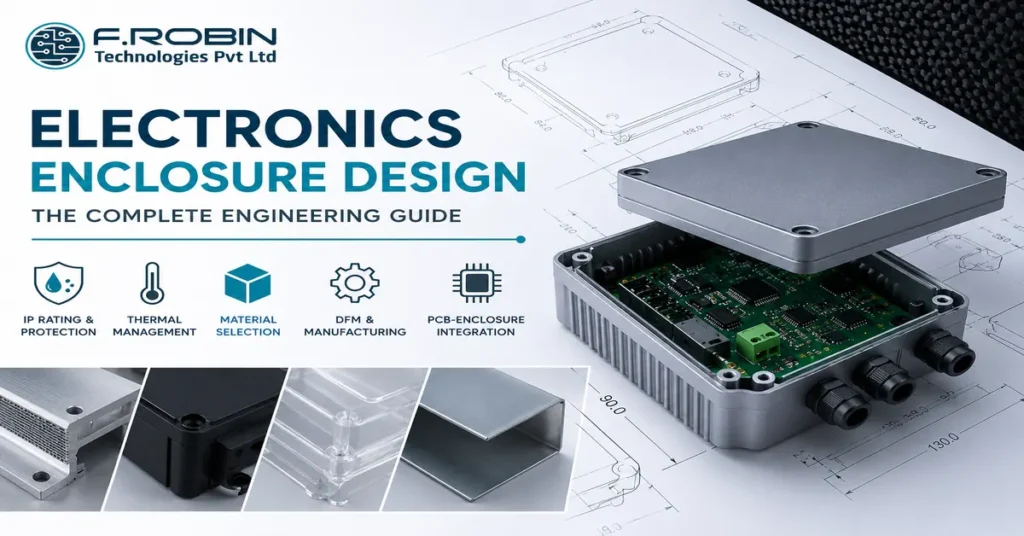
Electronics enclosure design in India is one of the most underestimated stages of hardware product development. Most engineering teams spend weeks optimising their PCB layout, then allocate a few days to the enclosure only to discover during production that the housing cracks under stress, traps heat around critical components, or fails its IP rating test because a cable gland was placed incorrectly. The enclosure is not packaging. It is an engineering system in its own right one that must manage heat, withstand mechanical stress, meet environmental protection ratings, comply with regulatory standards, accommodate manufacturing tolerances, and still look and feel like a finished product. Getting it wrong costs time, tooling money, and in some applications, product safety. This guide covers everything you need to know about electronics enclosure design material selection, IP ratings, thermal management, DFM rules, and how the enclosure and PCB design must work together from the earliest stages of development. 1. What Is Electronics Enclosure Design? Electronics enclosure design is the mechanical engineering discipline of designing the housing that protects and contains a printed circuit board and its associated components connectors, displays, switches, antennas, batteries, and wiring harnesses in a finished, deployable product. A well-designed enclosure serves several simultaneous functions. First, it provides mechanical protection shielding the PCB from physical impact, vibration, and handling damage. Additionally, it provides environmental protection sealing against dust, moisture, humidity, and chemical exposure. Furthermore, it manages thermal performance providing pathways for heat generated by components to dissipate safely. Finally, it ensures regulatory compliance meeting EMI/EMC shielding requirements, UL flammability ratings, and CE marking requirements for the target market. Why enclosure design must start alongside PCB layout The most expensive mistake in product development is treating enclosure design as an afterthought. Consequently, when the enclosure design begins after the PCB is finalised, the mechanical engineer is forced to design around a fixed board rather than co-designing the two together. This leads to: At F.Robin Technologies, PCB layout and mechanical enclosure design are integrated processes. Our engineering team co-designs the board and its housing simultaneously, which reduces respins and significantly shortens time to production. Learn more about our PCB design and layout services at frobintech.com/pcb-layout-design. 2. Enclosure Material Selection The choice of enclosure material is one of the most consequential decisions in the mechanical design process. Each material has specific trade-offs in mechanical strength, weight, thermal performance, cost, and manufacturability. Choosing the Right Material Aluminium (die-cast or machined) Aluminium is the preferred enclosure material for industrial, automotive, and outdoor electronics where thermal management, EMI shielding, and mechanical robustness are primary requirements. Die-cast aluminium is cost-effective at medium to high volumes, provides excellent heat dissipation (thermal conductivity 160–205 W/m·K), and offers natural EMI attenuation. Machined aluminium is used for low-volume, high-precision enclosures instrument housings, test equipment, and aerospace electronics where dimensional accuracy and surface finish are critical. However, machined aluminium is significantly more expensive per unit than die-cast at volume. ABS plastic (injection moulded) ABS (Acrylonitrile Butadiene Styrene) is the most common plastic enclosure material for consumer electronics, IoT devices, and indoor industrial products. It is lightweight, cost-effective at high volumes, easily coloured and textured, and straightforward to injection-mould with good dimensional consistency. ABS is not suitable for outdoor applications without UV-stabilised additives or protective coatings, and it provides minimal inherent EMI shielding (unlike metal). For applications requiring EMI shielding in a plastic enclosure, internal conductive coatings or gaskets are required. Polycarbonate (PC) Polycarbonate offers higher impact resistance than ABS, better optical clarity (relevant where display windows or light pipes are required), and superior heat resistance. It is commonly used in enclosures for outdoor lighting, medical devices, and safety equipment. PC is more expensive than ABS and can be more challenging to mould without warping in thick sections. PC/ABS blends PC/ABS blends combine the impact resistance of polycarbonate with the processability and lower cost of ABS. They are widely used in handheld devices, ruggedised consumer electronics, and industrial handhelds where both aesthetics and durability matter. Sheet metal (steel or aluminium) Sheet metal enclosures bent and welded from steel or aluminium sheet are cost-effective for low-to-medium volumes and allow rapid design iteration without expensive tooling. Standard sheet metal enclosures are widely available off-the-shelf for DIN rail mounting and 19-inch rack mounting. Custom sheet metal enclosures require only laser cutting and bending fixtures, not injection moulding tools, making them faster and cheaper to prototype. Material comparison table Material Thermal Conductivity EMI Shielding IP Achievable Relative Cost (High Volume) Best For Die-cast Aluminium Excellent Excellent IP67+ Medium Industrial, automotive, outdoor applications Machined Aluminium Excellent Excellent IP67+ High Low-volume, precision instruments ABS Plastic Poor Poor (unless coated) IP65 with gasket Low Consumer electronics, indoor IoT devices Polycarbonate Poor Poor (unless coated) IP67 with gasket Low–Medium Outdoor equipment, medical devices, lighting Sheet Metal (Steel) Good Good IP54 typical Low–Medium Industrial panels, 19-inch rack enclosures 3. IP Ratings Explained Choosing the Right Protection Level IP (Ingress Protection) rating is defined by IEC 60529 and specifies the degree of protection an enclosure provides against solid particles and liquids. Understanding IP ratings is essential before finalising the enclosure design, because the target IP rating directly drives gasket selection, cable gland specification, parting line placement, and surface finish requirements. How IP ratings work An IP rating consists of two digits. The first digit (0–6) specifies protection against solid particles from no protection (0) to complete dust-tight protection (6). The second digit (0–9K) specifies protection against liquids from no protection (0) to high-pressure, high-temperature water jets (9K). Common IP ratings and their applications IP54 — Dust protected, splash proof Protection against limited dust ingress and water splashing from any direction. Suitable for indoor industrial environments motor drives, PLC enclosures, factory automation. The most commonly achieved rating for sheet metal and plastic enclosures without specialist gaskets. IP65 — Dust tight, low-pressure water jet Complete dust protection and resistance to low-pressure water jets from any direction. Required for outdoor equipment not directly exposed to rain outdoor lighting, roadside infrastructure, solar inverters. Requires a continuous perimeter gasket
