
Multilayer PCB Design Best Practices: 10 Expert Tips (2026)
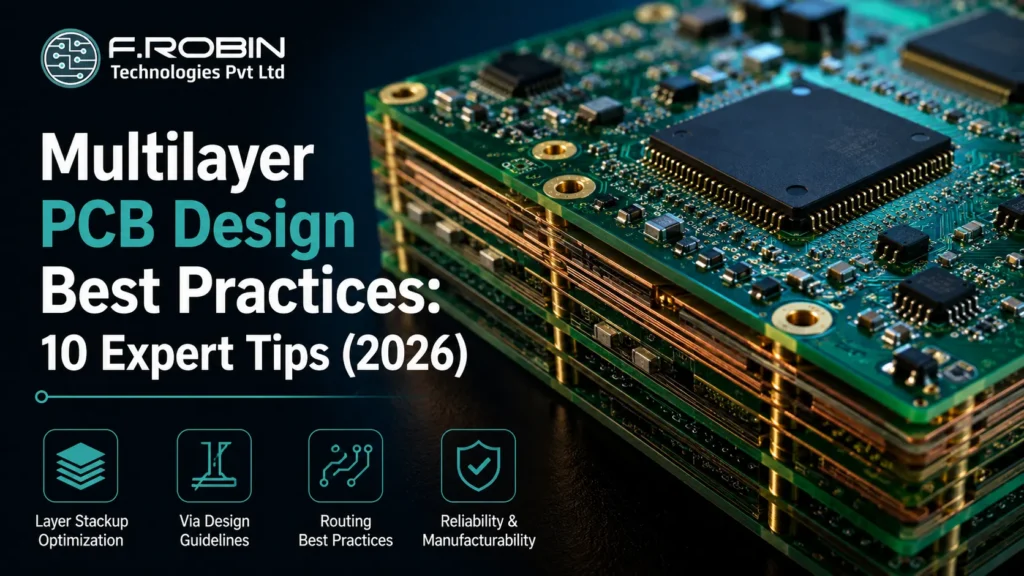
Multilayer PCB design best practices are what separate boards that pass EMC testing and work reliably in the field from those that don’t. As signals run faster, components shrink smaller, and certification requirements grow stricter, getting the fundamentals right before layout begins has never been more critical. This guide walks you through 10 proven best practices — from stackup planning and impedance control to thermal management and DFM so your multilayer design gets it right before a single Gerber file is sent to fabrication. What Is Multilayer PCB Design? Multilayer PCB design is the process of creating printed circuit boards with three or more copper layers separated by dielectric (insulating) materials, laminated under heat and pressure into a single rigid structure. Each layer serves a dedicated purpose signal routing, power distribution, or ground reference — enabling engineers to pack far more functionality into a smaller board footprint than single- or double-layer designs allow. Multilayer PCBs are the foundation of virtually every high-performance electronic product today: smartphones, industrial controllers, medical imaging equipment, 5G base stations, automotive ECUs, and aerospace avionics all rely on them. Quick Definition Multilayer PCB design involves boards with 3 or more copper layers — common counts are 4, 6, 8, 10, 12, and 16+ — that provide dedicated planes for power delivery, signal return paths, controlled impedance routing, and higher component density for complex electronic designs. When Does a Design Need More Than Two Layers? Not every board needs to be multilayer. However, your design almost certainly does if it includes any of the following: If any of these apply, the question is no longer whether to go multilayer it’s how many layers and how to structure them. That’s exactly what the following best practices cover. Best Practice 1 — Plan Your Layer Stackup First The stackup is the architectural blueprint of your multilayer PCB. It defines the number of layers, their sequence, the dielectric material between them, and the copper thickness on each layer. Plan your stackup before routing a single trace. Every impedance calculation, every signal layer assignment, and every power plane decision flows from it. Changing the stackup mid-layout invalidates every impedance-controlled trace and forces expensive re-routing. Key Stackup Principles Standard Stackup Reference Layer Count Typical Arrangement Best For 4-layer Signal / GND / PWR / Signal Medium-density microcontrollers, IoT, industrial 6-layer Signal / GND / Signal / Signal / PWR / Signal RF segregation, additional routing space 8-layer Signal / GND / Signal / GND / PWR / Signal / GND / Signal DDR, PCIe, multi-power-rail SoC designs 12+ layer Complex alternating signal/plane Advanced FPGA, telecom, aerospace Best Practice 2 — Choose the Right Layer Count More layers are not always better. Each additional layer adds fabrication cost, increases board thickness, and complicates via drilling and lamination. Too few layers, however, force routing compromises that degrade performance and EMC behaviour. Best Practice 3 — Master Signal Integrity and Impedance Control Signal integrity (SI) is the discipline of ensuring signals propagate accurately without distortion, ringing, or reflections. In multilayer PCB design, SI is controlled primarily through impedance management. What Is Controlled Impedance? Controlled impedance means designing trace geometry width and thickness — alongside dielectric thickness so that the characteristic impedance of a trace matches the system impedance. Typical targets: How to Achieve Controlled Impedance Best Practice 4 — Use Solid Ground Planes and Manage Return Paths The ground plane is not just a reference potential it is an active participant in signal transmission. Return current travels in the ground plane directly beneath a signal trace, following the path of least inductance, not least resistance. Ground Plane Best Practices Per the IPC- 2221 generic requirement of the design, maintaining continuous ground reference planes is a fundamental requirement for reliable high-speed multilayer PCB designs. Best Practice 5 — Route High-Speed Signals on Inner Layers Inner signal layers use a stripline geometry — the trace is sandwiched between two reference planes, which confine the electric field to the dielectric and provide natural EMI shielding on both sides. When to Use Inner vs. Outer Layers Signal Type Recommended Layer Reason Clock, DDR, PCIe, high-speed bus Inner (stripline) Shielded between reference planes; lower EMI Low-speed I/O, LED control, power signals Outer (microstrip) Easy access; EMI not critical RF / antenna traces Outer with controlled reference distance Specific impedance and radiation requirements Differential pairs (USB, HDMI, Ethernet) Inner preferred, outer acceptable Keep pairs on same layer; minimise layer changes Keep differential pairs on the same layer throughout their entire route. Every layer change via is an impedance discontinuity. If a layer change is unavoidable, use matched-length via stubs and place the transition well away from connectors and receivers. Best Practice 6 — Control Crosstalk With Layer Routing Direction Crosstalk is unwanted signal coupling between adjacent traces. In multilayer PCBs, the risk is highest between parallel traces on adjacent signal layers. The Perpendicular Routing Rule Route adjacent signal layers perpendicular to each other: This perpendicular relationship minimises the length over which traces on adjacent layers run parallel, dramatically reducing both capacitive and inductive coupling between them. Additional Crosstalk Reduction Techniques Best Practice 7 — Choose and Place Vias Strategically Vias are the vertical interconnects between layers. Via selection and placement directly affect routing density, signal quality, and manufacturing cost. Via Types in Multilayer PCBs Via Type Description Best Use Through-hole via Drilled through all layers Standard inter-layer connections; lowest cost Blind via Connects outer layer to one or more inner layers only BGA escape routing; saves routing space on unused layers Buried via Connects two inner layers only; not visible from outside Ultra-high-density designs; higher fabrication cost Microvia (laser-drilled) ≤0.15 mm diameter; HDI boards only Fine-pitch BGA (0.5 mm pitch and below) Engineering Insight Through-hole vias are the most economical option for standard multilayer PCBs, while blind, buried, and microvias are commonly used in HDI (High-Density Interconnect) designs to improve routing density and signal integrity for fine-pitch components. Via Placement Best Practices Best Practice 8 — Manage Thermal Distribution Across
EMI and EMC Explained for PCB & Electronics Design
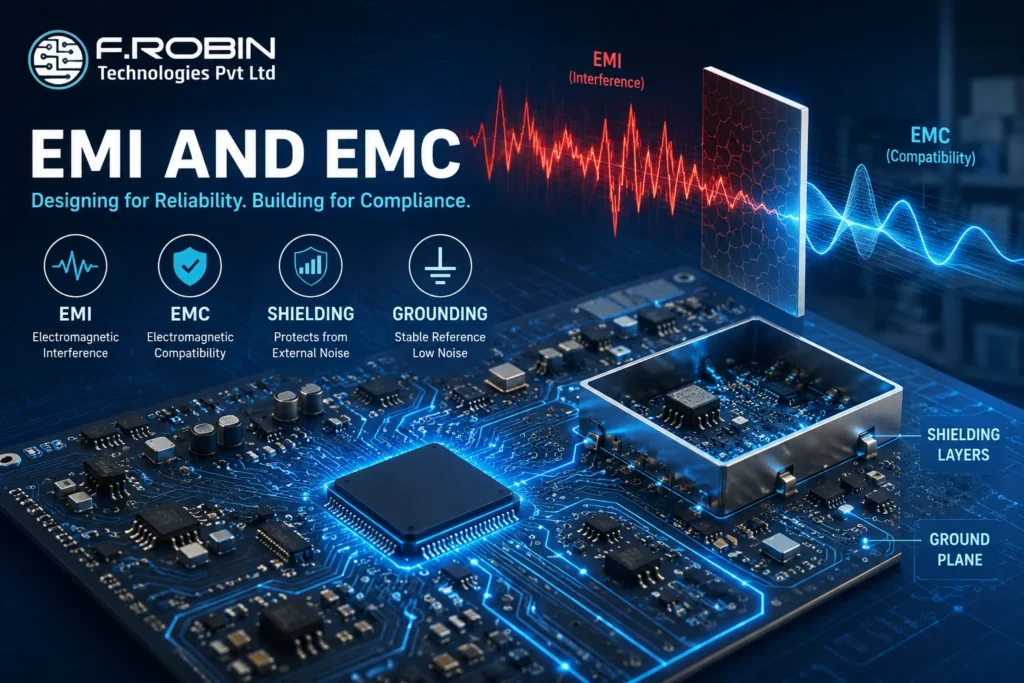
EMI and EMC are critical concepts in modern electronics, PCB engineering, and embedded system design. Electronic devices today operate in highly connected and signal-dense environments. From smartphones and industrial automation systems to automotive ECUs and medical electronics, every electronic product must function reliably without creating or receiving unwanted electromagnetic disturbances. This is where EMI and EMC become essential in electronics and PCB engineering. Electromagnetic interference (EMI) can disrupt signals, reduce device performance, and even cause system failures. Electromagnetic compatibility (EMC), on the other hand, ensures that electronic systems operate correctly without interfering with nearby devices. Understanding EMI and EMC is essential for PCB designers, embedded engineers, electronics manufacturers, and product development teams aiming to build reliable and standards-compliant products. In this guide, we will explain: What Is EMI? Electromagnetic Interference (EMI) refers to unwanted electromagnetic noise or signals that disrupt the normal operation of electronic devices. EMI can originate from: EMI affects signal integrity and may lead to: Common Examples of EMI What Is EMC? Electromagnetic Compatibility (EMC) is the ability of an electronic device to operate correctly in its electromagnetic environment without causing or experiencing interference. An EMC-compliant product: EMC is critical for: Difference Between EMI and EMC EMI vs EMC Comparison Table Parameter EMI EMC Full Form Electromagnetic Interference Electromagnetic Compatibility Meaning Unwanted electromagnetic noise Ability to function without interference Focus Problem source System immunity and compliance Impact Causes signal disruption Prevents malfunction Goal Reduce interference Ensure reliable operation Common Solution Shielding and filtering Compliance-focused PCB design Simple Explanation EMI is the interference itself, while EMC is the ability of a system to handle or avoid that interference. Types of EMI in Electronics 1. Conducted EMI Conducted EMI travels through electrical conductors such as: Sources 2. Radiated EMI Radiated EMI spreads through electromagnetic waves in the air. Sources Why EMI and EMC Matter in PCB Design EMI in PCB Design Poor PCB layout is one of the leading causes of electromagnetic interference. Common PCB EMI Problems PCB Design Areas That Affect EMC High-speed PCB designs require strong EMC considerations to avoid compliance failures. Best PCB Design Practices for EMC 1. Use Proper Ground Planes Continuous ground planes reduce return path impedance and lower EMI emissions. 2. Minimize Loop Areas Smaller current loops reduce electromagnetic radiation. 3. Separate Analog and Digital Signals This prevents noise coupling between sensitive circuits. 4. Add Decoupling Capacitors Decoupling capacitors stabilize power integrity and reduce switching noise. 5. Optimize Layer Stack-Up A proper multilayer PCB structure improves EMC performance significantly. For advanced PCB layout optimization, explore the professional PCB design solutions offered by Frobintech PCB Layout Design Services . EMI and EMC Testing Explained What Is EMI and EMC Testing? EMI and EMC testing verifies whether an electronic product: Main EMC Tests Test Type Purpose Radiated Emissions Measures electromagnetic radiation Conducted Emissions Measures noise through conductors ESD Testing Evaluates electrostatic discharge immunity Surge Testing Checks power surge resistance RF Immunity Testing Measures resistance to RF interference Why EMC Testing Is Important EMC testing helps manufacturers prevent product failures, meet certification requirements, improve product reliability, reduce field issues, and achieve faster market approval. EMC Compliance and Industry Standards Products must satisfy regulatory electromagnetic standards before entering the market. Proper EMC compliance helps ensure reliable device operation, reduces interference risks, and supports global certification requirements. Important EMC Standards Products failing EMC compliance may: EMI Shielding Techniques EMI shielding reduces electromagnetic noise using conductive or magnetic materials. Common EMI Shielding Methods Metal Shielding Uses aluminum or copper enclosures to block electromagnetic waves. Shielded Cables Protect signal integrity in noisy environments. Ferrite Beads Suppress high-frequency noise in circuits. Ground Shielding Improves electromagnetic containment in PCB layouts. EMI Filters Reduce conducted interference in power lines. Best Practices to Reduce EMI and Improve EMC Practical EMC Design Guidelines Use Shorter Signal Traces Shorter traces reduce antenna effects and radiation. Maintain Proper Grounding Good grounding lowers noise coupling. Avoid Sharp Trace Angles Use 45-degree bends to improve signal flow. Use Differential Pair Routing Improves noise immunity in high-speed circuits. Apply EMI Shielding Shield sensitive areas from RF interference. Perform Pre-Compliance Testing Early testing helps identify EMC problems before production. Key Takeaways Conclusion As electronic systems become faster and more compact, understanding EMI and EMC is increasingly important for engineers and manufacturers. From PCB design and embedded systems to industrial automation and consumer electronics, electromagnetic compatibility directly affects product reliability, compliance, and performance. By implementing proper grounding, shielding, filtering, and PCB layout techniques, companies can reduce electromagnetic interference and improve EMC compliance effectively. Organizations developing advanced electronic products should prioritize EMI and EMC considerations early in the design cycle to avoid costly redesigns and certification failures. Need Expert PCB Layout Support? Need expert support for EMC-friendly PCB layouts and high-speed electronics design? Explore professional PCB design solutions from Frobintech PCB Layout Design Services For project discussions and engineering consultation, contact the team here: Contact Frobintech FAQ
