
Why Signal Integrity Analysis Is Critical in High-Speed PCB Design
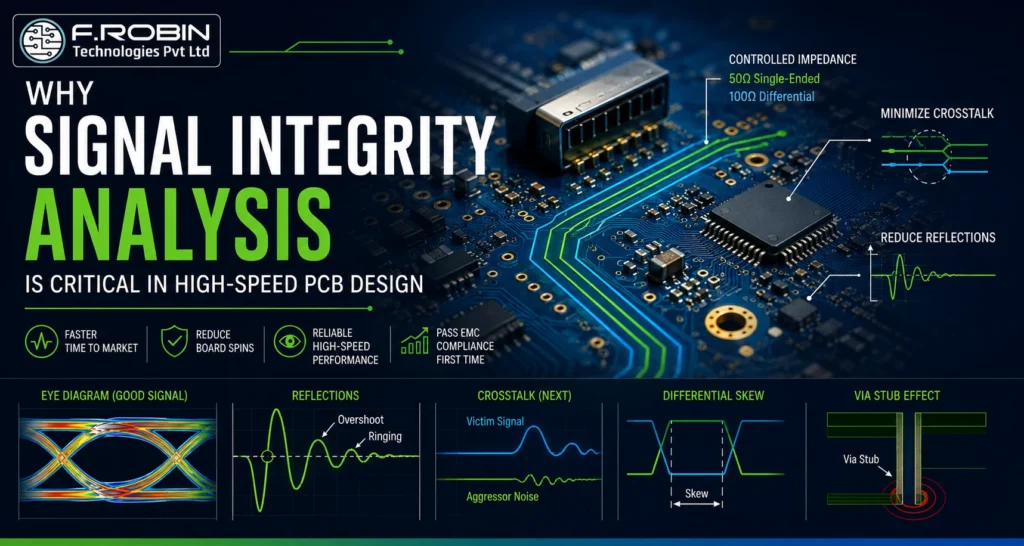
Signal integrity analysis is the difference between hardware that works on the first spin and hardware stuck in a six-week debug loop. As data rates push into multi-gigabit territory, every trace, via, and connector on your PCB becomes a potential failure point — and the physics will not wait for you to find it on the bench. Whether you are designing DDR5 memory interfaces, PCIe Gen 4/5 links, USB 3.x, or high-speed LVDS connections, signal integrity in PCB design is not an optional step. It is the engineering discipline that determines whether your board ships on schedule or gets pulled back for a costly respin. What Is Signal Integrity Analysis? Signal integrity (SI) analysis is the process of evaluating how electrical signals behave as they travel through PCB interconnects — traces, vias, connectors, and IC packages. The goal is straightforward: ensure that signals arrive at their destination accurately, without distortion, timing errors, or noise corruption. At its core, PCB signal integrity analysis examines three domains: Here is the physics reality that makes this non-optional: any PCB trace longer than roughly one-sixth of the signal’s wavelength behaves as a transmission line, not a simple wire. At 1 GHz, a quarter-wavelength in FR-4 is approximately 30 mm. Most high-speed nets are longer than that — which means transmission line effects on PCB are always present in modern high-speed designs. Why Signal Integrity Matters in High-Speed PCB Design The physics does not negotiate. When rise times fall below 1 nanosecond — standard in FPGAs, DDR5, PCIe Gen 4/5, and USB 3.x — signal integrity in PCB design directly determines whether a board functions or fails in production. Hardware Respins Are Expensive A PCB respin caused by signal integrity problems typically costs 4 to 12 weeks and tens of thousands of dollars in engineering time, board fabrication, and component procurement. Catching the same problem at the design stage is a zero-cost layout edit. Pre-layout SI analysis is among the highest-ROI activities in hardware development. EMC Compliance Depends on It Radiated emissions from high-speed PCB traces that are improperly routed, referenced, or terminated cause products to fail FCC, CE, and CISPR 32 compliance testing. Fixing electromagnetic interference in PCB design during layout costs nothing. Failing an EMC test after production can delay a product launch by months. Data Rates Leave Zero Margin At 10 Gbps, one unit interval is 100 picoseconds. Jitter, crosstalk, and reflections consume that margin fast. PCB noise reduction through deliberate design is the only reliable way to maintain acceptable bit error rates in serial interfaces like PCIe, SATA, and high-speed LVDS. The Five Most Common SI Failure Modes Understanding the failure modes is the first step in preventing them. 1. Reflections When a signal encounters an impedance discontinuity — at a via, connector, or unterminated stub — part of it reflects back toward the source. PCB reflection analysis reveals this as overshoot, undershoot, and ringing on the waveform. Impedance-controlled PCB design eliminates most reflection problems by maintaining consistent trace impedance end-to-end. 2. Crosstalk PCB crosstalk analysis quantifies the electromagnetic coupling between adjacent traces. Near-end crosstalk (NEXT) and far-end crosstalk (FEXT) inject noise onto quiet nets, causing false triggers in digital logic and SNR degradation in analog signals. Maintaining the 3W rule — spacing traces at least three times the trace width apart — and using differential pair routing are the primary countermeasures. 3. Ground Bounce When multiple output drivers switch simultaneously, parasitic inductance in the power and ground paths creates voltage spikes on the reference rails. Ground bounce shifts logic switching thresholds unpredictably and is often misdiagnosed as a signal problem when it is actually a power delivery failure. 4. Skin Effect and Dielectric Loss At high frequencies, current concentrates on the outer surface of a conductor, increasing effective trace resistance. Combined with dielectric loss in the PCB substrate, this causes high-frequency signal components to attenuate faster than low-frequency ones — limiting usable bandwidth on long traces in high-frequency PCB design. 5. Differential Pair Skew PCB trace length matching is critical for differential protocols. If the two traces in a pair have different physical lengths, a timing skew develops that degrades common-mode noise rejection. For interfaces above 1 Gbps, most design rules require length matching within 5 mils. 4. Signal Integrity vs. Power Integrity Power integrity and signal integrity address different failure modes but interact directly. A clean signal riding on a noisy power rail degrades unpredictably. Always run both analyses together. Aspect Signal Integrity (SI) Power Integrity (PI) Focus Waveform quality across interconnects Stable power delivery to IC pins Primary Concern Reflections, crosstalk, jitter, skew Voltage droop, rail noise, PDN impedance Key Parameters Trace impedance, rise time, termination Bypass capacitance, VRM response Tools TDR, eye diagram, IBIS simulation VNA, PDN simulation, power planes Interaction Rail noise degrades switching thresholds SI switching creates power transients Best Practice: A design with perfect impedance control can still fail if the power delivery network introduces voltage transients that shift logic switching thresholds. SI and PI must always be co-analysed. PCB Parameters That Directly Affect Signal Integrity Trace Impedance and PCB Stackup Design Characteristic impedance depends on trace width, dielectric height, and material Dk. Impedance-controlled PCB design targets 50 Ω single-ended and 100 Ω differential — specified on fabrication drawings and verified by the PCB manufacturer using TDR coupons. Deviations above ±10% produce measurable reflections at high data rates. Via Stubs A via that passes through multiple layers but connects at only a few creates a dangling stub. Stubs act as resonant elements that cause signal attenuation at specific frequencies. Back-drilling or using blind/buried vias eliminates stubs for designs operating above 5 Gbps. Reference Plane Continuity Every high-speed trace needs a continuous, unbroken reference plane beneath it. Routing over plane splits, cutouts, or large antipads increases trace inductance, disrupts return current paths, and creates electromagnetic interference hotspots in PCB designs. Termination Strategy PCB impedance matching through proper termination absorbs signal energy to prevent reflections. Source termination places a series resistor at the driver; parallel
