
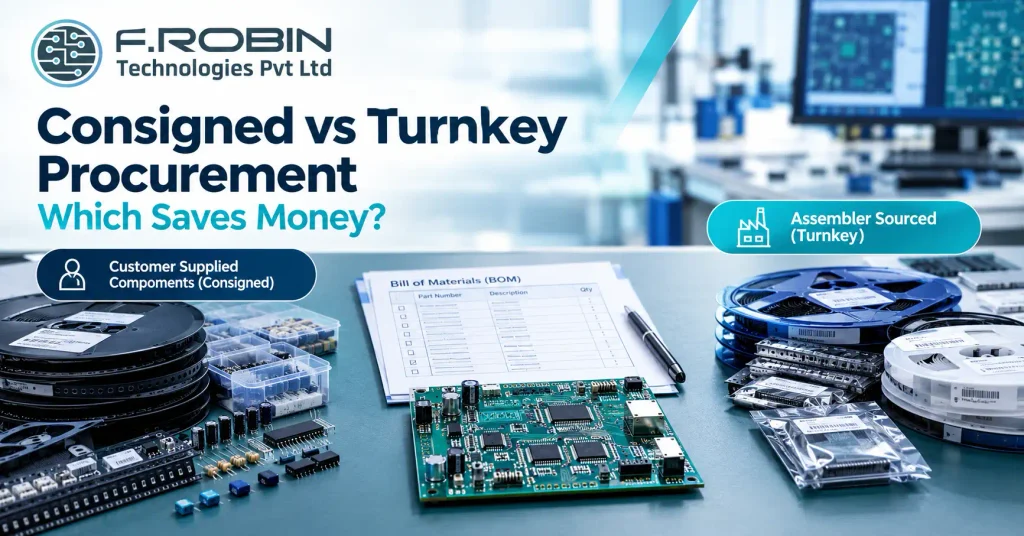
Should you supply the parts or let the assembler buy them? Neither model always saves money. In consigned vs turnkey procurement, turnkey usually saves time and effort on small, simple builds, while consigned can save money when you have better pricing, existing stock, or hard-to-find parts. The right answer depends on your bill of materials, your volume, and how much purchasing work your team can absorb. This guide breaks down consigned vs turnkey procurement so you can compare real costs, not just line prices.
It is written for hardware teams in Chennai and across India who buy printed circuit board assemblies. A note on transparency: F.Robin Technologies publishes this guide. We state no savings percentages, because the numbers change with every bill of materials, and we recommend you compare quotes using your own files.
Key Takeaways
- In consigned vs turnkey procurement, consigned means you supply the components, while turnkey means the assembler buys them.
- Consigned vs turnkey procurement is a total-cost question: part prices, handling fees, shortages, shipping, and your own team’s time all count.
- Turnkey often suits prototypes and low volumes, while consigned can suit teams with strong purchasing power or special parts.
- A partial turnkey model lets you supply critical parts and let the assembler buy the rest.
What Consigned vs Turnkey Procurement Means
Consigned procurement is a model in which the customer buys and delivers the components, and the assembler builds the boards with them. The customer keeps control of part sourcing, pricing, and lead times, and also takes on the purchasing work.
Turnkey procurement is a model in which the assembler buys the components, builds the boards, and delivers finished assemblies. The assembler handles sourcing, kitting, and shortages, usually adding a handling charge or margin to cover that work.
Many teams also use a hybrid called partial turnkey, which we cover below. If you are new to the build process itself, start with our guide to PCB assembly with SMT, THT, and mixed builds.
Consigned vs Turnkey Procurement at a Glance
This table summarises the main differences. Use it as a starting point, and then test each row against your own bill of materials.
| Factor | Consigned | Turnkey |
| Who buys the parts | You | The assembler |
| Control over part pricing | High, because you choose suppliers | Lower, because the assembler chooses sources |
| Purchasing effort for your team | Higher | Lower |
| Handling fee or margin | Usually none on parts | Often included in the quote |
| Shortage management | You manage it and deliver replacements | The assembler manages it, within agreed terms |
| Spare parts for placement losses | You must supply extras | Usually handled in the quote |
| Typically suits | Existing stock, special parts, strong buying power | Prototypes, small runs, limited purchasing time |
Where the Costs Come From in Consigned vs Turnkey Procurement
A fair comparison looks beyond the price of each component. In consigned vs turnkey procurement, these cost drivers usually matter most:
- Part price: your negotiated price against the assembler’s sourcing price.
- Minimum order quantities and reel sizes: you may need to buy more than a small build uses.
- Handling fee or margin: turnkey quotes often include a charge for sourcing and kitting.
- Spare parts: small passives can be lost during placement, so builds need extras.
- Shortages and expediting: a missing part can stall the whole run.
- Shipping, duties, and logistics: parts that cross borders add time and cost.
- Your team’s time: purchasing, tracking, and chasing suppliers has a real cost.
- Risk of wrong or poor-quality parts: someone must own the consequences.
When Consigned Procurement Saves Money
In consigned vs turnkey procurement, the consigned model tends to save money in situations like these:
- Stock from earlier builds already sits on your shelf.
- Volume buying gets you better prices than a small assembler could negotiate.
- The bill of materials includes specialised or hard-to-find parts that you already source.
- Your team has the purchasing capacity to manage orders and deliveries.
- A customer or contract requires approved suppliers for certain parts.
When Turnkey Procurement Saves Money
In consigned vs turnkey procurement, the turnkey model tends to save money in these situations:
- You are building prototypes or small runs with many low-cost parts.
- Minimum order quantities would leave you with large amounts of unused stock.
- Your team has little time for purchasing and supplier follow-up.
- You want one party to own shortages and part substitutions.
- You are in an early stage, where speed matters more than saving on each part.
The Hybrid Option in Consigned vs Turnkey Procurement: Partial Turnkey
You do not have to choose one model for the entire board. In a partial turnkey model, you supply the critical, expensive, or hard-to-find parts, and the assembler buys the commodity parts such as resistors and capacitors. As a result, you keep control where it matters and avoid the effort of buying hundreds of small items.
How to Decide: Consigned vs Turnkey Procurement Step by Step
Follow these steps to decide with evidence instead of instinct:
- Review the bill of materials. Check every line for complete manufacturer part numbers and quantities.
- Tag each part by sourcing difficulty. Mark which parts are common, which are hard to find, and which you already hold.
- Estimate your own purchasing cost. Include your team’s time, shipping, and any minimum order surplus.
- Request quotes under both models. Send the same files and ask for turnkey, consigned, and partial turnkey pricing.
- Compare total cost, not line prices. Add handling fees, spares, shipping, and expected delays to each option.
- Check the risk terms. Confirm who covers shortages, wrong parts, and delays, and put the answer in writing.
Consigned vs Turnkey Procurement in Chennai: Local Considerations
Location also changes the maths. Teams in Chennai can often reach component distributors and assembly lines quickly, which shortens delivery and makes small consigned top-ups easier to manage. In addition, a local partner can answer sourcing questions the same day. Even so, imported specialised parts still add shipping time and cost, so factor that into either model. Our guide to choosing PCB assembly services in Chennai covers how to compare local providers.
Common Mistakes in Consigned vs Turnkey Procurement
Teams often lose money through avoidable errors rather than the model they pick. Watch for these:
- Comparing line prices only, while ignoring handling fees, shipping, and surplus.
- Forgetting spare parts, which leaves the build short after placement losses.
- Sending an incomplete bill of materials, which delays quotes and invites substitutions.
- Leaving shortage and substitution terms unwritten.
- Ignoring leftover stock, which ties up cash after a prototype run.
Questions to Ask Before You Settle Consigned vs Turnkey Procurement
- Which sourcing models do you offer: consigned, turnkey, and partial turnkey?
- How do you price parts, and what handling fee or margin applies?
- How many spare parts do you recommend for placement losses?
- Who is responsible for shortages and part substitutions?
- Which sources do you buy from, and how do you protect against counterfeit parts?
- What happens to leftover parts after the build?
- Can I switch models between prototype and production?
A Hypothetical Example
Imagine a small team ordering ten prototype boards with a long list of low-cost parts. Under a consigned model, the team would buy from several suppliers, accept minimum order quantities well above its needs, and chase deliveries. Under turnkey, the assembler would consolidate that purchasing, so the team would likely save time, even if the part prices look higher on paper.
Now imagine the same team moves to production and already buys its main components in volume. In contrast, consigned or partial turnkey procurement could keep its better pricing while the assembler handles the rest. The numbers will differ for your project, so compare quotes instead of assuming.
How F.Robin Technologies Helps You Decide
Before you buy any parts, make sure the board is ready to build. F.Robin Technologies, headquartered in Chennai, offers PCB layout design services and DFA and DFM reviews that cover component placement, SMT and THT assembly feasibility, and manufacturing outputs, so you do not purchase parts for a design that still needs changes. For fabrication, see our PCB manufacturing service, and read our complete guide to PCB manufacturing. Please confirm which sourcing models apply to your project directly with our team.

3 Responses