
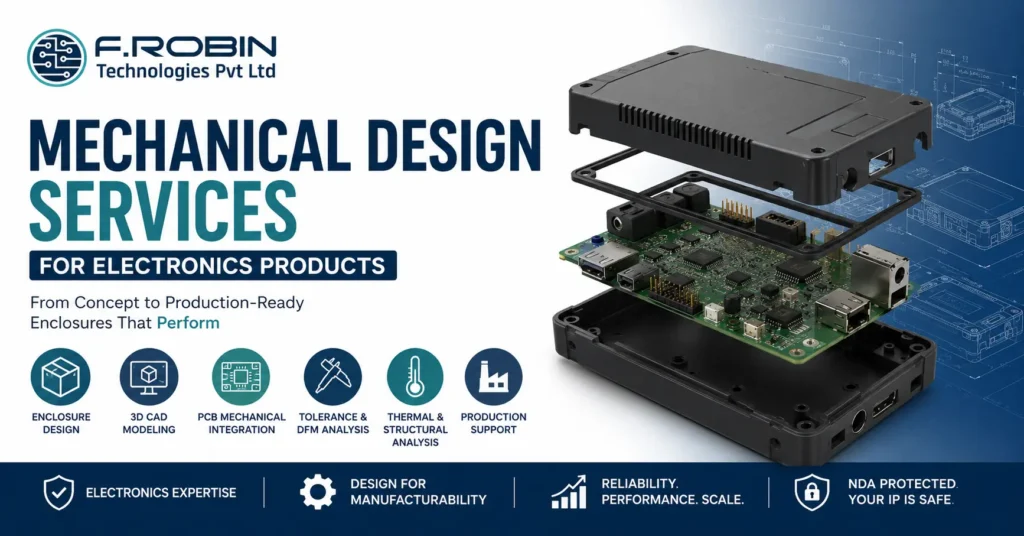
Mechanical design services turn electronic hardware into a real, manufacturable product the enclosure that protects your board, the fit that makes it work, and the tooling that lets you build it at scale. For any electronics company, choosing the right partner shapes cost, reliability, and time-to-market.
This buyer’s guide explains what mechanical design services cover for electronics, what to look for in a provider, and how to choose one with confidence whether you are based in Chennai, Bangalore, or anywhere else in India.
What Mechanical Design Services Cover
For electronics products, mechanical design services span far more than drawing a box. A capable provider delivers:
- Enclosure design — the housing that protects and packages your electronics.
- 3D CAD modelling — detailed models in tools like SolidWorks or PTC Creo.
- PCB mechanical integration — aligning the board, connectors, and mounting with the housing.
- Tolerance stack-up analysis — ensuring parts fit reliably despite manufacturing variation.
- Material selection — balancing cost, strength, thermal needs, and finish.
- DFM review — making the design manufacturable before tooling.
- Mechanical engineering and analysis — structural, thermal, and vibration checks.
- Production support — drawings, tooling handoff, and first-article inspection.
The strongest providers cover this whole scope, giving you end-to-end product development under one roof rather than stitching together separate vendors. Ask which parts stay in-house — the more that does, the smoother your project runs.
Why Mechanical Design Matters for Electronics
A weak enclosure can undo a brilliant board. Good mechanical design protects your electronics from dust, moisture, shock, and heat, while keeping the product usable and compliant.
The cost of getting it wrong is high. Fit clashes force board respins; poor sealing causes field failures; late changes after tooling are slow and expensive. Strong mechanical design services prevent these problems early, when fixes are cheap — protecting both reliability and budget. The enclosure also shapes how customers perceive your product, since it is the part they see and handle every day.
The Concept-to-Production Process
Most engagements follow a clear path from idea to manufacturable product:
- Requirements — size, environment, IP rating, thermal load, volume, and certifications.
- Concept design — exploring forms and layouts cheaply, before committing.
- Detailed 3D CAD — building the model precisely around your PCB.
- Tolerance and DFM — refining for reliable fit and the chosen manufacturing process.
- Prototyping — validating fit, function, thermal, and sealing.
- Production and tooling — cutting tools and moving to volume.
Understanding this concept-to-production design flow helps you judge whether a provider’s process is thorough or superficial. For a deeper look at one example, see our guide to electronic enclosure design.
What to Look For in a Partner
Evaluate any provider of mechanical design services across these areas:
- Electronics experience — do they understand boards, connectors, and thermal needs?
- PCB integration capability — can they design enclosure and board as one system?
- Analysis expertise — structural, thermal, and vibration analysis when needed.
- CAD tools — proficiency in SolidWorks, PTC Creo, or your preferred platform.
- DFM focus — designing for the manufacturing process from the start.
- Manufacturing links — a smooth path from design to tooling and production.
- IP protection — a clear NDA and secure file handling.
A partner strong in these areas will design a product that fits, performs, and can actually be built at your target cost. Location helps too: a partner in Chennai or Bangalore offers shared timezone, easier site visits, and faster review cycles than a distant vendor.
Questions to Ask Before You Commit
- ✅ Have you designed enclosures for similar electronics products?
- ✅ How do you handle PCB mechanical integration and fit checks?
- ✅ Do you run tolerance stack-up analysis?
- ✅ Which CAD tools do you use, and what files will I receive?
- ✅ Do you perform DFM review before tooling?
- ✅ Can you support prototyping and production tooling?
- ✅ Will you sign an NDA?
Clear, evidence-backed answers signal a professional partner. Vague ones are a warning sign.
Red Flags to Avoid
- No electronics-specific experience, only generic mechanical work.
- Designing the enclosure without the PCB model in hand.
- No tolerance analysis or DFM step in their process.
- Reluctance to sign an NDA or unclear file ownership.
- Quotes far below market, which often hide inexperience.
If several appear, keep looking — a weak partner costs far more in respins than careful vetting.
Key Takeaways
- Mechanical design services cover enclosure design, 3D CAD, PCB integration, tolerance, DFM, and analysis.
- Good mechanical design protects reliability and prevents costly respins and tooling changes.
- The process runs concept → CAD → tolerance/DFM → prototype → production.
- Choose a partner with electronics experience, PCB integration skill, analysis capability, and DFM focus.
- Always confirm NDA, deliverables, and the path to production before committing.
Conclusion
Choosing mechanical design services for an electronics product comes down to fit, expertise, and process. Look for a partner who understands electronics, designs the enclosure and PCB as one system, runs tolerance and DFM analysis, and can carry you from concept to production tooling. Get that right, and your product fits, performs, and ships on schedule.
Frequently Asked Questions
Mechanical design services include enclosure design, 3D CAD modelling, PCB mechanical integration, tolerance stack-up analysis, material selection, DFM review, structural and thermal analysis, and production support.
It ensures the PCB, connectors, and mounting points align perfectly with the enclosure. Designing them together prevents fit clashes that could otherwise result in expensive PCB respins or tooling modifications.
Most engineering teams use professional 3D CAD software such as SolidWorks or PTC Creo and exchange models with PCB design tools using STEP files to keep the enclosure and PCB synchronized.
Tolerance stack-up analysis evaluates how manufacturing variations accumulate across assembled components, ensuring reliable fit and preventing gaps, rattles, connector misalignment, or button issues.
Pricing depends on product complexity, thermal and ingress protection requirements, the number of prototype iterations, tooling needs, and production volume. A reliable engineering partner will provide a transparent quotation covering every stage of the project.
