
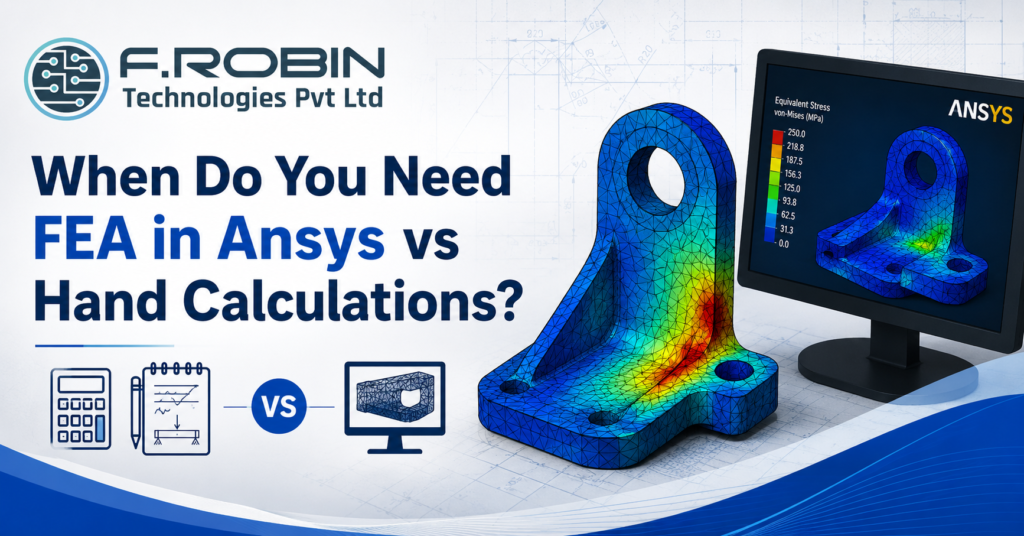
Every mechanical engineer faces the same question during structural analysis: do I reach for a quick hand calculation, or do I build a full FEA model in Ansys? Both are valid tools, and choosing the wrong one wastes time either by over-analyzing a simple part or by under-analyzing a complex one. The trick is knowing which method fits the problem in front of you.
This decision guide answers exactly that. We compare hand calculations and FEA in Ansys across accuracy, complexity, cost, and time, then give you clear rules for when each is the right choice. Whether you are sizing a simple bracket or validating a vibration-critical assembly, you will know which structural analysis method to trust.
What Is Structural Analysis?
Structural analysis is the process of determining how a part or assembly responds to loads — the stresses, deflections, and safety margins it experiences in service. Its goal is simple: confirm that a design will not fail under the forces it must withstand.
There are two broad ways to perform structural analysis. Hand calculations use established formulas and engineering theory to estimate stress and deflection quickly. Finite element analysis (FEA), run in tools like Ansys, divides a model into thousands of small elements and solves the physics numerically for complex shapes and loads.
Neither method is universally better. Each suits different problems, and skilled engineers move fluidly between them. Knowing when to use which is the essence of efficient structural analysis.
Hand Calculations: Strengths and Limits
Hand calculations are fast, cheap, and transparent. Using standard beam, plate, and stress formulas, an engineer can size a part or check a load case in minutes — with full visibility into every assumption.
Their strengths are speed and insight. Because you see the equations, you understand exactly what drives the result, which builds engineering intuition. They are ideal for simple geometry, standard load cases, and quick sanity checks.
Their limits appear with complexity. Hand calculations struggle with intricate geometry, complex or combined loading, contact, and dynamic effects. For those, the simplifying assumptions break down, and you need a numerical method instead.
FEA in Ansys: Strengths and Limits
FEA in Ansys handles what hand calculations cannot. By meshing a model into small elements, it computes stress and deflection across complex 3D geometry, combined loads, contact, vibration, and nonlinear behaviour — cases with no clean closed-form solution.
Its strength is versatility and detail. FEA reveals stress concentrations, mode shapes, and thermal effects that formulas miss, and it supports design optimization. For structural and vibration analysis of real assemblies, it is often the only practical option.
The trade-offs are time, cost, and skill. FEA takes longer to set up, demands expertise, and — critically — can produce confident-looking but wrong answers if the mesh, boundary conditions, or material data are poor. Powerful as it is, FEA still needs judgement to trust.
When Hand Calculations Are Enough
Reach for hand calculations first when the problem is simple. In many cases, they give you the answer faster and with more insight than a full model would. Use them when:
- Geometry is simple — beams, plates, shafts, or standard shapes.
- Loads are straightforward and well understood.
- You need a quick estimate early in design.
- You are sanity-checking an FEA result.
- Standard formulas exist for the exact case.
For a large share of everyday structural analysis, hand calculations are entirely sufficient. Jumping straight to FEA for a simple bracket wastes hours you could spend elsewhere. Match the effort to the problem.
When You Need FEA in Ansys
Turn to FEA in Ansys when complexity exceeds what formulas can handle. It becomes the right choice when:
- Geometry is complex, with features that concentrate stress.
- Loading is combined or non-uniform, defying simple formulas.
- Vibration or dynamics matter, needing modal or harmonic analysis.
- Thermal or nonlinear effects are significant.
- You are optimizing a design across many variables.
- Certification or high stakes demand detailed, documented evidence.
In these situations, a hand calculation cannot capture the real behaviour, and FEA earns its cost. Structural and vibration analysis of a full assembly, for example, almost always requires simulation. When failure is expensive or dangerous, the investment in FEA is clearly justified.
Hand Calc vs FEA Comparison
The table below compares the two methods at a glance.
Reading across the rows, the pattern is clear: hand calculations win on speed and simplicity, while FEA wins on handling complexity. The best engineers pick the method that fits — and often use both.
Best Practice: Use Both Together
The smartest approach is rarely one or the other — it is both. Hand calculations and FEA complement each other, and using them together produces more reliable results than either alone.
In practice, engineers use hand calculations to validate FEA. If a quick formula and a simulation broadly agree, confidence rises; if they diverge wildly, something is wrong with the model. This cross-check is one of the most valuable habits in structural analysis, because FEA can look convincing while being completely wrong.
So run a hand calculation before or alongside your Ansys model, and use it as a reality check. Add a mesh convergence study and proper validation, and you have results you can genuinely trust.
FEA Pitfalls to Avoid
FEA is powerful but easy to misuse. Watch for these pitfalls:
- Garbage in, garbage out — wrong loads or materials give wrong answers.
- Poor mesh quality, which distorts stress results.
- Skipping convergence checks, so results depend on element size.
- Bad boundary conditions, the most common source of error.
- No validation against hand calculations or test data.
- Over-trusting colourful plots without questioning them.
Avoiding these keeps your FEA-based structural analysis honest. A pretty stress plot means nothing if the setup is flawed which is exactly why validation matters so much.
Documenting Your Structural Analysis
Whichever method you choose, document your structural analysis. A good structural analysis is not just a number it is a record of assumptions, inputs, methods, and validation that others can review and trust. For certification or client sign-off, that paper trail is essential.
A solid report states the loads and boundary conditions, the method (hand calculation or FEA), the material data, any mesh convergence study, and how the result was validated. Clear documentation turns your structural analysis from a private calculation into defensible engineering evidence and it makes future design changes far easier to assess without repeating the whole structural analysis from scratch.
Key Takeaways
- Structural analysis can be done by hand calculations or by FEA in Ansys.
- Hand calculations are fast, cheap, and transparent — ideal for simple parts and quick checks.
- FEA handles complex geometry, combined loads, vibration, thermal, and nonlinear cases.
- Use hand calculations for simple problems and FEA when complexity demands it.
- Best practice is to use both — hand calculations to validate FEA.
- Always check mesh convergence and validate results before trusting them.
Conclusion
Choosing between FEA in Ansys and hand calculations is about matching the method to the problem. Use hand calculations for simple geometry, standard loads, quick estimates, and sanity checks. Turn to FEA when complexity, dynamics, thermal effects, or high stakes exceed what formulas can capture. Above all, use both together — hand calculations to validate FEA — and always check convergence before trusting a result.
Need Structural Analysis You Can Rely On?
Our mechanical engineering services combine advanced FEA in Ansys with proven hand-calculation validation to deliver accurate, reliable, and certifiable engineering results. Whether you’re validating a new product, optimizing an existing design, or solving complex structural challenges, partner with our engineering team for dependable analysis and confident design decisions.
