
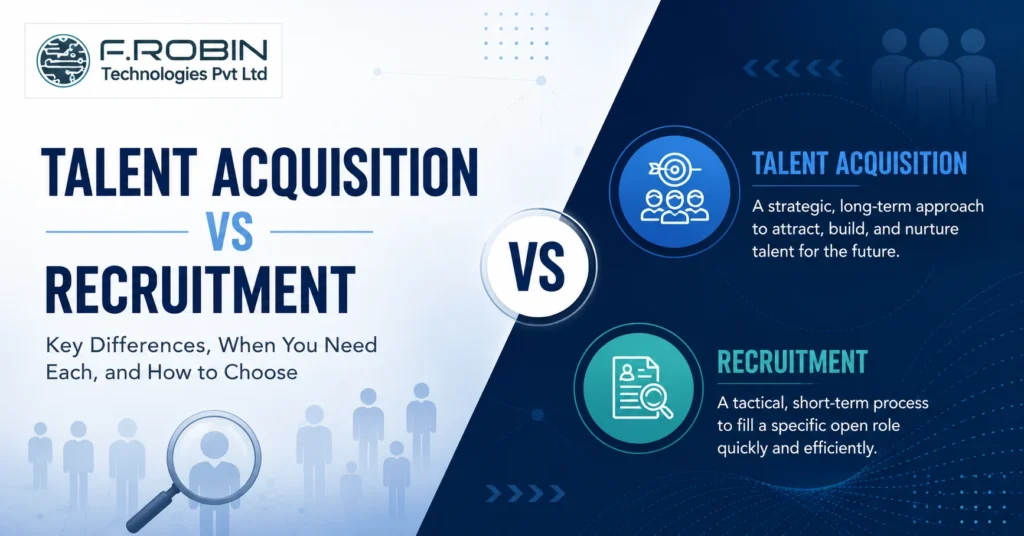
Talent acquisition and recruitment are often used interchangeably — but they are not the same thing. Recruitment is the tactical work of filling open roles, while talent acquisition is the broader, strategic approach to attracting and building talent over time. Confusing the two leads companies to hire reactively when they should be planning ahead.
So are they the same? The short answer is no: recruitment is part of talent acquisition, not a synonym for it. In this comparison, we define each term, break down the key differences, and explain when you need one, the other, or both. By the end, you will know exactly which approach fits your hiring needs.
What Is Talent Acquisition?
Talent acquisition is the strategic, ongoing process of identifying, attracting, and building a pipeline of talent to meet a company’s long-term needs. Rather than reacting to a single vacancy, it plans ahead for the skills the business will need months or years from now.
This strategic hiring approach includes workforce planning, employer branding, talent pipelines, and relationship-building with potential candidates. It treats hiring as a continuous investment, not a one-off event. As a result, companies with a strong talent strategy fill critical and senior roles faster, because they have already built relationships before the need arises.
In short, it is about playing the long game ensuring the right people are available when the business needs them, especially for hard-to-fill technical and leadership roles.
What Is Recruitment?
Recruitment is the tactical process of filling a specific open role — sourcing, screening, interviewing, and hiring a candidate for a defined position. It starts when a vacancy opens and ends when the seat is filled.
Recruitment is reactive by nature: a role becomes available, and the team moves to fill it quickly. It is essential, efficient, and the right tool for immediate hiring needs. Many companies use external recruitment services or a hiring agency to speed this up, especially for one-off or urgent roles.
The key point is scope. Recruitment handles the here-and-now vacancy, while the wider strategy looks beyond it. Both matter, but they operate on different timelines and mindsets.
Talent Acquisition vs Recruitment: The Key Differences
The two differ across three core dimensions. Understanding these makes the distinction clear.
Scope: Strategic vs Tactical
It is strategic and ongoing, covering planning, branding, and pipeline building. Recruitment is tactical and specific, focused on filling the role in front of you. One is the long-term system; the other is a single transaction within it.
Time Horizon: Long-Term vs Immediate
A strategic approach plans for future skills needs, often months or years ahead. Recruitment addresses an immediate vacancy with a short, defined timeline. Therefore, the two answer different questions: “Who will we need?” versus “Who do we hire now?”
Approach: Proactive vs Reactive
It proactively nurtures relationships with potential candidates before roles open. Recruitment reacts once a role exists. Consequently, proactive pipelines shorten time-to-hire when a vacancy finally appears.
Comparison Table
The table below summarizes the two at a glance.
| Factor | Talent Acquisition | Recruitment |
|---|---|---|
| Scope | Strategic and ongoing | Tactical and role-specific |
| Time Horizon | Long-term | Immediate |
| Approach | Proactive | Reactive |
| Focus | Building and nurturing a talent pipeline | Filling a current vacancy |
| Includes | Employer branding, workforce planning, talent pipelines, and recruitment | Sourcing, screening, interviewing, and hiring candidates |
| Best For | Critical, senior-level, and hard-to-fill positions | Specific and immediate hiring requirements |
The clearest takeaway: recruitment is one activity inside the wider talent acquisition function. They are related, not identical.
When You Need Talent Acquisition vs Recruitment
Match the approach to your situation with these guidelines.
Lean on recruitment when:
- You have an immediate, specific vacancy to fill.
- The role is common and easy to source.
- You need speed for a one-off or urgent hire.
Invest in talent acquisition when:
- You hire continuously or plan to scale.
- Roles are senior, scarce, or business-critical.
- You compete for in-demand skills like engineering or AI.
- You want to lower long-term hiring cost and time.
In reality, most growing companies need both — fast recruitment for today’s openings and strategic hiring for tomorrow’s. The mix depends on your growth rate and the scarcity of your roles.
How Talent Acquisition Works
A strong function rests on a few connected pillars:
- Workforce planning. Forecasting the roles and skills the business will need.
- Employer branding. Building a reputation that attracts candidates before you advertise.
- Talent pipeline. Nurturing relationships with potential hires over time.
- Sourcing and engagement. Proactively reaching passive candidates, not just applicants.
- Data and metrics. Tracking quality of hire, time-to-fill, and pipeline health.
These pillars feed each other. A strong employer brand fills the pipeline, the pipeline shortens time-to-hire, and good data sharpens planning. Together, they turn hiring from a scramble into a system.
For specialized fields, this matters even more. In technology and engineering, the best candidates are rarely on the job market, so a proactive pipeline and employer brand are what win them.
Do You Need Both?
For most companies, the answer is yes. Recruitment handles immediate needs; a ready pipeline ensures you are never starting from zero when a critical role opens. Relying on recruitment alone keeps you in permanent catch-up mode, while strategy without execution never fills a seat.
The smart approach blends them. Use a strategic approach to build pipelines and brand for your hardest roles, and efficient recruitment — often via a hiring agency or specialist partner to fill specific openings fast. Balanced together, they cut both cost and time-to-hire.
This is especially true for fast-scaling firms, where today’s vacancy and next year’s skills gap both demand attention at once.
Picture a fast-growing chip-design firm. It needs three verification engineers this quarter a clear recruitment job. At the same time, it knows it will need a design lead and ten more engineers within eighteen months. Building relationships with those future hires now, through an employer brand and a nurtured pipeline, is the strategic side. Handle only the urgent three and the firm will scramble later; handle both and it scales smoothly.
Benefits of a Strong Hiring Strategy
Investing beyond reactive hiring delivers lasting advantages:
- Faster hiring for critical roles, thanks to ready pipelines.
- Better quality of hire from proactive, relationship-led sourcing.
- Lower cost-per-hire over time as you rely less on urgent, expensive searches.
- Stronger employer brand that attracts talent passively.
- Reduced risk of unfilled, business-critical vacancies.
- Competitive edge for scarce skills like semiconductor, EMS, and AI talent.
These gains compound. The longer you invest in this approach, the deeper your pipeline and the easier each future hire becomes.
Common Misconceptions
A few myths cloud this topic. Clearing them up helps you plan better:
- “They mean the same thing.” They overlap, but one is strategic and ongoing while the other is tactical and role-specific.
- “Only big companies need a strategy.” Even small teams benefit from an employer brand and a modest pipeline, especially for scarce skills.
- “A pipeline is just a stack of resumes.” A real pipeline is a set of engaged relationships nurtured over time — not a dormant database.
- “Recruiters and strategists are interchangeable.” Filling a role fast and building long-term talent capability call for different skills and mindsets.
- “You can build a pipeline overnight.” Relationships and brand take time; the value compounds over months, not days.
Avoiding these misconceptions keeps your hiring grounded in reality and your expectations realistic.
Key Takeaways
- Talent acquisition and recruitment are related but not the same.
- Recruitment is tactical and fills specific roles; talent acquisition is strategic and ongoing.
- The differences come down to scope, time horizon, and approach.
- Recruitment is one activity within the wider hiring function.
- Most growing companies need both — fast recruitment plus strategic pipelines.
- A strong strategy lowers cost, speeds hiring, and wins scarce skills.
Conclusion
Talent acquisition and recruitment are not the same. Recruitment fills today’s vacancy; it builds the pipeline and brand that make tomorrow’s hires faster and stronger. They differ in scope, time horizon, and approach — but they work best together. Most growing companies need efficient recruitment for immediate roles and a strategic talent approach for the long term.
Build a Stronger Talent Pipeline
Competing for scarce Technology, Semiconductor, EMS, or AI talent? Our AI staffing services combine strategic talent acquisition with specialist recruitment to help you attract, engage, and secure the skilled professionals your business needs. Whether you’re planning long-term workforce growth or filling critical positions, we can create a hiring strategy tailored to your goals.
Talk to Our TeamFrequently Asked Questions
1. Are talent acquisition and recruitment the same thing?
No. Recruitment is the tactical process of filling a specific open role, while talent acquisition is the broader, strategic process of attracting, engaging, and building talent over time. Recruitment is one component of a comprehensive talent acquisition strategy.
2. What is the main difference between talent acquisition and recruitment?
The primary difference is scope and timing. Recruitment is reactive and focuses on filling immediate vacancies, while talent acquisition is proactive and plans for future workforce needs through employer branding, workforce planning, and talent pipeline development.
3. Is recruitment part of talent acquisition?
Yes. Recruitment is one activity within the broader talent acquisition function, which also includes workforce planning, employer branding, candidate relationship management, and long-term talent pipeline building.
4. When should a company use talent acquisition instead of recruitment?
A strategic talent acquisition approach is most valuable when a company hires continuously, scales rapidly, or competes for senior, specialized, or business-critical talent. Recruitment alone is often sufficient for filling immediate and easier-to-source positions.
5. Does a small company need a talent strategy?
Yes. Even small businesses can benefit from a basic talent strategy, including employer branding and maintaining a small candidate pipeline. As the business grows, this foundation makes hiring faster and more effective while supporting long-term workforce planning.
