
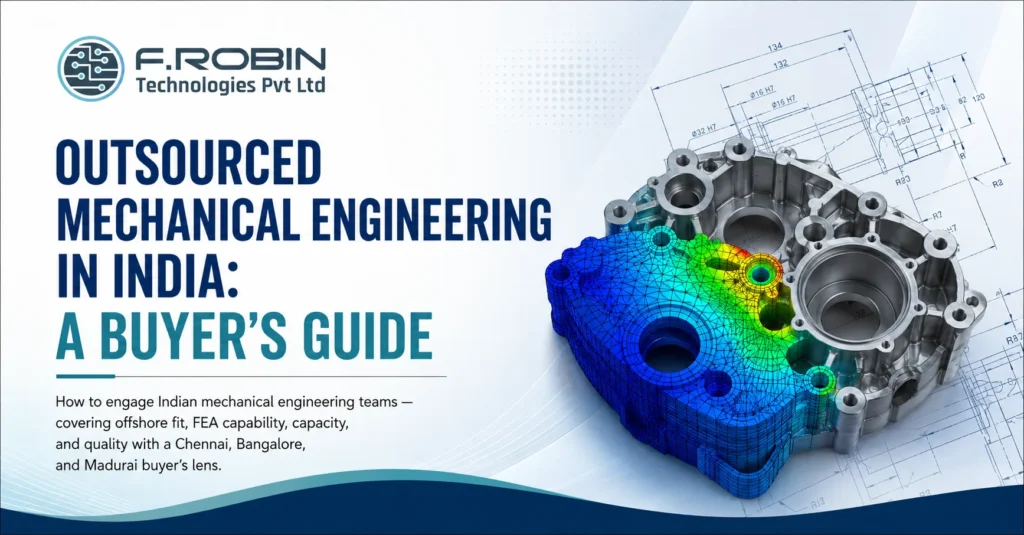
Global product companies increasingly look to outsourced mechanical engineering in India for a combination that is hard to find elsewhere: strong engineering talent, competitive cost, and a maturing ecosystem across hubs like Chennai, Bangalore, and Madurai. But engaging an Indian mechanical engineering team well requires understanding what actually differentiates a strong partner from a risky one — capability, capacity, quality systems, and how they handle the offshore working relationship itself.
This buyer’s guide walks through exactly that. We cover how to evaluate FEA and analysis capability, what capacity and quality mean in practice, the realities of working with an offshore team, and how to engage outsourced mechanical engineering in India confidently, whether your priority hub is Chennai, Bangalore, Madurai, or elsewhere in the country.
Why Companies Choose Outsourced Mechanical Engineering in India
India’s engineering talent pool has deepened significantly across mechanical design, structural analysis, and manufacturing engineering, supported by a mature electronics and industrial manufacturing base in states like Tamil Nadu and Karnataka. For global product companies, outsourced mechanical engineering in India offers access to that talent at a cost structure that is difficult to match with an in-house Western team.
Beyond cost, the value proposition includes flexibility — scaling a team up or down with project demand without the overhead of permanent headcount — and, increasingly, genuine technical depth in disciplines like FEA-based structural and vibration analysis that used to be harder to source offshore. Together, these factors are why outsourced mechanical engineering in India has moved from a purely cost-driven decision to a genuinely capability-driven one for many companies.
Evaluating FEA and Analysis Capability
Structural and vibration analysis (FEA) capability varies enormously among providers of outsourced mechanical engineering in India, and verifying it matters more than trusting a claim on a website. Ask specifically about their experience with tools like Ansys, their process for mesh convergence and validation, and examples of analysis work relevant to your product category.
A provider with genuine FEA depth will discuss specific study types — static structural, modal, harmonic, random vibration — and how they validate results against hand calculations or physical test data. Vague answers about “doing simulation” without this specificity are a sign the capability may be thinner than advertised.
Capacity: Can They Actually Scale With You?
Capacity is about whether a provider of outsourced mechanical engineering in India can genuinely support your project’s actual scale — not just take it on. Ask about team size, how many engineers are dedicated versus shared across multiple clients, and what happens if your project needs to ramp up quickly.
A provider stretched thin across many clients may struggle to deliver the responsiveness you need during a critical design phase. Confirm dedicated capacity commitments in writing, and ask for a realistic view of their current workload rather than assuming availability.
This question matters more for outsourced mechanical engineering in India than it might for a local hire, since distance makes it harder to gauge workload informally through office visibility or casual conversation — you have to ask directly and trust the answer.
Quality Systems and Process Discipline
Quality in mechanical engineering shows up as process: documented design reviews, DFM checks, tolerance analysis, and clear revision control — not just a finished CAD file. When evaluating outsourced mechanical engineering in India, ask what quality system governs their design process and what documentation you can expect to receive alongside deliverables.
Look specifically for evidence of structured design reviews and a defined process for catching manufacturability issues before tooling. A provider without this discipline may produce a design that looks complete but fails in ways that only surface during prototyping or production.
Quality discipline is arguably the single hardest thing to assess remotely, which is exactly why documentation and process evidence matter so much more when evaluating outsourced mechanical engineering in India than they would for a team you can walk over and observe directly.
Making the Offshore Relationship Work
The offshore dynamic itself — timezone overlap, communication cadence, and cultural working style — meaningfully affects how well an engagement runs, independent of raw engineering skill. Establish a clear communication rhythm early: regular design reviews, a shared project management tool, and a single point of contact on both sides.
Time zone overlap between India and Western markets is often workable but limited, so plan critical review meetings deliberately rather than assuming ad hoc scheduling will work smoothly. Written documentation of decisions matters more in an offshore relationship than in an in-person one, since it is the record both sides rely on when memory of a conversation fades.
Chennai, Bangalore, and Madurai: A Local Lens
Location within India shapes what a mechanical engineering partner brings to the table. Chennai sits within Tamil Nadu’s deep automotive, electronics, and industrial manufacturing base, giving mechanical teams there strong exposure to real production environments. Bangalore’s ecosystem leans further toward tech and product engineering, with teams often experienced in fast-moving hardware startup environments.
Madurai and similar tier-two hubs increasingly offer strong engineering talent at an even more competitive cost structure, though it is worth confirming the depth of their analysis and quality infrastructure specifically, since it may be less mature than in the larger hubs. Across all three, proximity to India’s broader manufacturing ecosystem is a genuine advantage when a mechanical design needs to move smoothly into local production.
A Buyer’s Checklist
- Request specific FEA examples and ask about Ansys study types used, not just a general capability claim.
- Confirm dedicated team capacity in writing, not just verbal reassurance of availability.
- Ask what quality system and documentation process governs their design work.
- Establish a communication cadence and time zone plan before the engagement starts.
- Clarify IP ownership and confidentiality terms explicitly in the contract.
- Ask for references from clients with a similar product category or complexity.
- Confirm whether they can support you from concept through production, or only part of that journey.
Working through this checklist before committing turns a promising pitch into a verified, evidence-based decision.
Red Flags to Avoid
- Vague or generic answers about FEA and analysis experience.
- No clear team capacity commitment, or unclear whether engineers are shared across many clients.
- No defined quality process or design review discipline.
- Reluctance to establish a regular, structured communication cadence.
- Unclear IP or confidentiality terms in early conversations.
- No references or examples relevant to your specific product category.
If several of these appear, the risk of a stalled or disappointing engagement rises significantly — vetting carefully upfront costs far less than a failed offshore relationship later.
Key Takeaways
- Outsourced mechanical engineering in India offers strong talent and cost advantages, but capability varies significantly between providers.
- Verify FEA and analysis capability with specific questions about tools like Ansys, study types, and validation practice.
- Confirm real, dedicated capacity in writing rather than assuming availability.
- Look for documented quality systems and design review discipline, not just a finished deliverable.
- Plan the offshore communication relationship deliberately — cadence, time zones, and documentation matter.
- Location within India (Chennai, Bangalore, Madurai, or elsewhere) shapes a team’s manufacturing exposure and cost structure.
