
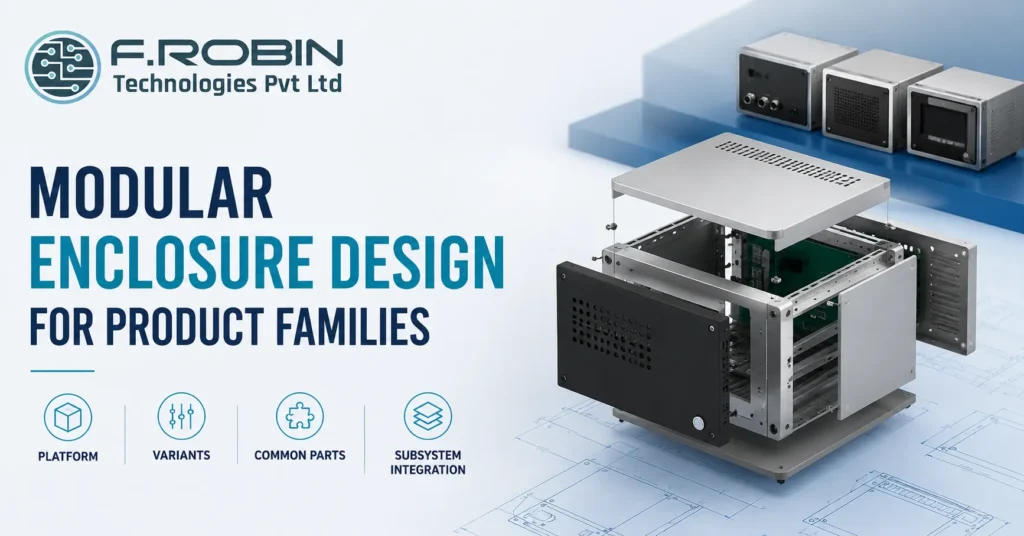
Designing a separate enclosure for every product in a family is expensive, slow, and hard to maintain. Modular enclosure design solves this by building one flexible platform that supports many variants through shared structure and swappable subsystems, rather than starting from a blank sheet for every new model.
This guide covers the best practices behind modular enclosure design: how to define a platform, where to draw variant boundaries, how much to standardize on common parts, and the trade-offs that come with each decision. Whether you are planning a small family of two or three products or a larger platform meant to scale for years, these principles apply — and the earlier they are applied in a program’s life, the more value they deliver.
What Modular Enclosure Design Actually Means
Modular enclosure design is the practice of building a shared mechanical platform — a common structure, mounting scheme, and subsystem architecture — that supports multiple product variants without a full redesign for each one. Instead of treating every new model as a fresh project, a product family shares a defined set of common parts and interfaces, varying only what genuinely needs to differ.
This is different from simply reusing a CAD file as a starting point. True modular enclosure design plans the platform and its variation points deliberately, from the very first product, so that adding the second and third variants is fast and predictable rather than another full design cycle.
Why Product Families Need a Platform Strategy
Without a platform strategy, each new product variant repeats the same enclosure design, tooling, and validation work from scratch. That repetition is expensive in engineering time, tooling cost, and the risk of introducing new defects into a process that should be well understood by the third or fourth variant.
A well-planned modular enclosure design compounds in value over a product family’s life. The first variant costs more to design carefully, but every subsequent variant becomes faster, cheaper, and lower-risk, because most of the structure, tooling, and qualification work carries over rather than starting over.
This compounding effect is easy to underestimate at the start of a program, when only one product exists and the platform investment can feel unnecessary. Teams that skip it often regret the decision by the third variant, when they are effectively redesigning the enclosure from scratch for the third time.
Defining the Platform
The platform is the shared foundation: the base structure, primary mounting scheme, and core mechanical interfaces that every variant in the family will use. Defining it well requires understanding the full range of variants you expect to support not just the first product so the platform is built wide enough from the start.
Look at your product roadmap, not just the current product, when defining the platform for modular enclosure design. A platform sized only for today’s variant often needs an expensive rework the moment a slightly larger or differently configured variant appears eighteen months later.
Where to Draw Variant Boundaries
Every product family needs clear boundaries between what is shared and what varies. Common candidates for variation include connector selection, port configuration, display or interface options, and mounting orientation — while the core structure, primary enclosure shell, and main assembly process usually stay constant across variants.
Draw these boundaries deliberately, based on genuine market or technical need, not convenience. Variation added without a clear reason quietly increases cost and complexity across the whole family, while variation withheld where it is genuinely needed forces awkward compromises into every future product.
Common Parts Strategy
Common parts fasteners, standoffs, gaskets, brackets, and similar hardware shared across every variant reduce cost through volume, simplify sourcing, and cut the inventory complexity of supporting multiple products at once. A strong common parts strategy is one of the most direct ways modular enclosure design pays for itself.
Standardize wherever there is no genuine functional reason to differ. A single fastener size across the whole family, for example, simplifies assembly instructions, reduces the chance of a build error, and lowers per-unit cost through consolidated purchasing benefits that compound across every variant and every unit produced.
Subsystem Integration
Modular enclosure design works best when it is planned alongside subsystem integration how the PCB, connectors, thermal management, and other functional subsystems interface with the shared platform. A platform designed without this coordination often forces awkward, variant-specific workarounds exactly where the design was supposed to stay common.
Plan subsystem interfaces mounting points, connector locations, thermal paths as part of the platform definition itself, not as an afterthought once the enclosure shape is set. This is where [PCB mechanical integration](/blog/pcb-mechanical-integration-fit-clashes/) becomes especially important, since board layout decisions ripple directly into how cleanly each variant’s subsystem fits the shared structure.
Trade-Offs to Manage
- Upfront cost vs long-term savings — a well-planned platform costs more initially but pays back across variants.
- Flexibility vs simplicity — more variation points add capability but also add cost and complexity to manage.
- Standardization vs product-specific optimization — shared parts may not be the absolute optimal choice for every single variant.
- Platform lifespan vs technology change — a platform built too rigidly may struggle to absorb a major future technology shift.
None of these trade-offs has a universally correct answer. The right balance depends on how many variants you genuinely expect, how different they need to be, and how long the platform needs to remain relevant.
A Modular Design Checklist
- Map the expected range of variants across the product roadmap, not just the current product.
- Define the platform’s core structure, mounting scheme, and primary interfaces explicitly.
- Identify and document deliberate variation points, with a clear reason for each.
- Standardize fasteners, hardware, and other common parts wherever function allows.
- Coordinate subsystem interfaces — PCB, connectors, thermal — as part of the platform, not after it.
- Validate the platform against at least two planned variants before committing to tooling.
- Document the platform architecture so future variants can be added without re-deriving the logic.
Working through this checklist before finalizing a platform catches most of the costly rework that shows up later in a product family’s life.
Common Mistakes to Avoid
- Designing only for the current product, without considering future variants in the same family.
- Adding variation points without a genuine functional or market reason.
- Skipping subsystem coordination, forcing workarounds into the shared structure later.
- Under-standardizing common parts, missing easy cost and simplicity gains.
- Validating the platform against only one variant before committing to tooling.
- Leaving the platform’s design logic undocumented, making future variants harder to add correctly.
Avoiding these keeps a modular enclosure design genuinely modular, rather than a single-product design that happens to get reused awkwardly.
Key Takeaways
- Modular enclosure design builds one shared platform to support many product variants deliberately, not by accident.
- Define the platform against your full product roadmap, not just the current product.
- Draw variant boundaries based on genuine need, and standardize common parts wherever function allows.
- Coordinate subsystem integration — PCB, connectors, thermal — as part of the platform definition.
- Validate the platform against at least two variants before committing to tooling.
- The upfront investment in a well-planned platform pays back across every subsequent variant.
