
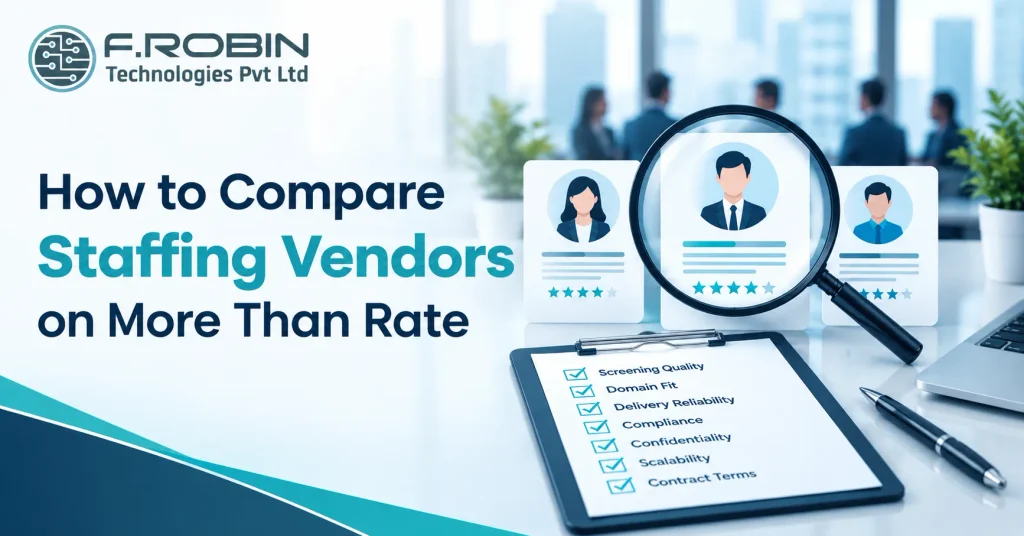
To compare staffing vendors fairly, look past the hourly rate or markup and score each vendor on screening quality, delivery reliability, compliance, confidentiality, scalability, and the contract terms that protect you when a placement goes wrong. A low rate can hide costs that surface later, while a slightly higher rate can save a lot of rework. This guide shows you how to compare staffing vendors step by step, using a simple scorecard you can adapt to your own hiring needs.
It is written for procurement teams, HR leaders, and engineering managers who need a defensible way to choose, not just a cheaper quote. If you are still deciding between vendor types, start with our guide to employment agencies versus staffing firms.
Key Takeaways
- Rate is one input to the decision, not the decision itself.
- Ask every vendor to break its rate into components so quotes line up.
- To compare staffing vendors well, score them on the same criteria, with weights that match your priorities.
- Read replacement, notice, and conversion terms before you sign, and consider a small pilot first.
Why Rate Alone Is a Poor Way to Compare Staffing Vendors
Rate is easy to compare because it is a single number. Unfortunately, it describes only one part of what you pay. A vendor that quotes less may screen less, submit fewer qualified profiles, or leave compliance gaps that land on your desk. Consequently, you pay in other ways: longer vacancies, repeat interviews, early exits, and managers who spend their time fixing problems.
None of this means a lower rate is a red flag. It means rate is an input, not the verdict. When you compare staffing vendors, ask what each rate includes and what happens when things go wrong.
What a Staffing Rate Actually Includes
Vendors package rates differently, so two quotes rarely match line for line. Ask each vendor to break its rate into these parts:
- Pay to the worker or candidate.
- Statutory and benefit costs.
- Vendor margin or markup.
- Onboarding, background checks, and documentation.
- Replacement or guarantee terms.
- Extra fees, such as conversion fees, minimum engagements, or notice charges.
With a breakdown in hand, you can compare staffing vendors on equal terms instead of weighing a bundled number against an unbundled one.
How to Compare Staffing Vendors Step by Step
Follow this seven-step process to compare staffing vendors consistently:
- Define the role and success measures. Write down the skills, experience, start date, and duration. Then decide how you will judge success, such as time to first interview or manager satisfaction at 90 days.
- Send every vendor the same brief. A shared brief removes guesswork, so responses become comparable. Ask for a written reply, not just a phone quote.
- Break down the rate. Request the components listed above, so you know what the price covers and what it leaves out.
- Score the non-price criteria. Use the scorecard below, and set weights before you read any responses. That way, price does not quietly dominate the result.
- Test the screening. Ask how the vendor assesses technical skill, and review a sample question set or assessment format.
- Check references and compliance. Speak to at least two customers in a similar field, and ask for documentation samples that show how the vendor handles contracts and statutory requirements.
- Pilot before you commit. Where possible, start with one role or a short engagement. A pilot shows you how the vendor actually performs when the pressure is on.
Seven Criteria to Compare Staffing Vendors Beyond Rate
1. Screening Quality
In fact, good screening saves your managers hours of interviews. Ask how the vendor tests skill instead of matching keywords, and how it separates strong candidates from weak ones. Our guide to candidate screening and assessment explains what a solid process looks like.
2. Domain Fit
A vendor that knows your field understands role titles, tools, and realistic expectations. For example, a hardware engineer search needs a different approach from a clerical one. Ask for examples of similar roles the vendor has filled, with client names removed if they are confidential.
3. Delivery Reliability
Speed matters, but profile quality matters more. Compare staffing vendors on how many submitted profiles reach interview, not only on how quickly the first one arrives. Typical timelines vary by role and market, so ask each vendor to explain its own.
4. Compliance and Documentation
Contracts, statutory compliance, payroll, and records should be clear and consistent. Ask what documents you will receive and who is responsible if an audit raises a question. In addition, vague answers here often turn into expensive surprises.
5. Confidentiality and IP Protection
Because the worker may see designs, code, or customer data, you need clear protection. Confirm that the vendor signs an NDA, explains how it handles your information, and states who owns the work product.
6. Scalability
Since your needs may grow or shrink within a few months, check whether the vendor can add people quickly, and what notice terms apply when you reduce the team.
7. Communication and Accountability
A named contact, regular updates, and a clear escalation path make a real difference. Meanwhile, a vendor that goes quiet after you sign will cost you time.
Read the Contract, Not Just the Quote
Contract terms can change the real cost of a placement more than the rate itself. Before you decide, check these points:
- Replacement or guarantee period, and what triggers it.
- Notice period if you end the engagement.
- Conversion fee if you hire the worker directly.
- Minimum engagement length.
- Payment terms and invoice structure.
A Simple Vendor Scorecard to Compare Staffing Vendors
Use this scorecard as a starting point. The weights are examples, so adjust them to match your priorities, and agree on them before you review any vendor responses.
| Criterion | Example weight | What good looks like | Red flag |
| Rate and total cost | 20% | Clear breakdown, no hidden fees | Single bundled number, unclear extras |
| Screening quality | 15% | Describes skill testing and shares a sample | Relies on resume keywords alone |
| Domain fit | 15% | Relevant examples for similar roles | Generic answers for every role |
| Delivery reliability | 10% | Explains its timeline and interview conversion | Promises speed with no process |
| Compliance and documentation | 15% | Shares sample documents and responsibilities | Vague on statutory handling |
| Confidentiality and IP | 10% | Signs an NDA and explains data handling | Hesitates on written protection |
| Scalability | 10% | Clear notice and ramp-up terms | Rigid or unclear terms |
| Communication | 5% | Named contact and reporting rhythm | No clear point of contact |
Score each vendor from one to five on every row, multiply by the weight, and add up the results. Then discuss any big gaps with your team, because a number never replaces judgment.
Questions to Ask When You Compare Staffing Vendors
- How do you screen candidates before presenting them?
- What does your rate include, and what costs extra?
- What is your replacement or guarantee policy?
- How do you handle statutory compliance and documentation?
- How do you protect confidential information and IP?
- Who will manage our account, and how often will we get updates?
- Can you share two references from similar engagements?
Red Flags When You Compare Staffing Vendors
- The vendor refuses to break down its rate.
- The vendor cannot explain how it screens candidates.
- Answers on compliance stay vague.
- Pressure builds to sign quickly.
- No references are on offer.
- Promises sound like guarantees of results.
A Hypothetical Example
Imagine two vendors quoting for a PCB design engineer. Vendor A quotes less and sends profiles within days. Vendor B quotes slightly more, describes a technical screening round, and offers a clear replacement window.
When you compare staffing vendors with a scorecard, you may find that Vendor A’s profiles need several interviews to produce one good fit. Those interviews cost engineer hours that never appear on an invoice. Vendor B’s shortlist, in contrast, may move faster to a decision. The numbers will differ in your case, so measure it instead of assuming.
Where F.Robin Technologies Fits
F.Robin Technologies offers AI staffing services and technical workforce solutions across engineering, IT, industrial, manufacturing, and corporate functions. We suggest you put us through the same scorecard and questions as any other vendor. If you hire electronics engineers, our buyer’s guide to staffing for electronics teams in India adds role-specific detail.
