
Custom PCB Design Services: When Off-the-Shelf Won’t Cut It
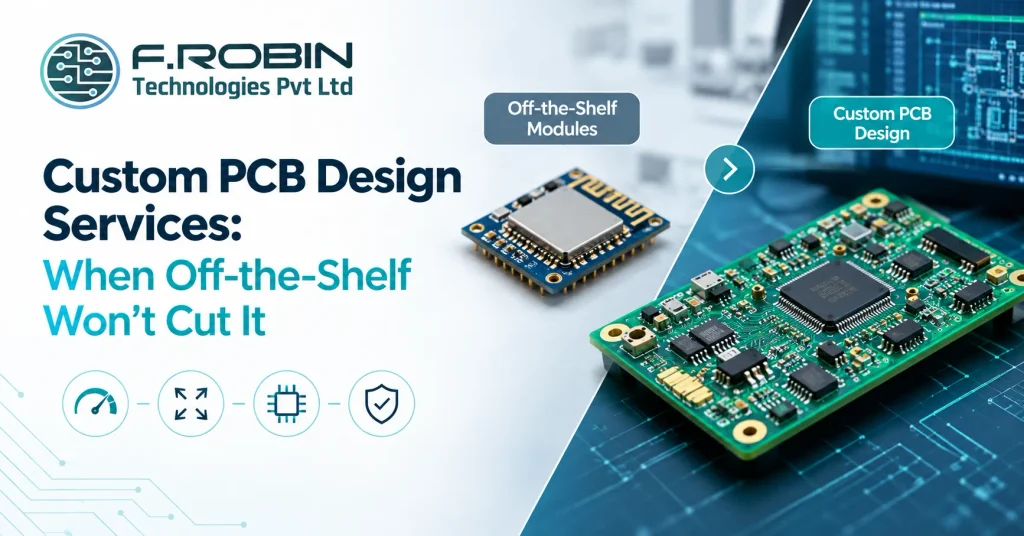
Off-the-shelf modules solve most early-stage hardware problems cheaply and fast — until they do not. The moment your product needs a specific form factor, a cost target modules cannot hit at volume, or genuine high-speed digital and mixed-signal PCB layout that a generic module was never designed for, custom PCB design services become the only real path forward. This decision guide covers exactly when that shift makes sense, what custom PCB design services actually involve, and what you should expect in cost, timeline, and process once you commit. Whether you are scaling past a prototype built on development boards or designing a product that a module simply cannot support, this guide will help you make the call with confidence — and avoid the common trap of discovering the limitation only after significant time has already been invested in a module-based approach. The Quick Answer In short: stick with off-the-shelf modules for early prototypes, low volume, and simple designs where speed to market matters more than cost or form factor. Move to custom PCB design services once you need a specific size or shape, a cost structure that only custom hardware can hit at volume, or performance — especially high-speed digital and mixed-signal PCB layout — that a generic module was never built to deliver. The decision is rarely close once you actually hit one of these triggers. The harder part is recognizing the trigger early, before a module-based prototype has locked in assumptions that make the eventual custom redesign more painful than it needed to be. Why Off-the-Shelf Modules Work Until They Don’t Modules exist because they solve a real problem well: a pre-certified, pre-tested subsystem lets a small team build a working prototype in weeks instead of months, without needing deep PCB design expertise on staff. For early validation, that speed is genuinely valuable, and there is no reason to reach for custom PCB design services before you need to. The trade-off is that modules are designed to be generic. They carry a fixed size, a fixed feature set, and a per-unit cost that includes someone else’s margin and overhead. That trade-off is invisible at low volume and increasingly expensive as volume grows, or once your product’s requirements diverge from what the module was designed to serve. Signs You Need Custom PCB Design Services If one or more of these apply, custom PCB design services are very likely the right next step, even if the transition feels premature. When High-Speed and Mixed-Signal Layout Forces the Issue High-speed digital and mixed-signal PCB layout is one of the clearest, least negotiable triggers for custom PCB design services. Modules are built as generic subsystems, and their layout is optimized for the module vendor’s own use cases — not for the specific high-speed interfaces, controlled impedance requirements, or sensitive analog sections your product actually needs. Once your design involves fast digital interfaces alongside sensitive analog or RF sections, the layout decisions — grounding strategy, plane splits, trace routing, component placement — become deeply product-specific. A generic module cannot make those decisions for you, because it was never designed with your specific mixed-signal requirements in mind. This is the point where custom PCB design services stop being a nice-to-have and become a technical necessity. For the underlying stack-up and signal-integrity decisions this involves, see our guide to impedance control in PCB design, which covers controlled impedance and signal integrity in depth. What Custom PCB Design Services Actually Involve A capable custom PCB design services provider covers this whole scope, or works cleanly alongside your existing manufacturing partner if you already have one in place. For boards with higher layer counts, see our guide to multilayer PCB design to understand how layer count interacts with the custom design process. Cost: Custom vs Module at Different Volumes The table below illustrates how the cost balance shifts between modules and custom PCB design services as volume grows. Factor Off-the-shelf module Custom PCB design Upfront cost Low (design already done) Higher (NRE for design and tooling) Per-unit cost at low volume Competitive Often higher due to NRE amortization Per-unit cost at high volume Fixed, includes vendor margin Typically lower once NRE is amortized Form factor control Limited to module footprint Full control Performance ceiling Generic, module-defined Matched exactly to your requirements The crossover point varies by product, but as a rule, custom PCB design services become cost-competitive once volume is high enough to amortize the upfront NRE investment across enough units. A Real-World Example Picture a startup that validated its first product using an off-the-shelf wireless module, a separate sensor breakout board, and a carrier board connecting them together. It worked well enough to raise funding and land early customers, but the assembly was bulky, expensive per unit, and used three separate boards where the final product needed to fit in a pocket-sized enclosure. Moving to custom PCB design services combined all three functions onto a single board, purpose-built for the target enclosure, with the wireless section laid out properly for its RF requirements alongside the sensor’s sensitive analog circuitry — real high-speed digital and mixed-signal PCB layout work that the original three-board stack never needed to solve. Unit cost dropped substantially at volume, and the product finally fit the form factor customers actually wanted. What to Expect: Timeline and Process Custom PCB design services take longer upfront than dropping in a module, and setting realistic expectations avoids frustration later. A straightforward design might move from requirements to a validated prototype in a matter of weeks; a complex board with genuine high-speed digital and mixed-signal PCB layout, tight certification requirements, or multiple design iterations can take considerably longer. Expect a structured process: requirements and schematic first, then layout, then DFM review, then a prototype build and validation cycle before production files are finalized. Build in time for at least one revision cycle — very few complex boards are perfect on the first pass, and planning for that reality up front keeps the overall timeline realistic rather than
