
How to Choose a Mechanical Design Partner With FEA Skills
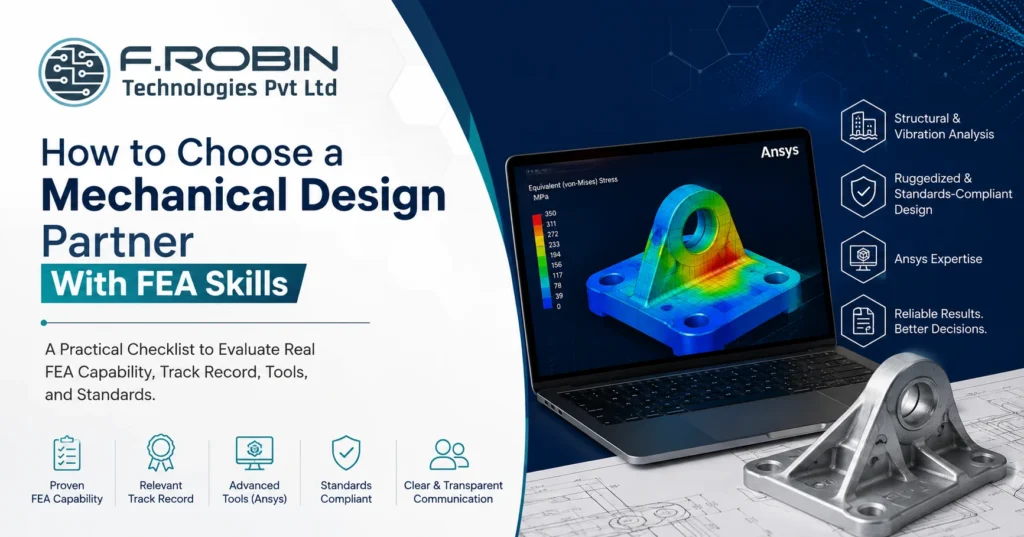
Plenty of firms list “FEA” on their website. Far fewer can actually run a structural or vibration analysis that holds up under scrutiny, defend the assumptions behind it, and turn the result into a design decision you can trust. Choosing a mechanical design partner without verifying real FEA capability is one of the most common — and most expensive — mistakes in product development. This checklist helps you evaluate a mechanical design partner specifically on FEA skill: what capability actually looks like, the questions that separate genuine expertise from a claim on a slide, and the standards and tools that signal a serious analysis practice. Whether you need vibration analysis for a ruggedized enclosure or structural validation for a safety-critical bracket, this checklist applies — and it works whether you are hiring a partner for a single project or a long-term relationship. Why FEA Capability Is Hard to Verify FEA output always looks credible. A colourful stress plot with clean contour lines and a clear “pass” result is easy to produce and easy to present, regardless of whether the underlying mesh, boundary conditions, and material data were set up correctly. This is exactly what makes evaluating a mechanical design partner on FEA skill genuinely difficult — the deliverable can look right while being quietly wrong. Because of this, evaluating capability requires going past the deliverable and into the process: how a mechanical design partner sets up a model, how they validate it, and how they communicate uncertainty. A mechanical design partner who cannot explain their meshing decisions or convergence checks in plain language is one whose results you cannot fully trust. This is not about distrust for its own sake. It is about recognizing that FEA is a skill with a wide range of real-world proficiency, and a client rarely has the technical background to catch a flawed analysis just by looking at the final report. The Checklist: What to Evaluate Score any mechanical design partner against this list before committing to FEA-dependent work, rather than judging capability from a single impressive-looking report. Track Record: What to Ask For Ask any mechanical design partner for specific examples of structural or vibration analysis work, ideally close to your product’s scale and criticality. A partner who has run FEA on similar enclosures, brackets, or ruggedized assemblies will speak about the work with concrete detail — load cases, failure modes, design iterations driven by the analysis. Be wary of answers that stay generic. “We do FEA on most projects” is not evidence of capability; a specific story about a design that changed because of an analysis result is. It is reasonable to ask for a redacted or high-level version of a past report if full confidentiality prevents sharing the original. A mechanical design partner confident in their work will usually find a way to demonstrate quality without breaching another client’s confidentiality. Tools: What Ansys Proficiency Actually Signals Ansys is one of the most widely used professional FEA platforms, and genuine proficiency in it signals real investment in analysis capability — the software itself is not trivial to master. But tool familiarity alone is not the same as sound engineering judgment; a mechanical design partner can operate Ansys competently and still set up a model incorrectly if their underlying process is weak. Ask how they use Ansys in practice: which modules, what kind of studies (static structural, modal, harmonic, random vibration), and how they interpret and report results. Specific, technical answers are a good sign; a vague “we use Ansys for everything” is not. Standards and Documentation A mechanical design partner working on ruggedized or standards-compliant design should be fluent in the relevant standards for your product — whether that is MIL-STD vibration profiles, IEC environmental standards, or industry-specific structural codes. Ask which standards they design and validate against, and expect a specific answer rather than a general claim of compliance awareness. Documentation matters just as much as the analysis itself. A capable partner delivers a clear report stating load cases, assumptions, boundary conditions, mesh details, and results — not just a pass/fail conclusion. That documentation is what lets you, a certifying body, or a future engineer trust and reuse the analysis. If your product needs formal certification, ask the mechanical design partner directly how their documentation supports that process. A report built with certification in mind looks noticeably different from one written as an internal engineering note. Comparison: Claimed vs Verified FEA Capability The table below contrasts what a claimed FEA capability looks like versus a genuinely verified one. Signal Claimed capability Verified capability Track record “We do FEA on most projects” Specific projects with load cases and outcomes Validation Not mentioned Cross-checked with hand calcs or test data Mesh process Not discussed Documented convergence study Tool skill “We use Ansys” Specific modules, study types, and reasoning Standards General compliance claim Named standards with specific application Documentation Pass/fail summary Full report with assumptions and boundary conditions Reading down the table, the pattern is clear: genuine capability shows up as specificity, while a weaker claim tends to stay general and unverifiable. Red Flags to Avoid If several of these appear, treat FEA-dependent claims from that mechanical design partner with real caution before relying on their results for a critical design decision. Key Takeaways FAQ – How to Choose a Mechanical Design Partner With FEA Skills Frequently Asked Questions CTA – Mechanical Design Partner With FEA Skills Need FEA You Can Actually Rely On? Track record, mesh convergence discipline, genuine Ansys proficiency, and standards fluency — our Mechanical Engineering Services bring verified structural and vibration analysis capability to ruggedized, standards-compliant designs, backed by documentation you can trust. Explore Mechanical Engineering Services Talk to Our Engineering Team
