
Should You Outsource Mechanical Design or Keep It In-House?
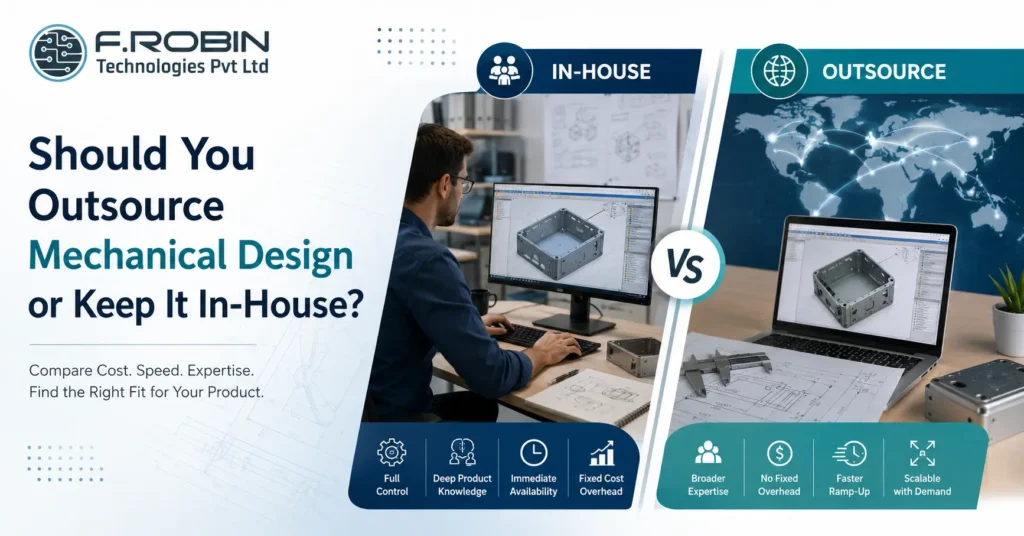
Every electronics company eventually faces the same question: should you hire a mechanical engineer in-house, or outsource mechanical design to an external partner? Both paths can produce a great enclosure the difference lies in cost, speed, flexibility, and how the decision fits your specific stage and workload. This decision guide compares the two options honestly, covering cost, speed, expertise, and control. We also look at how the right answer shifts depending on whether you are a startup in Chennai, a scaling product company in Bangalore, or an established manufacturer with steady mechanical work. By the end, you will know which path or which blend of both fits your situation. The Quick Answer Whether you outsource mechanical design or hire a mechanical engineer in-house depends mainly on your workload and stage. Steady, high-volume mechanical work usually justifies an in-house hire; variable, occasional, or specialized work is usually cheaper and faster to outsource. Neither choice is universally right. A Chennai hardware startup with one enclosure to design has very different needs from a Bangalore product company running continuous mechanical development across multiple lines. The rest of this guide breaks down exactly how to tell which situation you are in. In-House Mechanical Design: Pros and Cons Hiring a mechanical engineer in-house means building internal capability you control directly. Here is what that gets you — and what it costs. Pros: Cons: In-house mechanical design pays off when workload is steady enough to keep the role busy and productive year-round. Outsourcing Mechanical Design: Pros and Cons Choosing to outsource mechanical design means engaging an external partner for the work, paying per project or on a flexible arrangement. Here is the trade-off. Pros: Cons: For many companies, especially with variable workload, choosing to outsource mechanical design reduces both cost and risk compared with a full-time hire. Cost Comparison Cost is rarely as simple as comparing a salary to an hourly rate. An in-house engineer costs salary plus benefits, tools, software licenses, and management overhead — payable every month, whether or not there is enough work to fill their time. Choosing to outsource mechanical design converts that fixed cost into a variable one: you pay for the enclosure design you need, when you need it, with no idle-time cost. For a company with one or two projects a year, outsourcing is almost always cheaper. For a company running constant mechanical development across many products, an in-house hire can become more cost-effective once workload is high and steady enough to justify the fixed cost. The break-even point depends on your specific volume, but as a rule of thumb: intermittent work favours outsourcing, and continuous work favours hiring. Side-by-Side Comparison Factor In-house engineer Outsource mechanical design Cost structure Fixed (salary + overhead) Variable (per project) Best for Steady, continuous workload Intermittent or variable workload Expertise breadth Limited to the hire Broad, across many projects Ramp-up time Hiring cycle required Immediate Control High, direct Moderate, via clear briefs Scalability Limited by headcount Flexible with demand Reading across the rows, the pattern is clear: steady, predictable work favours hiring; variable, bursty work favours outsourcing mechanical design. When to Hire a Mechanical Engineer In-House Hiring in-house makes the most sense when: For an established company in Chennai or Bangalore with a steady product pipeline, an in-house hire can become the backbone of ongoing mechanical development. When to Outsource Mechanical Design Choosing to outsource mechanical design is usually the better choice when: For most early-stage hardware companies including many building in Chennai and Bangalore’s growing startup scenes choosing to outsource mechanical design gets a working enclosure built faster and cheaper than hiring would. A Hybrid Approach Many companies do not choose one path exclusively they blend both. A small in-house team handles day-to-day product knowledge and quick iterations, while an external partner is brought in for peak workload, specialized skills, or a first product line. This hybrid model captures the best of both: the control and continuity of an in-house presence, plus the flexibility and depth of an external partner when you need it. It is especially common among growing companies that started by choosing to outsource mechanical design entirely, then added in-house capability as volume grew. A Concrete Example Picture two companies. A three-person hardware startup in Chennai needs one enclosure designed for its first product launch. Hiring a full-time mechanical engineer would burn scarce runway on a role that sits idle after the design is done so choosing to outsource mechanical design to a specialist partner gets a professional result in weeks, at a fraction of the cost of a salaried hire. Now picture a scaling product company in Bangalore shipping four new devices a year, each needing ongoing mechanical iteration, tooling support, and field fixes. Here, an in-house mechanical engineer earns their keep every month, building deep product knowledge that an outsourced partner would have to relearn on every project. The same decision, applied to two different situations, produces two very different and equally correct answers. Key Takeaways CTA – Outsource Mechanical Design Should You Outsource Mechanical Design or Hire In-House? Weighing the decision for your product? Our Mechanical Engineering Services give Chennai and Bangalore hardware companies flexible, outsourced mechanical design — from a single enclosure to ongoing product development. Whether you need a one-off design or a long-term partner, we help you scale mechanical work without the overhead of a full-time hire. Explore Mechanical Design Services Talk to Our Engineering Team FAQ – Should You Outsource Mechanical Design or Keep It In-House? Frequently Asked Questions
