
From Prototype to Mass Production: A PCB Manufacturing Roadmap
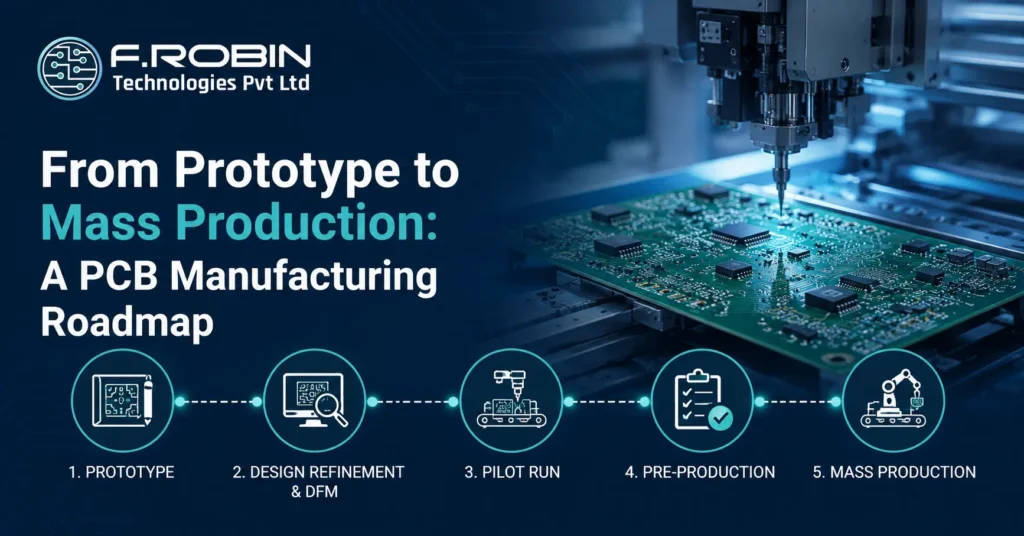
Taking a board from a single prototype to reliable mass production is one of the trickiest journeys in hardware. The PCB manufacturing steps that work for five boards do not simply scale to fifty thousand priorities shift from speed and flexibility to cost, consistency, and yield. Without a clear roadmap, teams stumble into delays, respins, and blown budgets at exactly the wrong moment. This guide gives you that roadmap. It walks through every stage of PCB manufacturing from first prototype to volume, covering prototyping, the pilot run, DFM, and the checkpoints that keep your scale-up on track. Whether this is your first product or your fiftieth, following these steps turns a risky leap into a controlled, predictable ramp. Why You Need a PCB Roadmap Scaling a board is not a single event — it is a sequence of stages, each with its own goals. Skipping stages is the most common and costly mistake in PCB manufacturing, because problems that are cheap to fix on a prototype become expensive once tooling and volume are committed. A roadmap forces you to validate the design, then the process, then the supply chain, in the right order. It replaces a risky leap with deliberate steps. As a result, you catch issues while they are still cheap to fix, and you arrive at mass production with confidence rather than crossed fingers. The stages below apply whether you build simple boards or complex assemblies that combine PCB assembly with fabrication. Stage 1: Prototype The journey starts with prototypes — a few boards built quickly to prove the design works. Here, speed and flexibility matter most. You expect revisions, so you use quick-turn fabrication and accept a higher per-board cost in exchange for fast feedback. At this stage, focus on function: does the circuit work, does the firmware run, do the interfaces behave? Build, test, learn, and iterate. Do not optimize for cost or volume yet; that comes later. The goal is simply a design that is proven and stable enough to move forward. Once your prototype works reliably and the design has settled, you are ready to prepare it for real PCB manufacturing. tage 2: Design Refinement and DFM Before scaling, refine the design for manufacturing. A design-for-manufacturability (DFM) review checks that your board can be built reliably at volume — catching undersized traces, tight clearances, and awkward features that a prototype run tolerates but production will not. This stage also freezes the design. Changes after this point get expensive fast, especially once tooling exists. So resolve every manufacturability and assembly issue now: Completing DFM thoroughly here is the single best predictor of a smooth ramp. It bridges a working prototype and a manufacturable product. Stage 3: The Pilot Run The pilot run is the rehearsal for mass production — a small production batch built on real processes, not prototype methods. Its purpose is to validate the manufacturing process itself, not just the design. A pilot run reveals issues that only appear at production scale: assembly bottlenecks, test-coverage gaps, yield problems, and supply-chain hiccups. Because you catch them on a modest batch, you avoid expensive surprises at full volume. This is why skipping the pilot is such a costly mistake in PCB manufacturing. Treat the pilot as your final checkpoint. If yield and process hold up here, you can scale with confidence. If they do not, fix the issues before committing to volume. Stage 4: Pre-Production With the pilot validated, prepare for full volume. Pre-production locks everything the ramp depends on: tooling, supply chain, test systems, and documentation. Key pre-production tasks include: This stage turns a validated process into a repeatable one. Done well, it makes the difference between a smooth production run and a chaotic one. Sourcing strategy also matters here — our guide to local vs overseas manufacturers helps you choose the right volume partner. Stage 5: Mass Production Finally, you reach mass production — building thousands of identical boards efficiently and consistently. Here the priorities are cost, yield, and repeatability, supported by automated inspection and statistical process control. At volume, small improvements compound. A one-percent yield gain across a large run saves real money, so production teams monitor data closely and refine continuously. Consistency is everything: every board should match the last. With the earlier stages done well, mass production becomes routine rather than dramatic. Reaching this point smoothly is the whole reward of following the roadmap. For the underlying process detail, see our complete PCB manufacturing guide. The Roadmap at a Glance The table summarizes each stage and its focus. PCB Manufacturing Stages at a Glance Each stage of PCB manufacturing has a different objective and priority. Understanding these phases helps improve product quality, reduce risks, and streamline production. Stage Goal Priority Prototype Prove the design works. Speed and flexibility DFM Refinement Make the design manufacturable and freeze the design. Manufacturability Pilot Run Validate the manufacturing process. Yield and process stability Pre-production Lock tooling and finalize the supply chain. Production readiness Mass Production Build at volume with consistent quality. Cost efficiency and consistency Reading down the table, the shift is clear: priorities move from speed toward cost and consistency as you progress. Each stage sets up the next, which is why the order matters as much as the steps. Choosing a PCB Manufacturing Partner for the Journey The right partner makes the whole journey smoother. Ideally, one PCB manufacturing partner supports you from quick-turn prototypes through volume, so you never re-qualify a new vendor mid-project. Switching suppliers between stages means repeating DFM, re-validating processes, and risking fresh yield surprises. When evaluating a PCB manufacturing partner, look for proven capability at both prototype and production scale, strong DFM support, transparent communication, and quality systems backed by IPC standards. A partner that also offers assembly — full pcb manufacturing and assembly under one roof — keeps accountability clear and lead times short. Above all, involve your manufacturer early. The sooner they review your design, the more cost and risk they can help you
