
Talent Acquisition vs Recruitment: Are They the Same?
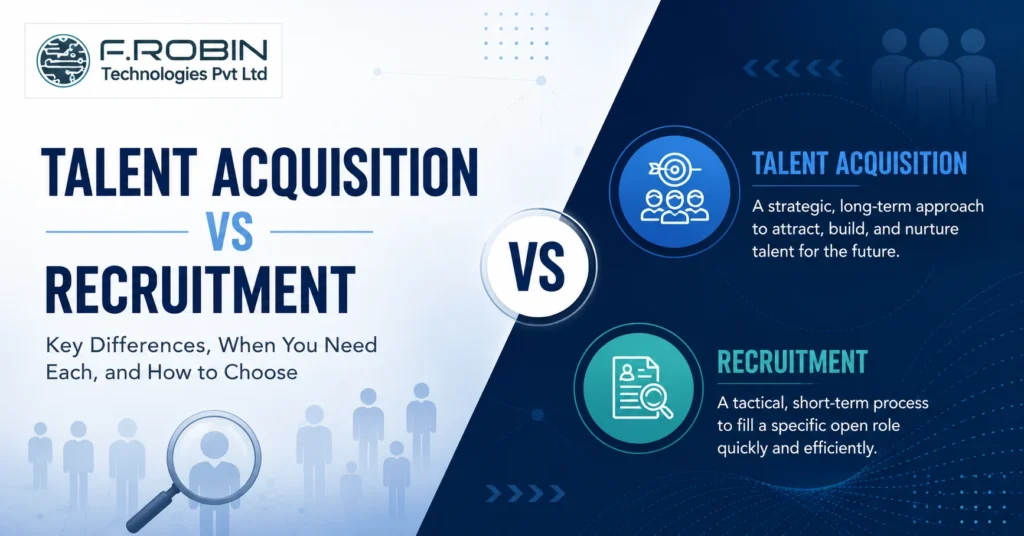
Talent acquisition and recruitment are often used interchangeably — but they are not the same thing. Recruitment is the tactical work of filling open roles, while talent acquisition is the broader, strategic approach to attracting and building talent over time. Confusing the two leads companies to hire reactively when they should be planning ahead. So are they the same? The short answer is no: recruitment is part of talent acquisition, not a synonym for it. In this comparison, we define each term, break down the key differences, and explain when you need one, the other, or both. By the end, you will know exactly which approach fits your hiring needs. What Is Talent Acquisition? Talent acquisition is the strategic, ongoing process of identifying, attracting, and building a pipeline of talent to meet a company’s long-term needs. Rather than reacting to a single vacancy, it plans ahead for the skills the business will need months or years from now. This strategic hiring approach includes workforce planning, employer branding, talent pipelines, and relationship-building with potential candidates. It treats hiring as a continuous investment, not a one-off event. As a result, companies with a strong talent strategy fill critical and senior roles faster, because they have already built relationships before the need arises. In short, it is about playing the long game ensuring the right people are available when the business needs them, especially for hard-to-fill technical and leadership roles. What Is Recruitment? Recruitment is the tactical process of filling a specific open role — sourcing, screening, interviewing, and hiring a candidate for a defined position. It starts when a vacancy opens and ends when the seat is filled. Recruitment is reactive by nature: a role becomes available, and the team moves to fill it quickly. It is essential, efficient, and the right tool for immediate hiring needs. Many companies use external recruitment services or a hiring agency to speed this up, especially for one-off or urgent roles. The key point is scope. Recruitment handles the here-and-now vacancy, while the wider strategy looks beyond it. Both matter, but they operate on different timelines and mindsets. Talent Acquisition vs Recruitment: The Key Differences The two differ across three core dimensions. Understanding these makes the distinction clear. Scope: Strategic vs Tactical It is strategic and ongoing, covering planning, branding, and pipeline building. Recruitment is tactical and specific, focused on filling the role in front of you. One is the long-term system; the other is a single transaction within it. Time Horizon: Long-Term vs Immediate A strategic approach plans for future skills needs, often months or years ahead. Recruitment addresses an immediate vacancy with a short, defined timeline. Therefore, the two answer different questions: “Who will we need?” versus “Who do we hire now?” Approach: Proactive vs Reactive It proactively nurtures relationships with potential candidates before roles open. Recruitment reacts once a role exists. Consequently, proactive pipelines shorten time-to-hire when a vacancy finally appears. Comparison Table The table below summarizes the two at a glance. Factor Talent Acquisition Recruitment Scope Strategic and ongoing Tactical and role-specific Time Horizon Long-term Immediate Approach Proactive Reactive Focus Building and nurturing a talent pipeline Filling a current vacancy Includes Employer branding, workforce planning, talent pipelines, and recruitment Sourcing, screening, interviewing, and hiring candidates Best For Critical, senior-level, and hard-to-fill positions Specific and immediate hiring requirements The clearest takeaway: recruitment is one activity inside the wider talent acquisition function. They are related, not identical. When You Need Talent Acquisition vs Recruitment Match the approach to your situation with these guidelines. Lean on recruitment when: Invest in talent acquisition when: In reality, most growing companies need both — fast recruitment for today’s openings and strategic hiring for tomorrow’s. The mix depends on your growth rate and the scarcity of your roles. How Talent Acquisition Works A strong function rests on a few connected pillars: These pillars feed each other. A strong employer brand fills the pipeline, the pipeline shortens time-to-hire, and good data sharpens planning. Together, they turn hiring from a scramble into a system. For specialized fields, this matters even more. In technology and engineering, the best candidates are rarely on the job market, so a proactive pipeline and employer brand are what win them. Do You Need Both? For most companies, the answer is yes. Recruitment handles immediate needs; a ready pipeline ensures you are never starting from zero when a critical role opens. Relying on recruitment alone keeps you in permanent catch-up mode, while strategy without execution never fills a seat. The smart approach blends them. Use a strategic approach to build pipelines and brand for your hardest roles, and efficient recruitment — often via a hiring agency or specialist partner to fill specific openings fast. Balanced together, they cut both cost and time-to-hire. This is especially true for fast-scaling firms, where today’s vacancy and next year’s skills gap both demand attention at once. Picture a fast-growing chip-design firm. It needs three verification engineers this quarter a clear recruitment job. At the same time, it knows it will need a design lead and ten more engineers within eighteen months. Building relationships with those future hires now, through an employer brand and a nurtured pipeline, is the strategic side. Handle only the urgent three and the firm will scramble later; handle both and it scales smoothly. Benefits of a Strong Hiring Strategy Investing beyond reactive hiring delivers lasting advantages: These gains compound. The longer you invest in this approach, the deeper your pipeline and the easier each future hire becomes. Common Misconceptions A few myths cloud this topic. Clearing them up helps you plan better: Avoiding these misconceptions keeps your hiring grounded in reality and your expectations realistic. Key Takeaways Conclusion Talent acquisition and recruitment are not the same. Recruitment fills today’s vacancy; it builds the pipeline and brand that make tomorrow’s hires faster and stronger. They differ in scope, time horizon, and approach — but they work best together. Most growing companies need efficient recruitment for immediate roles
Electronic Enclosure Design: Concept to Production
Mechanical enclosure design is the process of creating the protective housing that holds and shields your electronics from first sketch to production-ready tooling. A good enclosure does far more than look tidy: it protects the board, manages heat, resists the environment, and shapes how users interact with the product. Get it wrong, and you risk failures, rework, and costly tooling changes. This guide walks through electronic enclosure design from concept to production, stage by stage. You will learn how requirements turn into 3D CAD, how to choose materials, how tolerance and ingress protection shape the design, and how a concept becomes a manufacturable housing. Whether you are building a rugged industrial unit or a sleek consumer device, the path is the same. What Is Mechanical Enclosure Design? Mechanical enclosure design is the engineering of a physical housing that protects and packages electronic hardware. It covers the enclosure’s shape, material, fit, fastening, sealing, and thermal behaviour everything that keeps the electronics safe and usable. The discipline blends form and function. On one hand, the enclosure must protect the board from dust, moisture, shock, and heat. On the other, it must be manufacturable, serviceable, and pleasant to use. Because it touches mechanical, thermal, and industrial design at once, enclosure design is a true cross-disciplinary task. It also works hand in hand with the electronics inside. The board outline, connector positions, and mounting points all influence the housing, so good electronic enclosure design starts with the PCB and the enclosure considered together never in isolation. Why Mechanical Enclosure Design Matters A well-designed enclosure protects your investment and your users. Skimp on it, and even a brilliant board can fail in the field. Strong mechanical enclosure design delivers several benefits: The cost of getting it wrong is high. Late enclosure changes after tooling are slow and expensive, and a poor seal or weak mount can cause field returns. Therefore, investing in mechanical enclosure design early protects both reliability and budget. The Mechanical Enclosure Design Process: Concept to Production Here is how concept-to-production design unfolds, stage by stage. Each step builds on the last. Step 1: Requirements and Specification Start by capturing requirements: size limits, environment, IP rating, thermal load, mounting, ports, certifications, and volume. A clear spec anchors every later decision and prevents costly surprises. Step 2: Concept Design Next, explore concepts. Sketches and rough 3D models test different forms, layouts, and split lines. This is the cheapest stage to experiment, so explore several directions before committing. Step 3: Detailed 3D CAD Now build the detailed model. Engineers create the enclosure in 3D CAD commonly SolidWorks defining walls, bosses, ribs, and features precisely. The PCB model is imported so the housing fits the board exactly. Step 4: Material Selection With the form set, choose the material. Material selection balances strength, cost, weight, thermal needs, and looks. We cover the main options below. Step 5: Tolerance and DFM Then refine for manufacturing. Tolerance analysis ensures parts fit reliably, while design for manufacturability (DFM) tunes features for the chosen process moulding, sheet metal, or machining. Step 6: Prototyping and Validation Build prototypes — often 3D printed or machined — and test fit, function, thermal, and ingress. Validation here catches issues while changes are still cheap, before tooling. Step 7: Production and Tooling Finally, commit to production. Tooling (such as injection moulds) is cut, first articles are inspected, and volume manufacturing begins. A clean handoff here turns your design into real, repeatable parts. Material Selection for Enclosures Material drives cost, durability, and process. The table compares common enclosure materials. Material Strengths Best For Injection-moulded Plastic Low unit cost at volume, excellent design freedom Consumer and high-volume products Sheet Metal Strong, good for shielding, low tooling cost Industrial and low-to-mid volume products Die-cast Aluminium Rugged, excellent thermal and EMI shielding Rugged, high-reliability units Aluminium Extrusion Cost-effective for long, simple shapes Rack units, amplifiers, and instruments There is no single best material — the right choice depends on volume, environment, and budget. For high-power products, thermal performance often drives the decision; for consumer goods, cost and finish lead. Ingress Protection (IP Ratings) Ingress protection defines how well an enclosure keeps out dust and water, expressed as an IP rating (for example, IP65). The first digit rates solids, the second rates liquids. Choosing the right rating early shapes seals, gaskets, and joints throughout the design. Common targets include: Over-specifying ingress protection adds cost and complexity, while under-specifying risks failure. Match the IP rating to the real operating environment, and design seals and gaskets to achieve it from the start — retrofitting sealing later is difficult and unreliable. Tolerance and Fit Tolerance is where good mechanical enclosure design succeeds or fails. Parts must fit together, align with the PCB, and accommodate manufacturing variation all at once. Loose tolerances cause rattles and gaps; overly tight tolerances raise cost without benefit. A tolerance stack-up analysis checks that the accumulated variation across mating parts still produces a reliable fit. It is especially important where the enclosure meets connectors, buttons, and the board, since misalignment here is highly visible to users. The goal is balance: specify tolerances tight enough to work, but loose enough to manufacture affordably. Coordinating closely with the PCB through solid PCB layout design services — keeps connector and mount positions aligned with the housing. Mechanical Enclosure Design and the PCB The single biggest predictor of enclosure success is how early it is coordinated with the board. Mechanical enclosure design and PCB layout should advance together, sharing the same 3D model so connectors, mounting holes, and tall components never clash with the housing. When the two teams work in sync, problems surface on screen instead of on the bench. Connector cut-outs line up, standoffs land on real pads, and tall capacitors clear the lid. When they work in isolation, the first prototype reveals expensive surprises. A shared 3D CAD workflow exporting the PCB into the enclosure model turns mechanical enclosure design from a guessing game into a precise, predictable process. This
