
Finite Element Analysis Services: The Complete Guide for Product Engineers [2026]
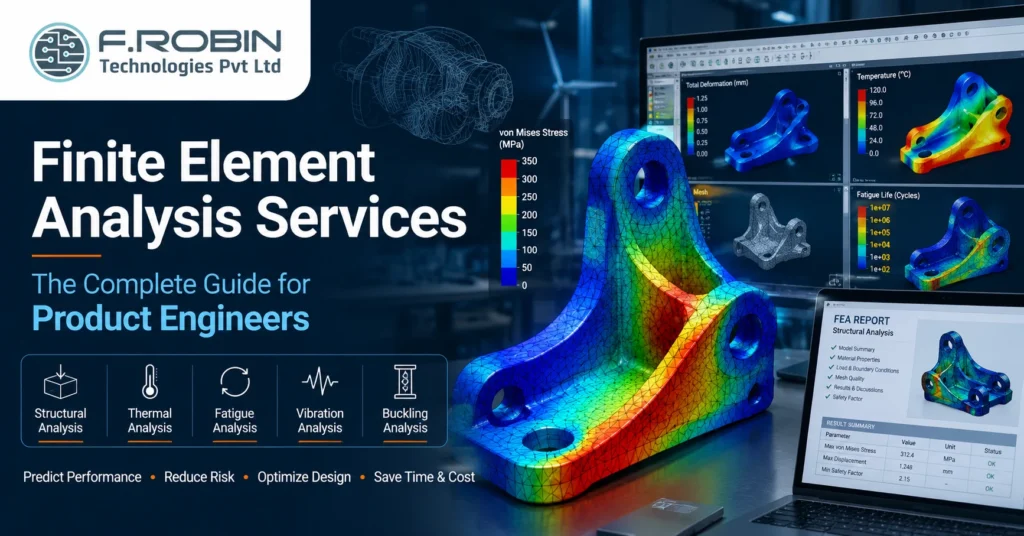
What Is Finite Element Analysis (FEA)? Finite Element Analysis (FEA) is a computational simulation technique that predicts how a product or structure will behave under real-world conditions before a single physical prototype is built. The underlying method divides a complex component into thousands of small, simple shapes called finite elements. Each element is mathematically analyzed under applied forces, temperatures, pressures, or vibrations. The results are then assembled across the entire model to produce detailed maps of stress, displacement, heat distribution, or fatigue life. In plain terms: FEA tells you whether your design will hold up or fail without the cost and delay of building and breaking actual parts. It is one of the most powerful tools in the modern engineering toolkit. From automotive crumple zones to satellite brackets, from pressure vessels in oil refineries to heat sinks in PCB enclosures, FEA underpins the safety and reliability of almost every engineered product in service today. How Does FEA Work? Step-by-Step Process Understanding the FEA workflow helps you communicate effectively with your simulation team and set realistic expectations for timelines and deliverables. Step 1 — CAD Model Preparation The process begins with a 3D CAD model of the component or assembly. Engineers simplify the geometry by removing non-structural features (small holes, fillets, logos) that add computation time without meaningfully affecting results. This step is called defeaturing or geometry clean-up. Step 2 — Material Definition Every element in the model needs material properties: Young’s modulus, Poisson’s ratio, yield strength, thermal conductivity, density, and more. Getting this right is critical an FEA model is only as accurate as the material data feeding it. Step 3 — Meshing The geometry is divided into finite elements. Mesh quality element size, shape, and density directly controls result accuracy. Critical regions (stress concentrations, welds, contact zones) need finer meshes. Poor meshing is one of the most common sources of error in FEA. Step 4 — Boundary Conditions and Loads Engineers define how the component is constrained (fixtures, bolted joints, welded connections) and what loads are applied (forces, pressures, temperatures, moments). Incorrect boundary conditions are the biggest cause of misleading FEA results. Step 5 — Solving The FEA solver (ANSYS, Abaqus, NASTRAN, etc.) assembles and solves a system of equations often millions of them for large models. This step runs computationally on high-performance workstations or cloud clusters. Step 6 — Post-Processing and Interpretation The solver outputs are visualized as color-coded contour plots (von Mises stress, temperature, displacement). Engineers interpret these results in the context of safety factors, material limits, and design codes (ASME, ISO, EN). Step 7 — Design Recommendations A professional FEA service doesn’t just hand you a stress map. The final deliverable includes an engineering report identifying failure risks, suggested design changes, and quantified safety margins. Types of Finite Element Analysis Not all FEA is the same. The type of simulation required depends on what could go wrong with your product. Here are the six most commonly used FEA types in mechanical engineering services. 1. Static Structural Analysis (Linear & Nonlinear) The most widely used type. Static analysis applies loads that don’t change over time and checks for stress, strain, and deformation. Linear static analysis assumes the material behaves elastically and deformations are small — suitable for most standard components under normal operating loads. Nonlinear static analysis is required when dealing with large deformations, material plasticity (permanent yielding), or complex contact between parts. It is computationally heavier but necessary for realistic results in demanding conditions such as press-fit assemblies, rubber components, or highly loaded structures. Typical use cases: structural brackets, frames, pressure vessels, machine parts, enclosure housings. 2. Thermal Analysis Thermal FEA simulates heat transfer through conduction, convection, and radiation. It can be run as a standalone analysis or coupled with structural analysis (thermo-mechanical analysis) to evaluate thermal stresses. Typical use cases: PCB enclosure thermal management, heat exchangers, turbine components, engine blocks. 3. Dynamic and Vibration Analysis Dynamic FEA evaluates how a structure responds to time-varying loads. The three primary subtypes are: Typical use cases: rotating machinery, aerospace structures, automotive NVH (noise, vibration, harshness), industrial equipment. 4. Fatigue Analysis Fatigue is responsible for the majority of mechanical failures in service. Fatigue FEA predicts how many load cycles a component can withstand before a crack initiates and propagates to fracture. Two main methodologies are used: stress-life (S-N) for high-cycle fatigue in components that experience millions of load cycles, and strain-life (ε-N) for low-cycle fatigue where plastic deformation occurs each cycle. Fatigue analysis is standard practice in automotive, aerospace, and rotating equipment design. Typical use cases: suspension components, aircraft structures, pressure vessels under cyclic loading, pump impellers. 5. Buckling Analysis Buckling analysis identifies the critical load at which a slender or thin-walled structure suddenly collapses under compressive forces — even before yielding occurs. The classic example is a column that bows and snaps under compressive load well below its material yield strength. Typical use cases: aerospace panels, structural columns, thin-walled pressure vessels, offshore risers. 6. Computational Fluid Dynamics (CFD) — Coupled Analysis While CFD is technically a separate discipline, it is frequently coupled with structural FEA in a workflow called Fluid-Structure Interaction (FSI). Pressure loads computed by CFD (airflow over a wing, fluid inside a pipe) are mapped onto an FEA model for structural validation. Typical use cases: offshore pipelines, HVAC ductwork, turbine blades, heat exchanger tube bundles. Industries That Use FEA Services FEA services are used across virtually every engineering-intensive industry. Here are the sectors where simulation-driven design delivers the greatest return. Aerospace and Defense Every primary flight structure must be analytically justified before it flies. FEA is used to validate wing spars, fuselage frames, landing gear, and satellite structures against stringent certification requirements (FAA, EASA, MIL-STD). Solver dominance: NASTRAN with Femap/Patran pre/post-processing. Automotive Three FEA workstreams define automotive engineering: crashworthiness (explicit dynamics, LS-DYNA), NVH (noise, vibration, harshness), and fatigue durability. A single body-in-white model may be reused across all three with different load cases and solver settings. Oil, Gas, and Process Industries ASME Section VIII pressure
