
What Is RPO? Recruitment Process Outsourcing Guide 2026
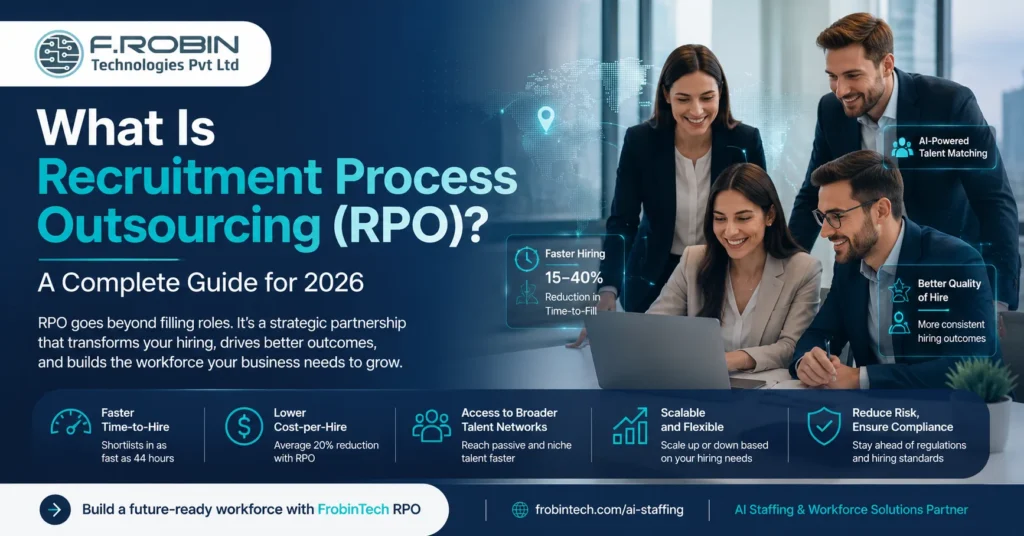
Finding the right talent has never been harder. Hiring timelines stretch for weeks. Internal HR teams get overwhelmed managing dozens of open roles simultaneously. And the cost of a single bad hire according to Gallup research can run anywhere from 50% to 200% of that person’s annual salary. Recruitment Process Outsourcing, or RPO, is how forward-thinking enterprises solve this problem at scale. In this guide, we break down exactly what RPO is, how it works, the different models available, and how to know whether it’s the right fit for your organization. What Is Recruitment Process Outsourcing (RPO)? Recruitment Process Outsourcing (RPO) is a business model in which a company transfers part or all of its recruitment function to an external provider. The RPO provider acts as an extension of your internal HR or talent acquisition team managing sourcing, screening, interviewing coordination, offer management, and onboarding support on your behalf. Unlike a traditional staffing agency that fills individual roles on a transactional basis, an RPO partner takes ownership of the entire hiring process. They use your employer brand, operate within your systems, and are accountable for results across the full recruitment lifecycle. The RPO market reflects just how much enterprises are embracing this model. The global RPO market was valued at over $11 billion in 2026 and is projected to reach $26 billion by 2033, growing at a compound annual growth rate of 12–17% depending on the segment. North America leads, accounting for roughly 42% of global market share, followed by the UK and India. How Is RPO Different From a Staffing Agency? This is one of the most common questions and the distinction matters. A staffing agency is typically engaged to fill one or a handful of specific roles. You pay a fee per placement. The agency works from their own candidate pool and may not integrate with your internal processes or brand identity at all. An RPO provider goes much deeper. They embed themselves into your hiring infrastructure. They use your ATS, represent your company in the market, build talent pipelines proactively, report on recruitment metrics, and continuously optimize the process over time. Think of the difference as transactional (staffing agency) versus strategic (RPO). Factor Traditional Staffing Agency RPO Provider Scope Single roles, short-term End-to-end recruitment function Brand Representation Their own brand Your employer brand ATS Integration Rarely Yes — works inside your systems Accountability Per placement Process outcomes and quality of hire Scalability Limited Built to scale with volume Pricing Model Fee per hire SLA-based, per-hire, or hybrid The 4 Core RPO Models Not every organization needs the same level of involvement. RPO comes in several distinct models, each suited to different company sizes and hiring goals. 1. Enterprise RPO (Full Outsourcing) The RPO provider takes over the entire recruitment function for the organization all roles, all departments, all locations. This model is designed for large enterprises with consistently high hiring volume. The provider fully embeds their team, manages the ATS, drives employer branding, and delivers detailed analytics to leadership. Multi-year contracts are common. Best for: Large enterprises with 500+ annual hires, companies undergoing major workforce transformation, or organizations with under-resourced internal TA functions. 2. Project RPO A time-bound engagement where the RPO provider manages hiring for a specific project, initiative, or hiring surge. Once the defined goal is achieved say, hiring 50 engineers for a product launch the engagement concludes. This model gives companies access to specialist capacity without long-term commitment. Best for: Companies expanding into new markets, launching new products, or scaling a specific team within a defined timeframe. 3. Selective / Functional RPO Rather than outsourcing all recruitment, the company delegates specific parts of the process to the RPO partner. For example, a company might keep strategic hiring in-house but outsource candidate sourcing, screening, and shortlisting to the RPO provider. This hybrid approach is also called Contingent RPO. Best for: Organizations that want to augment internal TA capabilities in specific areas — sourcing volume, specialist roles, or specific geographies without relinquishing full control. 4. On-Demand RPO The most flexible model, where the RPO provider is activated as needed typically during peak hiring periods or when internal capacity is temporarily insufficient. There’s no long-term contract; the client pays for what they use. Best for: Fast-growing startups, companies with seasonal hiring spikes, or businesses exploring RPO before committing to a larger engagement. What Does an RPO Provider Actually Do? Depending on the engagement model, an RPO provider can handle any or all of the following: Sourcing & talent attraction — Building pipelines through job boards, LinkedIn, talent networks, university partnerships, and passive candidate outreach using your employer brand. Screening & assessment — Reviewing applications, running initial interviews, administering skills assessments, and shortlisting qualified candidates for your hiring managers. Interview coordination — Scheduling interviews, managing candidate communication, and ensuring a seamless experience that protects your employer brand at every touchpoint. Offer management — Extending offers, handling negotiations, and managing the post-offer period to reduce drop-off rates before a candidate’s start date. Onboarding support — Coordinating background checks, documentation, and pre-boarding communications so new hires arrive ready to contribute. Analytics & reporting — Providing visibility into time-to-fill, cost-per-hire, source-of-hire quality, diversity metrics, and pipeline health through regular dashboards and business reviews. Workforce planning — In mature RPO partnerships, providers contribute to long-range talent planning — mapping future skills needs against market availability and designing proactive sourcing strategie The Business Case: Why Companies Choose RPO Faster time-to-hire RPO providers are specialists. They recruit full-time while your internal teams juggle competing priorities. Many organizations that adopt RPO report a 15–40% reduction in time-to-fill for critical roles. FrobinTech’s RPO clients regularly achieve shortlists within 44 hours for specialist technology roles. Lower cost-per-hire Organizations using RPO report an average cost-per-hire reduction of 20% compared to managing recruitment entirely in-house. This comes from economies of scale, optimized sourcing channels, reduced agency fees, and fewer bad hires due to structured screening. Access to broader talent networks RPO providers maintain extensive candidate databases, passive talent
