
Staff Augmentation vs RPO: Which Workforce Model Is Right for You in 2026?
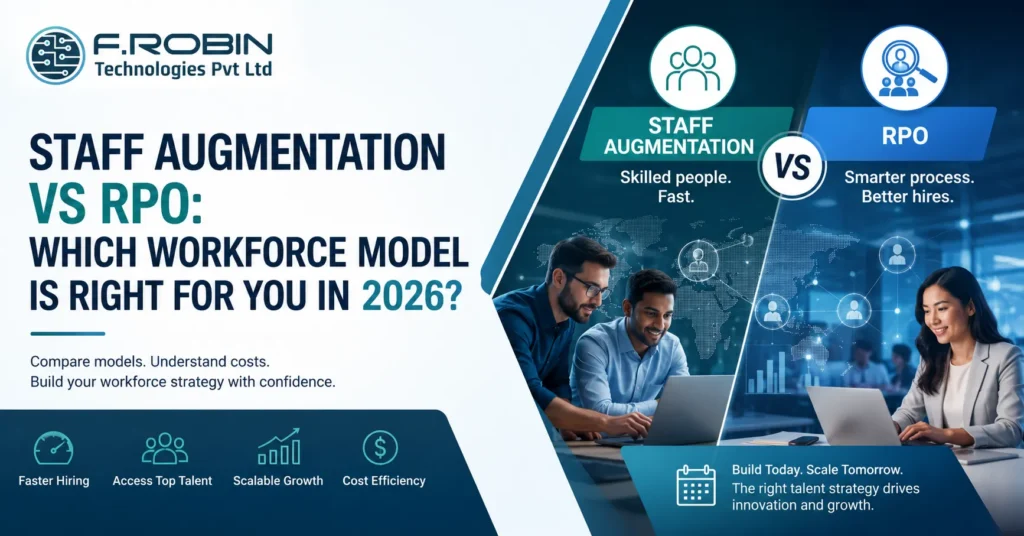
You need talent. Quickly. The question isn’t whether to bring in outside help it’s how. Two models dominate enterprise workforce strategy in 2026: Staff Augmentation and Recruitment Process Outsourcing (RPO). Both solve talent gaps. Both involve a third-party partner. But they are fundamentally different in scope, commitment, cost structure, and the business problems they solve. Choose the wrong one, and you’ll either overpay for infrastructure you don’t need or scramble to fill roles because your partner wasn’t built for volume hiring at speed. This guide cuts through the confusion. By the end, you’ll know exactly which model fits your situation, what each one costs, and why some of the fastest-scaling tech companies are choosing to use both. The Short Answer Staff Augmentation = You need skilled people fast, for a defined project or period. The provider sources contractors or specialists who work inside your team, under your direction. RPO = You need a smarter, scalable hiring system. The provider takes over part or all of your recruitment function sourcing, screening, and delivering permanent or long-term hires using your employer brand. They sit at opposite ends of the outsourcing spectrum. Staff augmentation gives you people. RPO gives you a process. What Is Staff Augmentation? Staff augmentation is a flexible workforce model where a company brings in external professionals — typically on a contract or project basis — to supplement its existing team. The augmented staff integrates directly into your team, uses your tools, attends your standups, and operates under your management. You’re not outsourcing a function. You’re adding skilled capacity. Common use cases: The IT staff augmentation market reflects just how widely this model has been adopted. The global IT staff augmentation and managed services market was valued at $291.71 billion in 2025 and is projected to reach $317.96 billion in 2026 growing toward $707 billion by 2035 at a 9% CAGR. Around 74% of enterprises now use staff augmentation to overcome talent shortages, and 54% report improved operational efficiency as a direct result. What Is Recruitment Process Outsourcing (RPO)? RPO is a strategic hiring model where a company transfers part or all of its recruitment function to an external provider. The RPO partner becomes an extension of your talent acquisition team — managing sourcing, screening, interview coordination, offer management, and pipeline reporting on your behalf. Unlike staff augmentation, RPO is about building a repeatable, scalable system for bringing permanent or long-term talent into your organization. The provider uses your employer brand, integrates with your ATS, and is held accountable to SLA-driven hiring outcomes. Common use cases: The RPO market is one of the fastest-growing segments in workforce services. Valued at over $11 billion in 2026, it is projected to reach $26 billion by 2033 at a CAGR of 12–17%. North America leads with roughly 42% of global market share, and enterprise RPO driven by multi-year contracts and high hiring volumes is the dominant segment. Staff Augmentation vs RPO: Head-to-Head Comparison Staff Augmentation vs RPO Understand the key differences to choose the right hiring model for your business growth. Factor Staff Augmentation RPO Primary Purpose Add skilled people fast Build a scalable hiring function Who Manages the Workers You (client) You hire them; RPO manages the process Employment Type Contractors / temporary Permanent or long-term employees Engagement Length Short to medium term Medium to long term Employer Brand Used Provider’s or neutral Your employer brand ATS Integration Typically no Works inside your systems Accountability Contractor availability Hiring outcomes & speed Hiring Volume Low to medium Medium to high Process Ownership Client-owned Partner-managed Pricing Model Hourly / monthly Per-hire / hybrid Scalability Limited availability High-volume scaling When to Choose Staff Augmentation Staff augmentation is the right move when speed and flexibility matter more than process. You know what skill you need, you know roughly how long you need it, and you don’t want to go through a full recruitment cycle to get there. Choose staff augmentation when: You have an immediate project gap. A critical initiative is stalled because you lack specific technical expertise an AI architect, a senior backend engineer, a silicon validation specialist. Staff augmentation gets that person embedded into your team in days, not months. You need to scale without permanent headcount commitment. Your roadmap is ambitious but your board wants lean permanent headcount. Augmentation lets you execute without adding to your FTE cost base. You’re bridging a hiring gap. You’ve opened a role and the permanent search is underway, but the work can’t wait three months for a hire. An augmented resource keeps momentum going. You want to retain control. The augmented professional reports to your managers, follows your processes, and works within your team culture. You direct the work the provider simply handles sourcing and contracting. You’re a startup or mid-market company. The infrastructure investment of a full RPO engagement may not make sense at lower hiring volumes. Staff augmentation scales to exactly what you need. When to Choose RPO RPO is the right move when your hiring process itself is the bottleneck not just headcount. If you’re consistently struggling to fill roles, experiencing long time-to-fill cycles, losing candidates to competitors, or scaling too fast for your internal TA team to manage, RPO addresses the root cause. Choose RPO when: You have sustained high hiring volume. If you’re hiring 50, 100, or 500+ people per year, managing that through internal recruiting or ad-hoc agency relationships creates enormous friction and inconsistency. RPO builds the system to handle it reliably. You need consistent quality across locations or departments. When different teams hire differently, you get unpredictable results. RPO installs a repeatable process that delivers consistent hiring quality whether you’re filling roles in Austin, Bangalore, or London. You’re building a new capability. Entering a new market, launching a new business unit, or standing up a new engineering team requires building a talent pipeline from scratch. RPO partners do this at speed, using your brand and market presence. Your employer brand needs professional management. How candidates experience your recruitment process
