
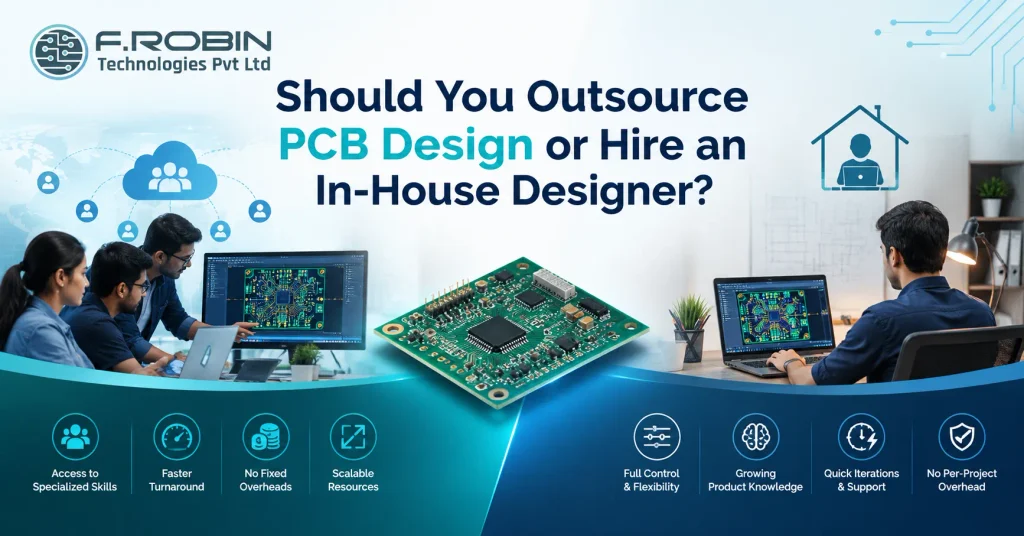
“Is it worth outsourcing PCB layout, or should I just hire someone?” is one of the first real staffing decisions a growing hardware team faces, and getting it wrong in either direction is expensive. Hire too early and you carry a fixed salary against inconsistent design workload; outsource everything indefinitely and you may pay more per board than an in-house hire would have cost once volume justifies the headcount.
This decision guide compares the two paths honestly — cost, speed, design capacity, and control so you can match the choice to your actual situation rather than defaulting to whichever your last company did. Whether you are building your first product in Chennai, scaling a design team in Bangalore, or anywhere else, the same underlying logic applies, and the right answer can shift as your board volume grows.
The Quick Answer
In short: outsource PCB design when your board workload is occasional or variable, and hire an in-house designer when you have steady, continuous layout work to keep that person productive year-round. Neither path is universally correct — the right answer depends on your workload, your timeline, and how much day-to-day control you need over the design process.
A Chennai hardware startup building its first product has very different needs from a Bangalore product company running continuous PCB development across multiple lines. The sections below help you identify which situation you are actually in, and every one of the factors below applies whether you decide to outsource PCB design for one board or for an entire product line.
This mirrors the same decision on the mechanical side see our guide to outsourcing mechanical design vs hiring in-house if your product also needs enclosure or mechanical work.
In-House PCB Designer: Pros and Cons
Pros
- Full control over priorities, timelines, and daily communication.
- Deep, accumulating product knowledge that improves with every board.
- Immediate availability for quick layout iterations and questions.
- No per-project overhead once the hire is productive and ramped up.
Cons
- Fixed salary and tool licensing cost regardless of actual workload.
- Expertise limited to what one or two designers know well.
- Hiring time and risk, since finding a genuinely skilled PCB designer takes effort.
- Idle capacity during quiet periods between board projects.
An in-house PCB designer pays off when layout work is steady enough to keep the role genuinely busy and productive across the full year, not just during your next single project.
Outsource PCB Design: Pros and Cons
Pros
- Access to broader expertise across high-speed, HDI, and mixed-signal layout.
- No fixed overhead — you pay for design work as you need it.
- Faster ramp-up, since the team already has tools and process in place.
- Scalability to handle a burst of board projects without a hiring cycle.
Cons
- Less day-to-day control over pace and priority versus a direct employee.
- Communication overhead, especially with a distant or unfamiliar partner.
- Per-project cost that can exceed in-house cost at very high, steady volumes.
- IP considerations, requiring a clear NDA and secure file handling.
For most companies with variable board workload, choosing to outsource PCB design reduces both cost and hiring risk compared with a full-time layout hire.
Cost Comparison
An in-house PCB designer costs salary, benefits, CAD tool licensing, and management overhead payable every month whether or not there is enough layout work to fill that time. For a company with one or two board projects a year, this fixed cost is expensive relative to the actual work delivered.
Outsourcing converts that fixed cost into a variable one: you pay for the specific board design you need, when you need it, with no idle-time cost between projects. The break-even point shifts with your actual project volume intermittent PCB work favors choosing to outsource PCB design, while continuous, high-volume layout work can make an in-house hire more cost-effective over time, once workload is steady enough to justify the fixed cost.
Side-by-Side Comparison
| Factor | In-house PCB designer | Outsource PCB design |
| Cost structure | Fixed (salary + tools) | Variable (per project) |
| Best for | Steady, continuous layout work | Occasional or variable board projects |
| Expertise breadth | Limited to the hire’s skill set | Broad, across many past projects |
| Ramp-up time | Hiring cycle required | Immediate |
| Control | High, direct | Moderate, via clear briefs |
| Scalability | Limited by headcount | Flexible with project demand |
Reading down the table, the pattern is consistent: steady, predictable board work favors hiring in-house, while variable, project-based work favors choosing to outsource PCB design.
When to Hire In-House
- Board layout work is continuous, not occasional, across the year.
- You need daily, hands-on involvement with manufacturing or assembly teams.
- Deep, evolving product knowledge matters more than broad design experience.
- You have enough project volume to justify a full-time salary and CAD licenses.
For an established company in Chennai or Bangalore with a steady product pipeline, an in-house PCB designer can become the backbone of ongoing hardware development.
When to Outsource PCB Design
- You have a single board project or infrequent layout needs.
- You need specialized skills you lack internally — high-speed, HDI, or complex mixed-signal design.
- Speed matters and hiring a qualified designer would take too long.
- You are a startup conserving runway and headcount early on.
For most early-stage hardware companies — including many building their first product in Chennai and Bangalore’s growing startup ecosystems — choosing to outsource PCB design gets a working board built faster and cheaper than hiring would.
Apply our full 12-point checklist for choosing a PCB design company once you decide to outsource, and see our Chennai buyer’s guide if sourcing locally.
A Hybrid Approach
Many companies do not choose one path exclusively. A small in-house designer handles day-to-day product knowledge, quick revisions, and manufacturing liaison, while an external partner is brought in for peak workload, specialized high-speed or HDI work, or a first product line before headcount is justified.
This hybrid model captures the control and continuity of an in-house presence alongside the flexibility and depth of an outside partner exactly when you need it. It is especially common among growing companies that started by choosing to outsource PCB design entirely, then added in-house capacity once board volume grew enough to justify it.
A practical way to start the hybrid approach is to map your last year of board projects: which ones an in-house hire would have handled comfortably, and which ones genuinely needed outside expertise or extra hands. That history usually makes the right split between the two obvious without much further guesswork.
If your workload has grown beyond simple layouts, see our guide to custom PCB design services for when off-the-shelf modules no longer fit your needs.
A Real-World Example
Picture a three-person hardware startup in Chennai building its first IoT sensor product. Hiring a full-time PCB designer would burn scarce runway on a role that sits idle after the layout is finished, so choosing to outsource PCB design to a specialist partner gets a professional board built in weeks, at a fraction of the cost of a salaried hire.
Now picture a scaling product company in Bangalore shipping four new devices a year, each needing ongoing layout revisions and close coordination with manufacturing. Here, an in-house PCB designer earns their keep every month, building deep product knowledge that an outsourced partner would have to relearn on every project. Same decision, two different situations, two equally correct answers.
Key Takeaways
- Whether to hire an in-house PCB designer or outsource PCB design depends mainly on workload and project stage.
- In-house hiring suits steady, continuous layout work with deep, evolving product knowledge.
- Outsourcing suits variable, occasional, or specialized board projects, with no fixed overhead.
- Cost favors outsourcing for intermittent work and hiring for continuous, high-volume layout work.
- A hybrid model — small in-house team plus an outsourced partner for peaks — works well for many growing companies.
- Startups in Chennai, Bangalore, and elsewhere typically benefit most from outsourcing PCB design early on.
