
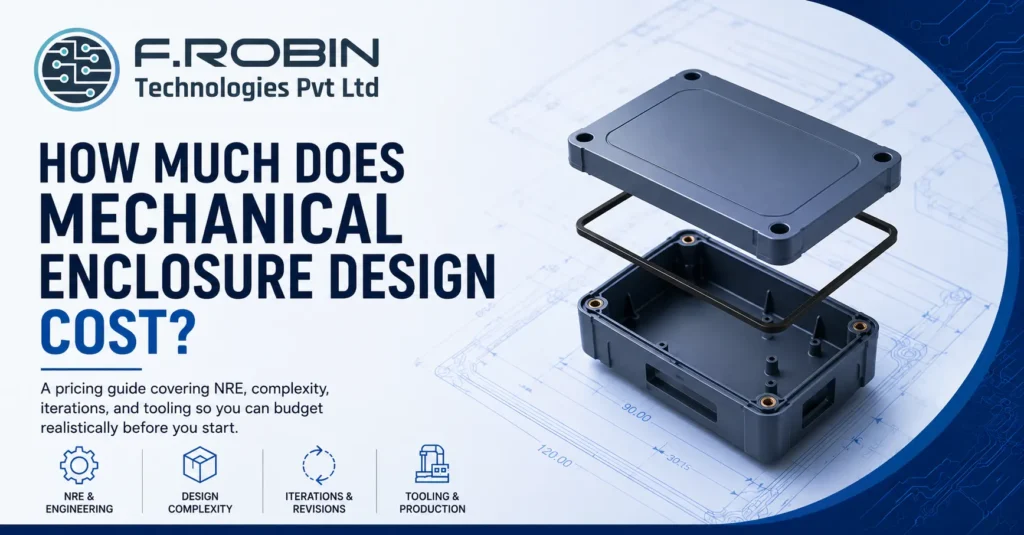
How much will this cost?” is usually the first question in any mechanical enclosure design conversation, and it is also one of the hardest to answer with a single number. Cost varies enormously depending on complexity, how many design iterations you need, and whether tooling for production is included — so a quote for one project can look nothing like a quote for another that seems similar on the surface.
This pricing guide breaks down what actually drives mechanical enclosure design cost: non-recurring engineering (NRE) charges, design complexity, the number of iterations built into the process, and tooling investment for production. Understanding these drivers will help you budget realistically and evaluate quotes with confidence, rather than being surprised by costs that were not obvious upfront — and it will help you ask sharper questions of any provider you talk to.
Why There Is No Single Price
Mechanical enclosure design cost depends on so many variables — complexity, material, tolerance requirements, IP rating, iteration count, and whether tooling is included — that any single number quoted without context is close to meaningless. A simple plastic housing for a low-volume prototype and a ruggedized, IP67-rated die-cast enclosure for a certified product sit at completely different points on the cost spectrum, even though both are technically “enclosure design.”
Understanding the actual cost drivers, rather than chasing a single average figure, is what lets you budget accurately and compare quotes meaningfully. The sections below walk through each driver in turn, and a rough cost framework near the end helps you place your own project on the spectrum.
NRE: What You Are Actually Paying For
NRE, or non-recurring engineering, covers the one-time design and development work that goes into a mechanical enclosure design — concept exploration, detailed 3D CAD, tolerance analysis, DFM review, and documentation. This is distinct from per-unit manufacturing cost, which only applies once you move to production.
NRE scales with the depth of engineering required. A quick concept sketch and basic CAD model costs far less than a fully validated design with structural analysis, thermal simulation, and multiple design reviews. When comparing quotes, always clarify exactly what NRE includes, since a lower headline mechanical enclosure design cost sometimes reflects a narrower scope rather than better value.
Complexity: The Biggest Cost Driver
Complexity is usually the single largest driver of mechanical enclosure design cost. A simple box with a lid and a few mounting bosses costs a fraction of a design with multiple sealed compartments, precise PCB mechanical integration, complex venting, or moving parts.
Specific complexity factors that raise cost include tight tolerance requirements, ingress protection (IP) ratings that demand careful sealing design, thermal management features, and any need for structural or vibration analysis. Each of these adds engineering hours and design iterations, which shows up directly in the final mechanical enclosure design cost.
Iterations: Budgeted vs Unlimited
Design iterations — revisions based on review feedback, prototype testing, or changing requirements — are a major and often underestimated cost factor in mechanical enclosure design cost. Some quotes include a fixed number of iterations within the base price, while others charge for each round of changes beyond an initial concept.
Ask explicitly how many iterations are included in a quoted mechanical enclosure design cost, and what happens if you need more. Projects with unclear or evolving requirements tend to need more iterations than a simple, well-defined design, so budget extra contingency for iteration cost if your requirements are still in flux.
Tooling: The Production Cost Jump
Tooling — the moulds, dies, or fixtures needed to manufacture an enclosure at volume — is where mechanical enclosure design cost jumps sharply once you move from prototype to production. Injection-moulded plastic and die-cast metal enclosures both require tooling investment that can dwarf the original design NRE, especially for complex geometries.
Tooling cost is a one-time investment that then amortizes across your production volume, so the per-unit impact shrinks as volume grows. This is why concept-to-production design that plans for manufacturability from the start — rather than redesigning after a prototype-only process — avoids expensive tooling rework later.
Two Example Projects
Picture a simple plastic housing for an indoor sensor prototype: modest tolerances, no IP rating requirement, a fixed two rounds of iteration, and no tooling since only a handful of units will ever be 3D printed. This sits at the low end of mechanical enclosure design cost — the NRE covers concept and CAD work only, with no analysis or production tooling involved.
Now picture a ruggedized outdoor enclosure for a certified industrial product: IP67 sealing, structural and thermal analysis, PCB mechanical integration, several rounds of design review against a changing specification, and injection-mould tooling for a production run of ten thousand units. This sits at the high end, and the tooling investment alone can exceed the entire NRE of the first example many times over.
Most real projects land somewhere between these two, which is exactly why the cost framework below is more useful than any single average number. Neither project’s price is a mistake or overcharging — the numbers simply reflect two very different scopes of engineering work.
A Rough Cost Framework
While exact numbers vary enormously by project, this framework helps you think through where your project sits on the cost spectrum.
| Factor | Lower cost | Higher cost |
| Complexity | Simple box, few features | Multiple compartments, sealing, thermal |
| Tolerance requirements | Standard, generous | Tight, precision-critical |
| IP rating | None or basic (IP54) | High (IP65+), sealed design |
| Analysis required | None or hand calculations | Full FEA (structural/vibration) |
| Iterations | Fixed, few rounds | Open-ended, evolving requirements |
| Tooling | Prototype only, no tooling | Production tooling for volume |
Most real projects sit somewhere across this spectrum rather than at either extreme, so use this table to identify which factors are pushing your specific project’s cost up or down. A project that scores low on most rows but high on just one — say, a tight IP rating requirement on an otherwise simple design — will still see a meaningful cost increase from that single factor alone.
Questions to Ask for an Accurate Quote
- What exactly is included in the NRE — concept only, or full detailed design and validation?
- How many design iterations are included, and what is the cost of additional rounds?
- Does the quote include DFM review and manufacturability checks?
- Is tooling included, or quoted separately once the design is finalized?
- What analysis, if any, is included — hand calculations, FEA, or none?
- What deliverables will I receive — CAD files, drawings, and in what format?
Asking these questions upfront turns a vague number into an accurate, comparable quote, and prevents budget surprises later in the project. A provider willing to answer all six clearly is also, generally, a provider worth trusting with the work itself.
Key Takeaways
- Mechanical enclosure design cost has no single number — it depends on complexity, iterations, analysis, and tooling.
- NRE covers one-time design and development work, separate from per-unit manufacturing cost.
- Complexity — sealing, thermal management, tight tolerances, analysis needs — is usually the biggest cost driver.
- Clarify how many design iterations are included in any quote before comparing prices.
- Tooling for production is a major cost jump that amortizes across volume over time.
- Ask specific questions about scope, iterations, analysis, and deliverables to get an accurate, comparable quote.
