
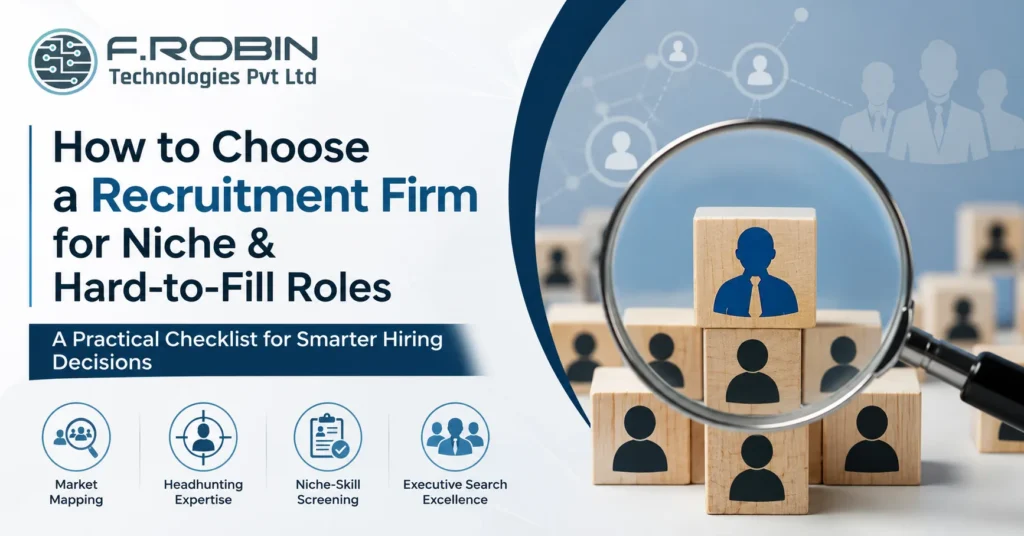
Filling a niche or hard-to-fill role exposes the gap between an ordinary recruitment firm and a genuinely capable one almost immediately. Generic sourcing, job-board postings, and keyword-matched resumes work fine for common roles, but they fall apart the moment you need a rare combination of skills, a scarce certification, or a candidate who is not actively looking at all.
This checklist helps you vet a recruitment firm specifically for niche and hard-to-fill roles. We cover what makes these roles different, the capabilities to look for, the questions to ask before you commit, and the red flags that signal a firm is out of its depth. By the end, you will have a clear, repeatable way to evaluate any recruitment firm for your hardest roles one you can reuse the next time a scarce vacancy lands on your desk.
Why Niche Roles Need a Different Approach
A niche or hard-to-fill role is defined by scarcity: too few qualified people exist, and most of them are not actively job hunting. A recruitment firm built around processing high volumes of active applicants simply has no lever to pull here — there is no pile of resumes to filter, because the candidates who matter are not applying anywhere.
This changes what “good” looks like. Speed and volume metrics that work for common roles are the wrong measure for niche hiring. Instead, you need a recruitment firm that can map a scarce market, approach passive candidates directly, and assess specialized skills accurately — capabilities that a generalist, high-volume operation rarely builds.
Getting this wrong is costly in a specific way: the role stays open far longer than expected, the firm cycles through the same small pool of active applicants repeatedly, and you eventually restart the search with a different partner months later than necessary. Vetting for niche capability up front avoids that entire cycle.
The Checklist: What to Evaluate
- Market mapping capability — can they identify who exists in this niche, not just who applies?
- Headhunting experience — do they proactively approach passive candidates, not just post jobs?
- Niche-skill screening — can they actually assess the specialized skill, not just keyword-match it?
- Executive search discipline — for senior or highly scarce roles, do they run a retained, structured search?
- Relevant placements — can they show real examples of similar niche roles filled successfully?
- Realistic timelines — do they set an honest, evidence-based expectation rather than a generic promise?
- Transparent fees — is pricing for this kind of search clearly explained upfront?
Score any recruitment firm against this list before you commit, and you avoid the common mistake of judging a specialist search by generalist criteria.
Market Mapping Capability
Market mapping is the process of identifying every credible candidate in a niche field, not just the ones who happen to be looking. A recruitment firm doing this well builds a real picture of who holds the skill, where they work, and how the market is structured, before a single approach is made.
Ask any firm to describe their market mapping process concretely. A strong answer includes research methods, industry sources, and how they keep that map current. A vague answer — “we have a database” — is a sign the firm has not actually built this capability for your specific niche.
Headhunting vs Job-Board Sourcing
Headhunting means proactively identifying and approaching candidates who are not applying anywhere, often while they are happily employed elsewhere. This is fundamentally different from job-board sourcing, which waits for candidates to come to you.
For a hard-to-fill role, a recruitment firm that only knows job-board sourcing will simply run out of candidates fast, because the pool of active applicants in a scarce niche is tiny or nonexistent. Ask directly what percentage of their niche placements come from proactive outreach versus inbound applications — the answer tells you a great deal about their real capability.
Niche-Skill Screening
Matching keywords on a resume is not the same as verifying a specialized skill. A recruitment firm serious about niche roles invests in technical screening — either in-house expertise, subject-matter partners, or structured technical assessments — to confirm a candidate genuinely has the skill claimed.
Without this, you risk a shortlist that looks right on paper but fails the moment real technical depth is tested. Ask how the firm screens for the specific niche skill in your role, and expect a concrete answer, not a general description of their interview process.
Executive Search for the Hardest Roles
For the scarcest, most senior, or most sensitive niche roles, executive search is often the right model rather than standard recruitment. A retained executive search commits a firm’s dedicated effort to a thorough, confidential search, which matters when the pool of qualified candidates is measured in dozens, not hundreds.
When evaluating a recruitment firm for your hardest roles, ask whether they offer retained executive search, and how that process differs from their standard placements. A firm that treats every search the same way — regardless of scarcity — is unlikely to give your hardest role the depth it needs.
This distinction matters more than it might first appear, because a contingency search naturally spreads a recruiter’s effort across many open roles at once, while a retained search dedicates real, focused time to yours specifically — a meaningful difference when the candidate pool is this thin.
Questions to Ask Before You Commit
- How do you map this specific niche market before starting outreach?
- What percentage of your niche placements come from proactive headhunting?
- How do you screen for this specific specialized skill?
- Do you offer retained executive search for senior or highly scarce roles?
- Can you share examples of similar niche roles you have filled?
- What is a realistic timeline for a role this scarce?
- How are your fees structured for this type of search?
Clear, specific answers to every question signal a recruitment firm that has genuinely built niche capability. Vague or generic answers are a warning sign worth taking seriously.
Comparison: Generalist vs Specialist Firms
The table below summarizes how a generalist recruitment firm typically compares with a specialist one for niche and hard-to-fill roles.
| Factor | Generalist firm | Specialist niche firm |
| Sourcing method | Job boards, inbound applications | Market mapping, direct headhunting |
| Skill screening | Keyword and resume matching | Technical or subject-matter assessment |
| Candidate pool | Active job seekers | Active and passive candidates |
| Search model | Standard contingency | Retained executive search when needed |
| Track record | Broad, high-volume | Deep, niche-specific placements |
Reading down the table, the pattern is clear: niche and hard-to-fill roles reward depth and proactive reach, which is exactly where a specialist recruitment firm outperforms a generalist one.
Red Flags to Avoid
- Vague answers about market mapping or sourcing methods.
- No examples of similar niche placements when asked directly.
- Reliance on job-board sourcing alone for a scarce skill.
- No structured way to verify the specific technical or specialized skill.
- Unrealistic timelines that ignore how scarce the role actually is.
- Unclear or unusually low fees for a search this specialized.
If several of these appear, keep looking. A recruitment firm without genuine niche capability will burn time on a search it was never equipped to win.
Key Takeaways
- Niche and hard-to-fill roles need a fundamentally different approach than common-role hiring.
- Evaluate any recruitment firm on market mapping, headhunting, niche-skill screening, and executive search capability.
- Ask specific, pointed questions and expect concrete answers, not generic reassurance.
- A specialist firm typically outperforms a generalist one on depth, proactive reach, and screening accuracy.
- Watch for red flags like vague sourcing descriptions and unrealistic timelines.
- For the scarcest, most senior roles, retained executive search is often the right model.
