
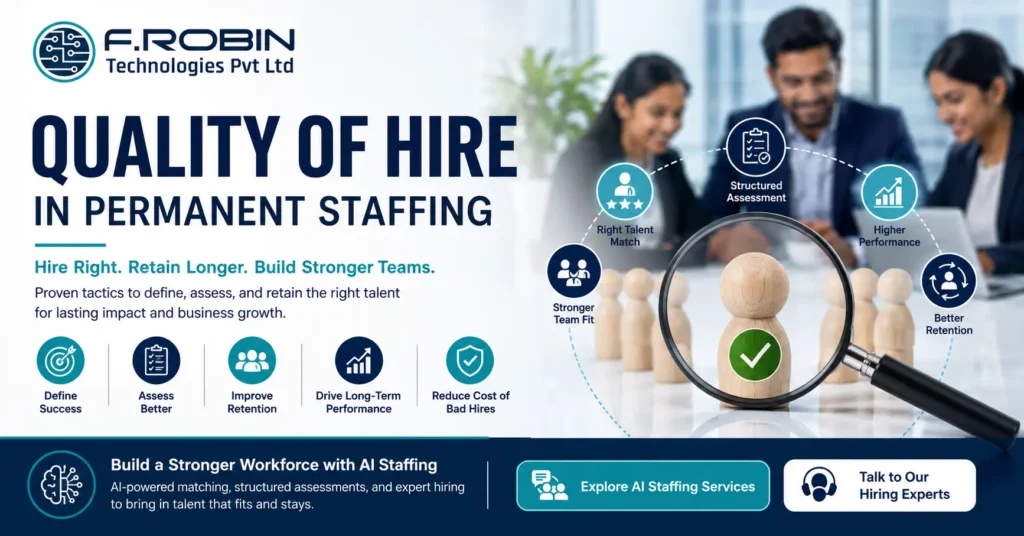
Quality of hire is the single metric that matters most in permanent staffing, yet it is also the hardest to get right. Speed and cost-per-hire are easy to measure; whether someone actually performs, stays, and grows is not. The result is that many companies optimize for the wrong things fast placements over lasting ones and pay for it later in turnover and lost productivity.
This guide gives you practical tactics to raise quality of hire in permanent staffing. We cover how to define it, the assessment methods that predict success, the retention practices that protect your investment, and the mistakes that quietly undermine even a well-run process. Whether you hire occasionally or run a constant pipeline, these tactics will help you hire people who genuinely work out.
What Is Quality of Hire?
Quality of hire measures how well a new employee performs, fits, and stays — not just how quickly the seat was filled. It combines performance ratings, time to full productivity, retention, and manager satisfaction into a single picture of whether a hire actually worked out.
This differs sharply from the metrics permanent staffing teams usually track. Time-to-fill and cost-per-hire measure the process; quality of hire measures the outcome. A fast, cheap hire who leaves in six months is a worse result than a slower, costlier one who thrives for years — yet most dashboards reward the former.
Getting this right in permanent staffing starts with agreeing what “good” looks like before the search begins, not after the person has started.
Why Permanent Staffing Needs to Prioritize Quality of Hire
Permanent roles carry long-term consequences that contract placements do not. A weak permanent hire affects the team for years, not months, and the cost of replacing them — sourcing, onboarding, lost productivity — is substantial.
Because permanent staffing decisions are hard to reverse cheaply, the bar for quality has to be higher than for short-term placements. A slightly slower process that reliably surfaces the right person beats a fast one that gambles on fit. This is why the tactics below focus on predicting long-term success, not just filling the role.
Fixing the Job Requirements
Quality of hire is often decided before sourcing even starts — in how the role is defined. Vague or bloated requirements attract the wrong candidates and make good ones hard to spot.
Improve this stage by:
- Separating must-haves from nice-to-haves, so screening does not reject strong candidates over minor gaps.
- Defining success in the role, not just a list of skills — what will this person actually need to achieve?
- Involving the hiring manager early, so requirements reflect real needs, not a generic template.
- Checking requirements against your best current performers, to calibrate what “good” really looks like.
In permanent staffing, a precise, outcome-focused brief is the foundation every later step builds on — get it wrong, and no amount of clever assessment fixes it.
Better Assessment Methods
Resume screening and gut-feel interviews are poor predictors of performance. Stronger assessment methods catch what they miss:
- Work samples or case studies that mirror real tasks in the role.
- Skills tests relevant to the actual work, not generic aptitude puzzles.
- Behavioural assessment that probes how candidates have handled real situations before.
- Reference checks focused on specific, verifiable performance details.
- Panel evaluation, reducing the bias of a single interviewer’s opinion.
In permanent staffing, combining two or three of these methods gives a far more reliable signal than any one alone. The goal is evidence of how someone actually works, not how well they interview.
Structured Interviews
Unstructured interviews — different questions for every candidate, judged on gut feel — are notoriously unreliable. Structured interviews fix this by asking every candidate the same core questions, scored against the same criteria.
To structure interviews well:
- Define the criteria first, tied to what success in the role looks like.
- Write consistent core questions, asked of every candidate.
- Use a scoring rubric, not just a pass/fail impression.
- Involve multiple interviewers, then compare scores independently.
- Separate evaluation from selling the role, so assessment stays objective.
This structure removes much of the noise and bias that erodes results in permanent staffing, and it produces a clear, comparable record for every candidate — useful for both the decision and future calibration.
Retention Starts Before Day One
Quality of hire is not just about who you select — it is also about whether they stay and thrive. Retention begins well before the first day of work.
Build retention into the hiring process itself:
- Set honest expectations during interviews about the role, culture, and challenges.
- Involve the future team in interviews, so both sides can assess fit.
- Plan onboarding before the offer is signed, not after.
- Check for genuine motivation, not just qualification, to spot the best long-term fits.
A candidate who fully understands the role and feels genuinely matched to it is far more likely to stay and perform. Treating retention as part of selection, not a separate HR task, meaningfully raises quality of hire in permanent staffing.
The Cost of Getting It Wrong
It helps to see the numbers behind why this matters so much. A failed permanent hire typically costs far more than salary alone once you add sourcing time, onboarding, lost productivity, and the disruption to the team while the role is filled again. Estimates commonly put the true cost of a bad permanent hire at several times their annual salary.
That is the real business case for investing in quality of hire. Spending a little more time on requirements, assessment, and structured interviews is trivial next to the cost of repeating the whole permanent staffing cycle for the same role within a year. Treat the extra diligence as insurance, not overhead.
Measuring Quality of Hire
You cannot improve what you do not measure. Track a combination of indicators over time:
| Metric | What it shows |
|---|---|
| 90-day performance rating | Early on-the-job success |
| 1-year retention rate | Whether the hire lasted |
| Manager satisfaction score | Fit and contribution as perceived by the team |
| Time to full productivity | How quickly the hire became effective |
| Promotion / growth rate | Longer-term potential realized |
Review these metrics regularly, and feed what you learn back into your requirements and assessment methods. Over time, this creates a feedback loop that steadily improves permanent staffing outcomes rather than repeating the same mistakes.
Common Mistakes That Hurt Quality of Hire
Even well-intentioned processes undermine themselves. Watch for these:
- Optimizing for speed alone, rushing decisions that need more evidence.
- Relying on a single interview with no structure or scoring.
- Ignoring retention signals during the hiring process itself.
- Vague job requirements that attract the wrong candidates from the start.
- No feedback loop, so the same mistakes repeat hire after hire.
- Overweighting interview charisma over demonstrated ability.
Avoiding these keeps your permanent staffing process focused on lasting hires, not just filled seats.
Key Takeaways
- Quality of hire measures performance, fit, and retention — not just how fast a role was filled.
- Fix job requirements first; a vague brief undermines every later step.
- Use work samples, skills tests, and structured interviews for reliable signal.
- Build retention into the process itself, starting before day one.
- Track 90-day performance, 1-year retention, and manager satisfaction over time.
- Avoid rushing decisions, skipping structure, and ignoring feedback loops.
Conclusion
Improving quality of hire in permanent staffing starts long before the interview — with a precise job brief — and continues through better assessment, structured interviews, and retention built into the process itself. Track the right metrics, feed what you learn back into your process, and resist the pull to optimize for speed alone. The result is fewer bad hires, less turnover, and a team that performs.
Frequently Asked Questions
Quality of hire measures how well a new employee performs, fits the organization, and stays over time. It combines metrics such as performance ratings, retention, time to productivity, and hiring manager satisfaction to evaluate overall hiring success.
Improve quality of hire by defining clear job requirements, using structured assessments such as work samples and skills tests, conducting consistent interviews, and focusing on long-term employee retention from the beginning of the hiring process.
Time-to-fill measures how quickly a vacant position is filled, while quality of hire evaluates whether the selected candidate performs well, fits the company culture, and remains with the organization. Prioritizing speed alone can reduce hiring quality.
Structured interviews ask every candidate the same core questions and evaluate responses using consistent scoring criteria. This reduces interviewer bias and provides more objective, reliable comparisons between candidates.
Set realistic job expectations during interviews, involve future teammates in the hiring process, assess genuine motivation, and plan onboarding before the offer is accepted. Candidates who clearly understand the role are more likely to stay long term.
