
Finding the right talent has never been harder. Hiring timelines stretch for weeks. Internal HR teams get overwhelmed managing dozens of open roles simultaneously. And the cost of a single bad hire according to Gallup research can run anywhere from 50% to 200% of that person’s annual salary.
Recruitment Process Outsourcing, or RPO, is how forward-thinking enterprises solve this problem at scale. In this guide, we break down exactly what RPO is, how it works, the different models available, and how to know whether it’s the right fit for your organization.
What Is Recruitment Process Outsourcing (RPO)?
Recruitment Process Outsourcing (RPO) is a business model in which a company transfers part or all of its recruitment function to an external provider. The RPO provider acts as an extension of your internal HR or talent acquisition team managing sourcing, screening, interviewing coordination, offer management, and onboarding support on your behalf.
Unlike a traditional staffing agency that fills individual roles on a transactional basis, an RPO partner takes ownership of the entire hiring process. They use your employer brand, operate within your systems, and are accountable for results across the full recruitment lifecycle.
The RPO market reflects just how much enterprises are embracing this model. The global RPO market was valued at over $11 billion in 2026 and is projected to reach $26 billion by 2033, growing at a compound annual growth rate of 12–17% depending on the segment. North America leads, accounting for roughly 42% of global market share, followed by the UK and India.
How Is RPO Different From a Staffing Agency?
This is one of the most common questions and the distinction matters.
A staffing agency is typically engaged to fill one or a handful of specific roles. You pay a fee per placement. The agency works from their own candidate pool and may not integrate with your internal processes or brand identity at all.
An RPO provider goes much deeper. They embed themselves into your hiring infrastructure. They use your ATS, represent your company in the market, build talent pipelines proactively, report on recruitment metrics, and continuously optimize the process over time. Think of the difference as transactional (staffing agency) versus strategic (RPO).
| Factor | Traditional Staffing Agency | RPO Provider |
|---|---|---|
| Scope | Single roles, short-term | End-to-end recruitment function |
| Brand Representation | Their own brand | Your employer brand |
| ATS Integration | Rarely | Yes — works inside your systems |
| Accountability | Per placement | Process outcomes and quality of hire |
| Scalability | Limited | Built to scale with volume |
| Pricing Model | Fee per hire | SLA-based, per-hire, or hybrid |
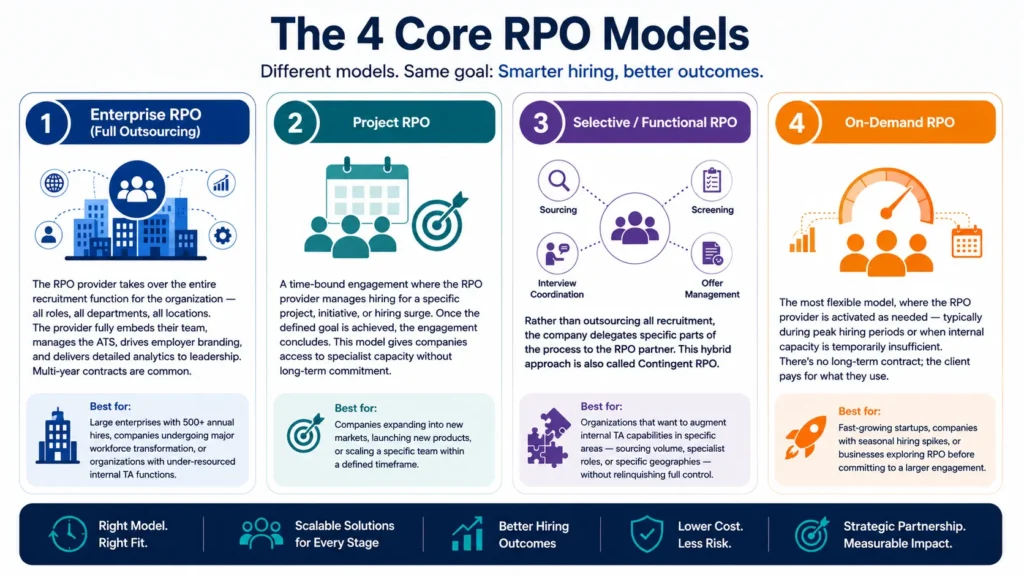
The 4 Core RPO Models
Not every organization needs the same level of involvement. RPO comes in several distinct models, each suited to different company sizes and hiring goals.
1. Enterprise RPO (Full Outsourcing)
The RPO provider takes over the entire recruitment function for the organization all roles, all departments, all locations. This model is designed for large enterprises with consistently high hiring volume. The provider fully embeds their team, manages the ATS, drives employer branding, and delivers detailed analytics to leadership. Multi-year contracts are common.
Best for: Large enterprises with 500+ annual hires, companies undergoing major workforce transformation, or organizations with under-resourced internal TA functions.
2. Project RPO
A time-bound engagement where the RPO provider manages hiring for a specific project, initiative, or hiring surge. Once the defined goal is achieved say, hiring 50 engineers for a product launch the engagement concludes. This model gives companies access to specialist capacity without long-term commitment.
Best for: Companies expanding into new markets, launching new products, or scaling a specific team within a defined timeframe.
3. Selective / Functional RPO
Rather than outsourcing all recruitment, the company delegates specific parts of the process to the RPO partner. For example, a company might keep strategic hiring in-house but outsource candidate sourcing, screening, and shortlisting to the RPO provider. This hybrid approach is also called Contingent RPO.
Best for: Organizations that want to augment internal TA capabilities in specific areas — sourcing volume, specialist roles, or specific geographies without relinquishing full control.
4. On-Demand RPO
The most flexible model, where the RPO provider is activated as needed typically during peak hiring periods or when internal capacity is temporarily insufficient. There’s no long-term contract; the client pays for what they use.
Best for: Fast-growing startups, companies with seasonal hiring spikes, or businesses exploring RPO before committing to a larger engagement.
What Does an RPO Provider Actually Do?
Depending on the engagement model, an RPO provider can handle any or all of the following:
Sourcing & talent attraction — Building pipelines through job boards, LinkedIn, talent networks, university partnerships, and passive candidate outreach using your employer brand.
Screening & assessment — Reviewing applications, running initial interviews, administering skills assessments, and shortlisting qualified candidates for your hiring managers.
Interview coordination — Scheduling interviews, managing candidate communication, and ensuring a seamless experience that protects your employer brand at every touchpoint.
Offer management — Extending offers, handling negotiations, and managing the post-offer period to reduce drop-off rates before a candidate’s start date.
Onboarding support — Coordinating background checks, documentation, and pre-boarding communications so new hires arrive ready to contribute.
Analytics & reporting — Providing visibility into time-to-fill, cost-per-hire, source-of-hire quality, diversity metrics, and pipeline health through regular dashboards and business reviews.
Workforce planning — In mature RPO partnerships, providers contribute to long-range talent planning — mapping future skills needs against market availability and designing proactive sourcing strategie
The Business Case: Why Companies Choose RPO
Faster time-to-hire
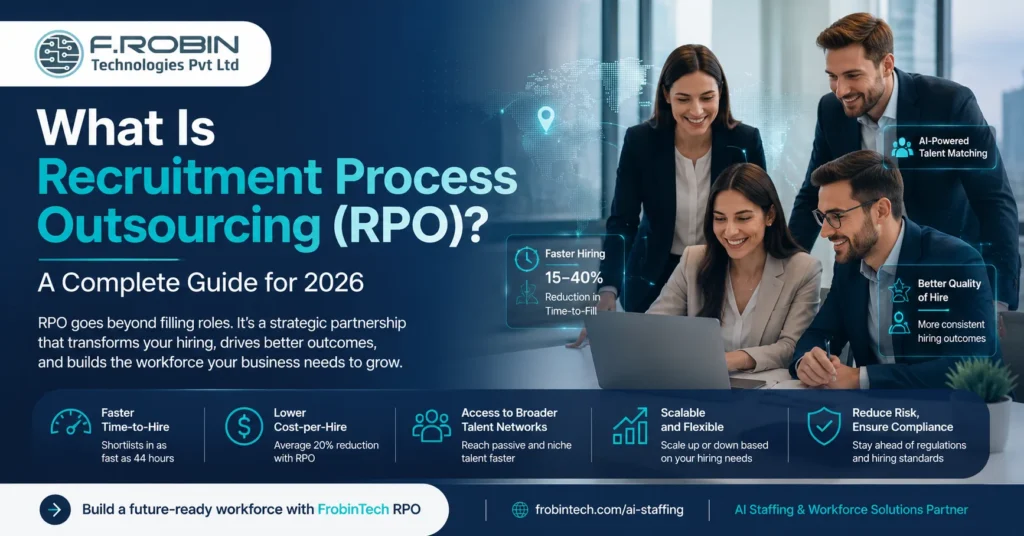
RPO providers are specialists. They recruit full-time while your internal teams juggle competing priorities. Many organizations that adopt RPO report a 15–40% reduction in time-to-fill for critical roles. FrobinTech’s RPO clients regularly achieve shortlists within 44 hours for specialist technology roles.
Lower cost-per-hire
Organizations using RPO report an average cost-per-hire reduction of 20% compared to managing recruitment entirely in-house. This comes from economies of scale, optimized sourcing channels, reduced agency fees, and fewer bad hires due to structured screening.
Access to broader talent networks
RPO providers maintain extensive candidate databases, passive talent relationships, and sourcing infrastructure that most internal teams simply cannot build on their own. For niche roles AI engineers, MLOps specialists, silicon validation engineers — this access is often the deciding factor.
Scalability without overhead
Hiring needs fluctuate. Business growth accelerates. Markets shift. An RPO model scales up and down with your actual demand, without the cost of maintaining a large permanent TA function during slow periods.
Consistent quality of hire
When every department or hiring manager recruits independently, quality becomes unpredictable. RPO introduces structured, repeatable processes that improve consistency across roles, teams, and geographies. Research shows that 51% of companies using RPO report more consistent hiring outcomes.
Risk and compliance management
RPO providers stay current on labor law, data privacy regulations, and hiring compliance requirements across jurisdictions. For companies hiring internationally or managing contractor-heavy workforces, this expertise is significant risk mitigation.
When Is RPO Not the Right Choice?
RPO isn’t a universal solution. It’s worth considering alternatives when:
Your hiring volume is low. If you hire fewer than 10–15 people per year, the infrastructure investment of an RPO relationship may not be justified. Direct hire or contingent staffing may offer better value at that scale.
You have highly unique culture requirements. Companies where cultural fit is extraordinarily nuanced — and requires deep internal judgment at every step — may find full outsourcing creates friction. Selective RPO (handling sourcing only) may be a better middle ground.
You’re evaluating a short-term pilot. If you’re unsure whether RPO fits, a Project RPO engagement is the right way to test before committing to enterprise-level outsourcing.
RPO vs. Staff Augmentation vs. Contingent Staffing: A Quick Comparison
The staffing landscape can be confusing. Here’s how RPO sits relative to other common workforce models:
| Model | What It Delivers | Ownership | Best For |
|---|---|---|---|
| RPO | Full/partial recruitment process | Provider manages process | Sustained hiring at scale |
| Staff Augmentation | Individual skilled contractors | Client manages workers | Filling specific skill gaps quickly |
| Contingent Staffing | Temporary workers, flexible contracts | Agency sources talent | Short-term capacity needs |
| Direct Hire | Permanent placement, one role at a time | Agency places, you retain | Senior or specialized single roles |
What to Look for in an RPO Partner
Choosing an RPO provider is a strategic decision, not a procurement exercise. The right partner should demonstrate:
Deep domain expertise. A generalist firm that recruits for everything from warehouse workers to AI engineers may not have the specialist knowledge your technology or engineering hiring demands. Look for demonstrated experience in your specific verticals.
Technology infrastructure. Modern RPO relies on AI-powered sourcing, ATS integration, and real-time analytics. Ask what technology stack the provider uses and how it integrates with your existing HR systems.
Transparent SLAs. Time-to-shortlist, candidate quality scores, offer acceptance rates, and retention benchmarks should all be defined in advance and reported against regularly.
Flexible engagement models. Your business needs change. The right RPO partner offers models that scale with you — from project-based pilots to full enterprise partnerships rather than locking you into a one-size structure.
Candidate experience focus. Every interaction a candidate has with your RPO provider reflects your employer brand. Evaluate how providers manage candidate communication, feedback loops, and the overall experience.
RPO Trends Shaping 2026
The RPO market is evolving quickly. Several trends are defining what best-in-class providers deliver today:
AI-assisted candidate matching. Leading RPO providers now use AI to match candidates against role requirements with greater speed and precision compressing sourcing timelines while improving quality. The technology accelerates identification of qualified candidates by up to 50% in hard-to-fill roles.
Strategic workforce advisory. RPO relationships are moving beyond transactional hiring. Top providers function as workforce intelligence partners bringing talent market data, competitor hiring analysis, and long-range planning into the conversation alongside day-to-day recruiting execution.
Remote and global talent delivery. The normalization of remote work has expanded the hiring geography dramatically. RPO providers with global delivery capability allow companies to access talent across markets without building regional HR infrastructure.
Outcome-based pricing. Traditional RPO pricing was largely input-based (fixed retainers, per-hire fees). The market is shifting toward outcome-based models where provider compensation is tied to quality of hire, time-to-fill performance, and retention rates aligning incentives far more directly.
Employer brand integration. Candidate experience has become a competitive differentiator. Sophisticated RPO providers now integrate employer branding into every touchpoint of the recruitment journey, from the first job ad to the offer call.
How FrobinTech Delivers RPO
FrobinTech’s RPO solution is built for enterprises that need more than a vendor filling requisitions. We operate as a workforce intelligence partner combining talent expertise, AI-assisted matching, and operational discipline to deliver hiring outcomes your business can rely on.
Our RPO clients benefit from:
- Deep capability across AI/ML, DevOps, cybersecurity, data science, cloud, and hardware engineering verticals
- A structured governance model with regular business reviews, pipeline reporting, and proactive communication
- Nationwide and global delivery geography is never a barrier
- Flexible engagement models from project pilots to full enterprise RPO programs
Scale Smarter with Recruitment Process Outsourcing
Whether you’re scaling a 50-person engineering team, entering a new market, or transforming an underperforming talent acquisition function, FrobinTech has the infrastructure, expertise, and AI-driven workforce solutions to deliver measurable hiring outcomes.
Talk to Our Team About Your RPO Needs →FrobinTech is an AI Staffing and Workforce Solutions partner serving enterprise clients across technology, engineering, and professional verticals.
Learn More About AI Staffing Solutions →Frequently Asked Questions
No. RPO augments your internal team rather than replacing it. In most models, the RPO provider handles sourcing, screening, and coordination while your internal HR team focuses on strategic priorities, culture, and final hiring decisions.
A specialist RPO provider covers the full spectrum of technology and professional roles — AI engineers, data scientists, DevOps specialists, cybersecurity professionals, cloud architects, project managers, UX designers, and more. At FrobinTech, we also recruit across hardware engineering verticals including embedded systems, silicon validation, and PCB design — a capability most staffing firms don’t offer.
RPO focuses on permanent and direct hire recruitment. An MSP manages contingent (contractor/temporary) workforce programs. Some providers, including FrobinTech, offer both through a Master Vendor Program — giving enterprises a single partner for all workforce types.
