
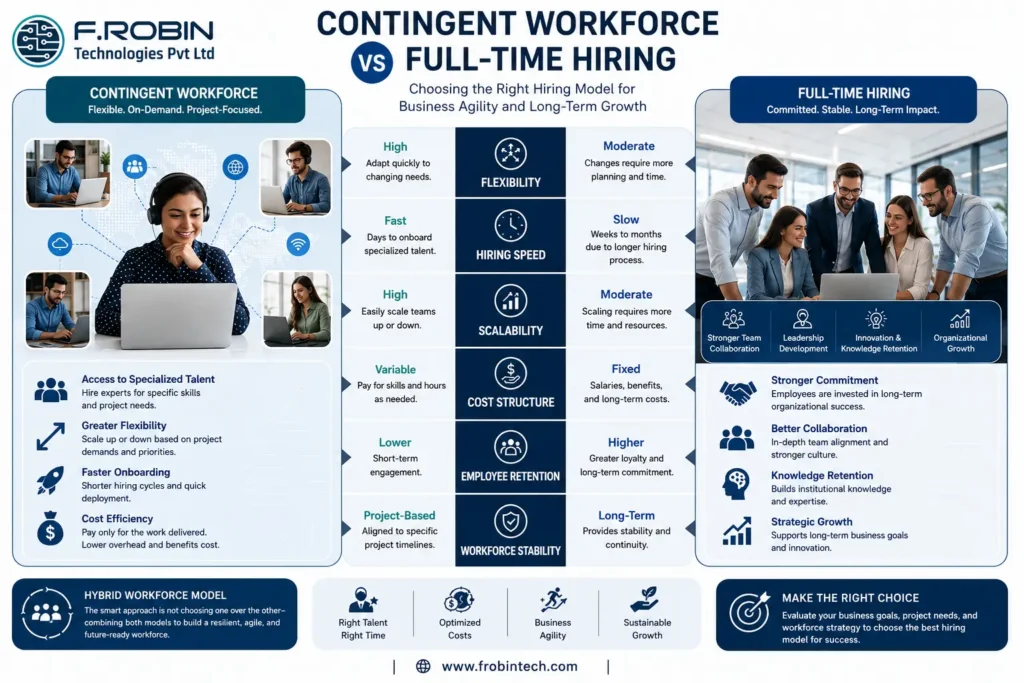
Businesses today are under constant pressure to scale quickly, reduce operational costs, and access specialized talent faster than ever before. As a result, the debate around contingent workforce vs full-time hiring has become increasingly important for organizations navigating AI, semiconductor engineering, embedded systems, cloud computing, and digital transformation initiatives.
Some companies prefer direct hire recruitment for long-term stability and organizational growth. Others rely on contingent staffing and contract staffing models to improve agility and fill critical skill gaps quickly.
So, which hiring strategy is right for your business?
The answer depends on your:
- hiring timelines
- project complexity
- workforce flexibility requirements
- budget constraints
- long-term growth goals
In this guide, we’ll compare contingent workforce vs full-time hiring models, explain their advantages and challenges, and help businesses choose the best hiring strategy for modern workforce demands.
What Is a Contingent Workforce?
A contingent workforce consists of non-permanent professionals hired temporarily for projects, specialized assignments, or short-term operational needs.
A contingent worker may include:
- contractors
- consultants
- freelancers
- temporary employees
- project-based specialists
Contingent staffing has become common in industries where technical expertise and project timelines change rapidly.
For example, technology companies often hire contingent labor for:
- AI implementation projects
- PCB design support
- semiconductor validation
- embedded software development
- cybersecurity audits
This workforce model helps organizations scale faster without long-term employment commitments.
What Is Full-Time Hiring?
Full-time hiring refers to recruiting permanent employees who become long-term members of an organization.
These employees usually receive:
- salaries
- healthcare benefits
- paid leave
- long-term career development opportunities
Direct hire recruitment is commonly used for:
- leadership roles
- core engineering teams
- operations management
- customer success departments
- product development
Full-time hiring focuses on stability, employee retention, and organizational continuity.
Contingent Workforce vs Full-Time Hiring
This comparison highlights why many organizations now combine both workforce models depending on business requirements.
Benefits of Contingent Staffing
1. Faster Access to Specialized Talent
One of the biggest advantages of contingent staffing is speed.
Businesses can quickly hire specialists for short-term projects without lengthy recruitment cycles.
This is especially valuable in industries requiring expertise in:
- AI and machine learning
- semiconductor engineering
- cloud infrastructure
- DevOps
- embedded systems
2. Greater Workforce Flexibility
A contingent workforce allows companies to adapt quickly to changing business conditions.
Organizations can:
- scale teams up or down
- respond to seasonal demand
- support product launches
- manage temporary workload increases
This flexibility improves operational efficiency while reducing long-term staffing risks.
3. Reduced Overhead Costs
Contract staffing can lower costs associated with:
- employee benefits
- long-term payroll commitments
- onboarding
- workforce restructuring
For startups and high-growth businesses, this financial flexibility is often critical.
Advantages of Full-Time Hiring
Long-Term Stability
Full-time employees contribute to organizational continuity and long-term strategic growth.
Permanent teams help preserve:
- institutional knowledge
- engineering expertise
- operational consistency
- company culture
Stronger Employee Engagement
Employees hired through direct hire models are typically more invested in long-term business success.
This often leads to:
- higher collaboration
- better accountability
- stronger team integration
- improved retention
Better for Core Business Functions
Full-time recruitment works best for roles involving:
- leadership
- product ownership
- R&D
- infrastructure management
- long-term customer relationships
These positions benefit from stability and deep organizational involvement.
When Should Companies Choose Contract Staffing?
Contract staffing is ideal when businesses:
- need talent quickly
- require temporary expertise
- have project-based workloads
- face fluctuating workforce demand
- want flexible workforce solutions
For example, a semiconductor company preparing for tape-out validation may require contingent engineering specialists for a limited project duration.
Similarly, companies undergoing cloud migration or AI deployment often rely on contingent labor to accelerate execution timelines.
When Is Full-Time Hiring the Better Choice?
Full-time hiring makes more sense when:
- long-term retention is important
- company culture matters
- strategic leadership roles must be filled
- proprietary knowledge needs protection
- ongoing operational support is required
Organizations investing in long-term innovation often prioritize direct hire recruitment for critical technical and managerial positions.
Hybrid Workforce Models Are Becoming More Common
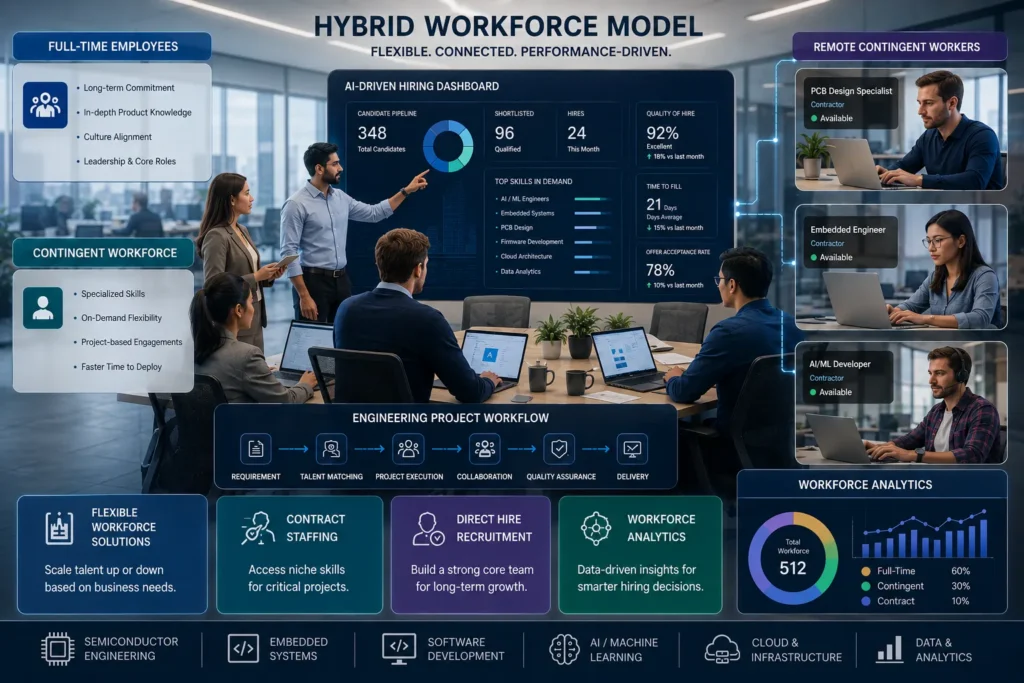
Today, many organizations no longer choose between contingent workforce vs full-time hiring exclusively.
Instead, they adopt hybrid workforce strategies that combine:
- permanent employees
- contingent workers
- outsourced consultants
- project-based teams
This approach allows businesses to balance:
- agility
- workforce stability
- cost efficiency
- specialized expertise
Modern workforce solutions providers increasingly support these blended staffing models.
How to Choose the Best Hiring Model for Companies
Before selecting a workforce strategy, businesses should evaluate several factors.
Ask These Questions
- Is the role temporary or permanent?
Temporary needs often favor contingent staffing.
- How quickly must hiring happen?
Contract staffing usually provides faster onboarding.
- Does the project require specialized expertise?
Contingent labor can help businesses access niche technical talent quickly.
- Is long-term retention important?
Strategic leadership and core engineering roles are often better suited for full-time hiring.
- What are the budget considerations?
organizations must balance hiring costs, employee benefits, and long-term operational expenses.
Contingent Workforce Trends in Technology and Engineering
Industries such as semiconductor engineering, AI development, electronics manufacturing, and embedded systems increasingly rely on flexible hiring models.
Several factors are driving this shift:
- talent shortages
- faster innovation cycles
- remote work adoption
- digital transformation initiatives
- demand for specialized technical expertise
As a result, contingent workforce solutions are becoming a major part of enterprise workforce planning.
Businesses looking for scalable AI and technical recruitment support can explore FrobinTech AI Staffing Services for specialized workforce solutions tailored to modern technology environments.
Key Takeaways
- Contingent workforce models offer flexibility, scalability, and rapid access to specialized talent.
- Full-time hiring supports long-term growth, stability, and organizational continuity.
- Contract staffing is ideal for project-based or short-term workforce requirements.
- Direct hire recruitment works best for strategic and leadership roles.
- Many organizations now combine both hiring models through hybrid workforce strategies.
Conclusion
The decision between contingent workforce vs full-time hiring depends on your organization’s goals, project timelines, workforce strategy, and operational priorities.
Businesses operating in fast-moving industries increasingly use a combination of contingent staffing and direct hire recruitment to remain agile while maintaining long-term stability.
Organizations that build flexible workforce strategies are better positioned to adapt, innovate, and compete in rapidly changing markets.
Build a Smarter Workforce Strategy
Looking for scalable workforce solutions for engineering, AI, or technology teams? Connect with FrobinTech Workforce Experts to explore flexible staffing and hiring solutions tailored to your business needs.
Connect With Us TodayFAQ
Direct hire recruitment involves hiring permanent employees directly onto a company’s payroll. The recruitment process typically includes sourcing, screening, interviews, offer negotiation, and onboarding for long-term employment.
Full-time recruitment refers to the process of hiring permanent employees for ongoing organizational roles. These employees usually receive salaries, benefits, and long-term career opportunities within the company.
A contingent employee is a non-permanent worker hired temporarily for a project, assignment, or specialized task. Examples include contractors, consultants, freelancers, and temporary technical specialists.
